









Large allocators interacting with digital asset markets encounter a fundamental operational challenge: blockchain diversity creates fragmented workflows. Each network has its own transaction format, signing logic, performance profile, settlement sequencing, and risk surface. For institutions operating across multiple ecosystems, this fragmentation increases operational overhead and introduces avoidable complexity.
Chain abstraction for institutions addresses this issue by offering a unified settlement environment where multiple blockchains can be accessed through a consistent operational layer.
Rather than managing isolated wallets, custom routing systems, and network-specific operational rules, allocators use a single execution rail that integrates the underlying chain interactions on their behalf. This enables more orderly, reliable, and standardized processes across digital asset infrastructures.
Why Institutions Need Chain Abstraction
Institutional portfolio activity now spans execution venues, tokenized funds, collateral networks, and permissioned chains operated by regulated financial entities. As assets, liquidity, and settlement primitives diverge across ecosystems, operational fragmentation becomes unavoidable.
Each network requires a separate wallet infrastructure, access policy structure, custody setup, and compliance pipeline. This environment forces large allocators to build bespoke middleware just to maintain operational continuity.
Chain abstraction solves this by consolidating all chain interactions into a unified execution and settlement layer, removing the need for institutions to manually manage signing keys, bridging, or chain-specific routing logic.
Instead of interacting with a blockchain, institutions interact with a policy engine that enforces identity, compliance, and settlement parameters across every connected network.
The Operational Workflow: What Chain Abstraction Looks Like in Practice
A unified settlement layer reshapes the workflow for trades and asset movements.
Here’s how a typical allocation event is processed:
- Instruction Intake
- The portfolio or treasury system sends a “unified instruction” using a standard API schema.
- Fields include asset ID, amount, target venue, policy tags, and execution preferences.
- Policy Verification
- The abstraction layer validates account limits, signers, compliance flags, and time-of-day rules.
- If required, co-signers authenticate via MPC-based policy enforcement.
- Routing and Chain Translation
- The layer determines the correct destination chain and converts the instruction into the chain-specific transaction format.
- Gas policies, nonce management, and fee estimation are automated.
- Settlement and Finality Tracking
- The transaction is broadcast with deterministic sequencing.
- Finality is confirmed based on the institution’s predefined security threshold—not the chain’s defaults.
- Unified Post-Trade Reporting
- The position registry updates balances.
- A harmonised settlement record is generated for custodians, fund administrators, and internal reporting rails.
This workflow removes dozens of operational steps that institutions once had to replicate across each blockchain.
How Chain Abstraction Reduces Complexity for Allocators
Institutions benefit from chain abstraction by eliminating operational overhead:
- No wallet fragmentation:A single interface replaces dozens of operational wallets across networks.
- No bridge risk:Cross-chain operations are handled by the unified layer without exposing funds to bridging protocols.
- Single compliance perimeter:Regulatory rules, AML checks, and whitelisting propagate uniformly across connected chains.
- Simplified custody:Assets remain in custody-controlled wallets that the abstraction layer manages through policy bindings.
- Consolidated reporting:Trade records, risk logs, and settlement attestations are standardized across networks for audit readiness.
Operational Architecture Behind Chain Abstraction Layers
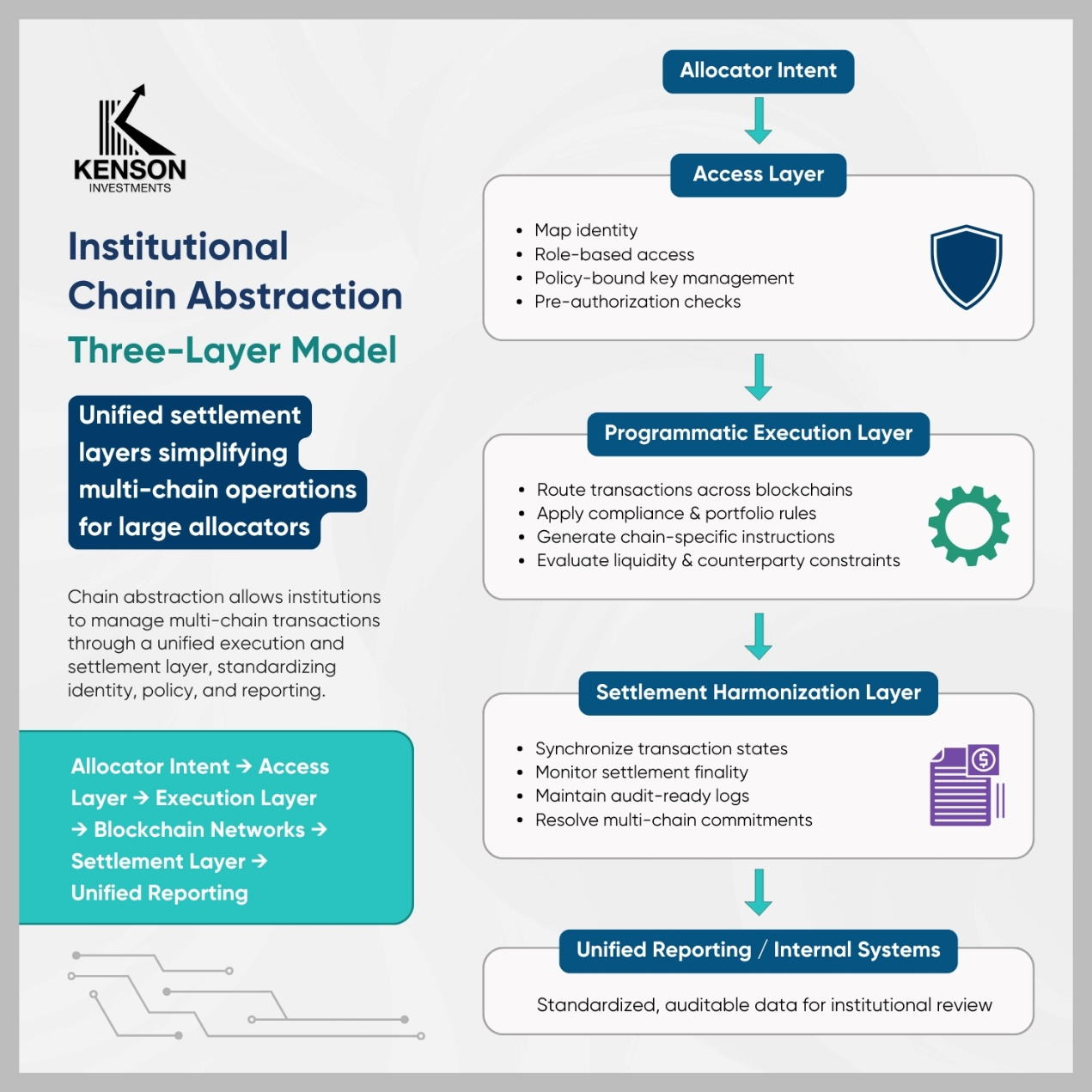
The architecture of chain abstraction for institutions can be broken down into three core layers, each with distinct functions:
- Access Layer
- Integrates institutional identity systems
- Implements permissioning models
- Enforces policy-bound key management
- Programmatic Execution Layer
- Evaluates liquidity venues and counterparty rules
- Uses routing engines to select optimal execution paths
- Abstracts chain-specific protocols into a unified set of transaction types
- Applies portfolio thresholds and operational policies
- Settlement Harmonization Layer
- Synchronizes transaction states across multiple networks
- Monitors settlement finality
- Resolves multi-chain commitments consistently
- Maintains audit trails, message authentication, and deterministic address derivation
This layered approach allows institutions to maintain operational control while offloading the complexity of managing multiple blockchain environments manually.
Security Controls Embedded in the Abstraction Model
- Policy-Guarded Signing:
Transactions are never signed directly by users. Instead, MPC or hardware-secured modules sign only after policy validation. - Segregated Transaction Domains:
Institutional portfolios, strategies, and users operate in isolated logical domains that prevent cross-strategy key leakage or routing errors. - Deterministic Address Issuance:
Chain addresses are generated from institutional identity anchors, enabling predictable account structures across networks. - Dual-State Finality Checks:
The system records settlement in both the target chain and the unified layer’s state log, ensuring reconciliation without manual intervention. - Continuous Attestation Logging:
Every transaction is referenced through structured logs, allowing auditors and compliance teams to verify the institution’s activity across chains.
How Routing Logic Works Across Networks
- The abstraction layer evaluates permissible networks based on institution-defined rules.
- It resolves optimal execution paths using liquidity indexes, counterparty filters, and gas market conditions.
- It assesses compatibility between settlement constraints and underlying network rules.
- It translates institution-level intents into chain-specific instruction sets.
- It queues and releases transactions once compliance modules validate policy alignment.
- It logs settlement states and links them to institutional reporting dashboards.
This ensures institutions never need to manage RPC endpoints, bridge contracts, or protocol quirks directly.
Why Large Allocators Are Standardizing Toward Unified Layers
Large allocators increasingly manage tokenized treasuries, deposit tokens, fund shares, and on-chain collateral obligations across multiple networks operated by regulated issuers. These portfolios demand operational uniformity—consistent compliance enforcement, standardized trade reporting, and deterministic settlement behavior.
Chain abstraction achieves this by letting allocators define intent once while the unified layer handles chain selection, transaction generation, and post-trade reconciliation. This reduces operational burden, lowers error rates, and increases the reliability of cross-network workflows. The allocator’s team focuses on allocation and risk—not chain mechanics.
Speak With Kenson Investments About Institutional Digital Infrastructure
Institutional adoption of tokenized assets requires infrastructure that eliminates fragmentation while strengthening security and compliance. Our digital asset management consultants help institutions evaluate unified execution layers, settlement frameworks, and policy architectures that support scalable multi-chain operations.
Join the tribe to explore how chain abstraction can streamline your digital asset infrastructure.
Disclaimer: The information provided on this page is for educational and informational purposes only and should not be construed as financial advice. Crypto currency assets involve inherent risks, and past performance is not indicative of future results. Always conduct thorough research and consult with a qualified financial advisor before making investment decisions.
“The crypto currency and digital asset space is an emerging asset class that has not yet been regulated by the SEC and the US Federal Government. None of the information provided by Kenson LLC should be considered as financial investment advice. Please consult your Registered Financial Advisor for guidance. Kenson LLC does not offer any products regulated by the SEC, including equities, registered securities, ETFs, stocks, bonds, or equivalents.”