









Fund accounting teams and administrators are now incorporating onchain controls into NAV workflows as tokenized fund structures gain traction across institutional operations.
Tokenized fund accounting does not alter an administrator’s role; instead, it enhances data reliability, standardizes transaction flows, and introduces structured verification layers. These changes reshape how administrators handle pricing inputs, transaction sequencing, reconciliation, and oversight without implying any financial expectations or outcomes.
The shift is driven by the adoption of permissioned ledger rails that serve as synchronized reference points. Every authorized action—subscriptions, redemptions, fee updates, transfers, and position adjustments—moves through a programmable rule set rather than a purely manual process. This creates a clearer operational environment and reduces the inconsistencies that arise when fund data travels across multiple internal and external systems.
Why Tokenized Fund Accounting Changes NAV Workflows
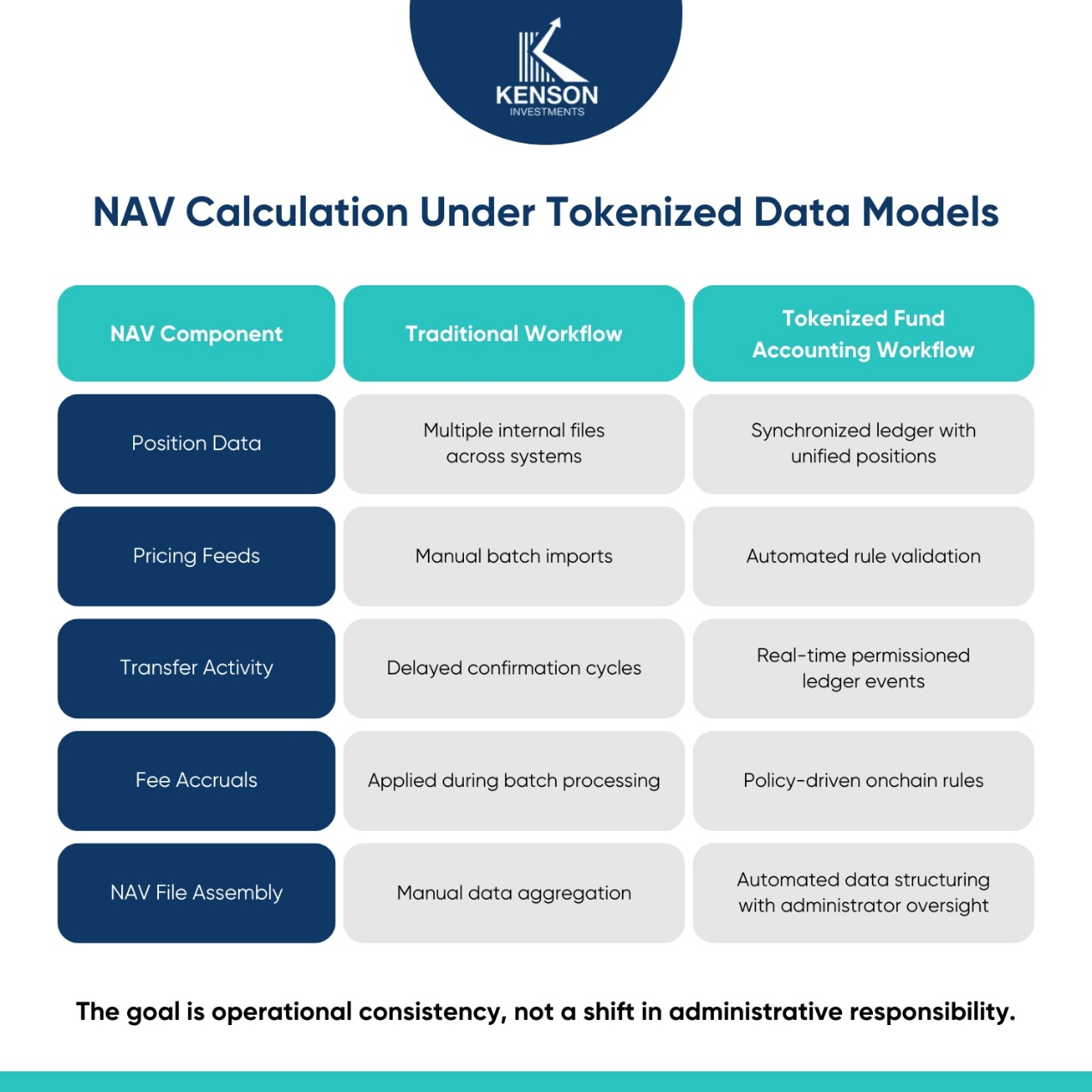
Traditional accounting workflows rely on batch data imports, manual validation, and multi-step reconciliations across separate custodians, pricing services, counterparties, and fund systems. Tokenized fund accounting changes the operational model.
Onchain records act as synchronized reference points, giving administrators a consistent view of fund positions and transactions. Every authorized update—subscriptions, redemptions, rebalances, fees, or distributions—is recorded as a permissioned ledger event. This reduces fragmentation and creates an audit-ready sequence of events that can be programmatically reviewed.
NAV calculation becomes less dependent on timing gaps because the ledger continuously reflects fund movements with deterministic state changes. Administrators retain responsibility for oversight while offloading repetitive reconciliation tasks to systems that can evaluate ledger data, pricing rules, and position weights with far less manual coordination.
Operational Shifts in Tokenized Fund Accounting
Tokenized accounting introduces several workflow adjustments:
- Single Source of Position Truth:All position changes are recorded as authenticated ledger events, eliminating discrepancies across systems.
- Synchronized Subscription and Redemption Activity:Authorized transfers update only after administrator approval, reducing errors linked to manual settlement cycles.
- Deterministic Share Ownership:Tokenized shares remove settlement ambiguity and support accurate shareholder recordkeeping.
- Programmable Pricing Rules:Ledger-based controls verify pricing inputs before they impact NAV files.
- Immutable Operational Evidence:Every update is logged, creating a timestamped audit trail for administrator review.
These changes support internal controls without modifying administrator authority.
How Onchain Price Controls Strengthen NAV Procedures
Administrators depend on accurate, validated pricing data. Tokenized fund accounting allows price controls that operate through structured rule sets:
- Multi-Source Verification
Systems compare price inputs across pre-approved oracles and internal feeds before acceptance. Outliers trigger review procedures. - Tolerance and Methodology Enforcement
Pricing rules—such as valuation methodologies or allowable variance ranges—are embedded directly into the ledger workflow. - Timestamp-Driven Acceptance
Only price updates within permitted windows are incorporated, reducing reliance on stale or mismatched data. - Permissioned Price Submissions
Each pricing update is tied to an approved source, producing a clear record for administrators to validate.
These controls support NAV accuracy without implying anything about asset performance or outcomes.
Reconciliation Workflows Become More Efficient and More Transparent
Tokenized fund accounting reduces the reconciliation complexity that administrators typically face when aggregating data from banks, custodians, prime brokers, and trading venues.
A tokenized structure enables:
- Real-time visibilityinto asset movements validated by finality proofs
- Automated mappingof wallet-level movements into accounting classifications
- Embedded control logicthat identifies discrepancies before they move downstream
- Instant traceabilitythrough immutable audit trails
- Cross-system alignmentthat reduces breaks between internal records and external counterparties
Instead of compiling spreadsheets and investigating breaks manually, administrators receive a transaction history that is sequentially organized and cryptographically verified.
Administrator Oversight in Tokenized Fund Structures
Oversight responsibilities do not change, but tokenized workflows create new tools for administrators:
- Access Governance:Only authorized actors can initiate or approve fund-related transactions.
- Sequencing Controls:Events leading to NAV—pricings, transfers, fees—occur in a controlled order enforced by the ledger.
- Real-Time Checks:Administrators can verify position balances and pricing updates without waiting for overnight batches.
- Immutable Audit Trails:Every action is preserved for later review, improving transparency during evaluations or audits.
- Operational Escalation Paths:Discrepancies automatically route to administrators with supporting event data.
These capabilities strengthen internal control frameworks without modifying the administrator’s core role.
Cross-System Synchronization and Internal Integration
Tokenized fund accounting improves the way data flows between fund administrators, custodians, treasury systems, and accounting software. Instead of relying on file uploads or manually prepared reports, ledger events integrate directly into internal systems through standardized interfaces. Administrators still validate every NAV component, but they receive cleaner, more consistent inputs.
Key integration elements include:
- Direct ledger-to-system syncingfor NAV-relevant updates.
- Connectivity with treasury modulesfor automated cash activity tracking.
- Alignment with internal accounting booksthrough structured data ingestion.
- Integration with reporting enginesfor operational monitoring.
- Reduced reliance on manual importsas events flow automatically into core systems.
This helps administrators maintain operational accuracy across multiple platforms.

Operational Controls in Partially Tokenized Funds
Partial tokenization is common when only some fund components—such as subscriptions or specific holdings—move onchain. This requires hybrid controls that connect tokenized events with traditional accounting systems. Administrators apply structured rules to ensure consistency between offchain records and onchain states.
Typical hybrid controls include:
- Sequencing checks between ledger events and internal books
- Periodic reconciliation cycles
- Automated roll-forward testing
- Validation of transfer events across both environments
These operational safeguards give administrators the structure needed to manage blended workflows effectively.
Access Insights Into Emerging Digital Market Infrastructure
As strategic digital asset consulting partners, Kenson Investments provides educational resources that help individuals understand how digital asset infrastructure—such as tokenized fund accounting—affects operational processes inside institutional environments.
Our digital asset consultants are available to share general market insights and support users who want to learn more about how blockchain technology is influencing fund operations.
Register now to stay informed and deepen your understanding of digital asset infrastructure.
Disclaimer: The information provided on this page is for educational and informational purposes only and should not be construed as financial advice. Crypto currency assets involve inherent risks, and past performance is not indicative of future results. Always conduct thorough research and consult with a qualified financial advisor before making investment decisions.
“The crypto currency and digital asset space is an emerging asset class that has not yet been regulated by the SEC and the US Federal Government. None of the information provided by Kenson LLC should be considered as financial investment advice. Please consult your Registered Financial Advisor for guidance. Kenson LLC does not offer any products regulated by the SEC, including equities, registered securities, ETFs, stocks, bonds, or equivalents.”