







Tokenized systems collapse the distance between decision and execution. What once passed through multiple operational layers now settles directly on-chain, often with immediate finality. This shift forces banks, asset managers, and custodial institutions to reconsider how authority, accountability, and oversight are structured internally.
Operational segregation has always existed in financial institutions. Trading, custody, accounting, compliance, and audit have long been separated by function and control. Tokenization does not remove the need for segregation. It intensifies it. When digital assets move without intermediated buffers, organizational design becomes part of the control surface.
Institutions engaging in blockchain and digital asset consulting frequently discover that technology is not the primary constraint. Organizational alignment is. The way teams are structured, permissions are assigned, and oversight is enforced determines whether tokenized operations remain controlled or become brittle under scale.
Why Tokenization Forces Organizational Redesign
Traditional market infrastructure assumes delay. Trades are confirmed. Files are exchanged. Exceptions are reviewed. Tokenized systems remove those assumptions entirely.
Once a transaction is authorized and broadcast, it becomes part of an immutable ledger. There is no operational unwind window, no overnight reconciliation buffer, and no manual override after execution. This reality fundamentally alters how institutions must think about separation of duties, escalation, and accountability.
In tokenized environments:
- Authority is exercised through cryptographic keys rather than job titles
- Controls are enforced by executable logic rather than procedural checks
- Oversight must occur before execution, not after
These conditions force governance out of policy manuals and into system design. Segregation is no longer a periodic compliance exercise. It becomes a continuously operating control surface that must function across markets that never close and systems that never pause.

Functional Segregation in Tokenized Operations
At a high level, institutions still separate responsibilities across familiar domains. What changes is how those separations are enforced and validated.
Execution vs. Oversight
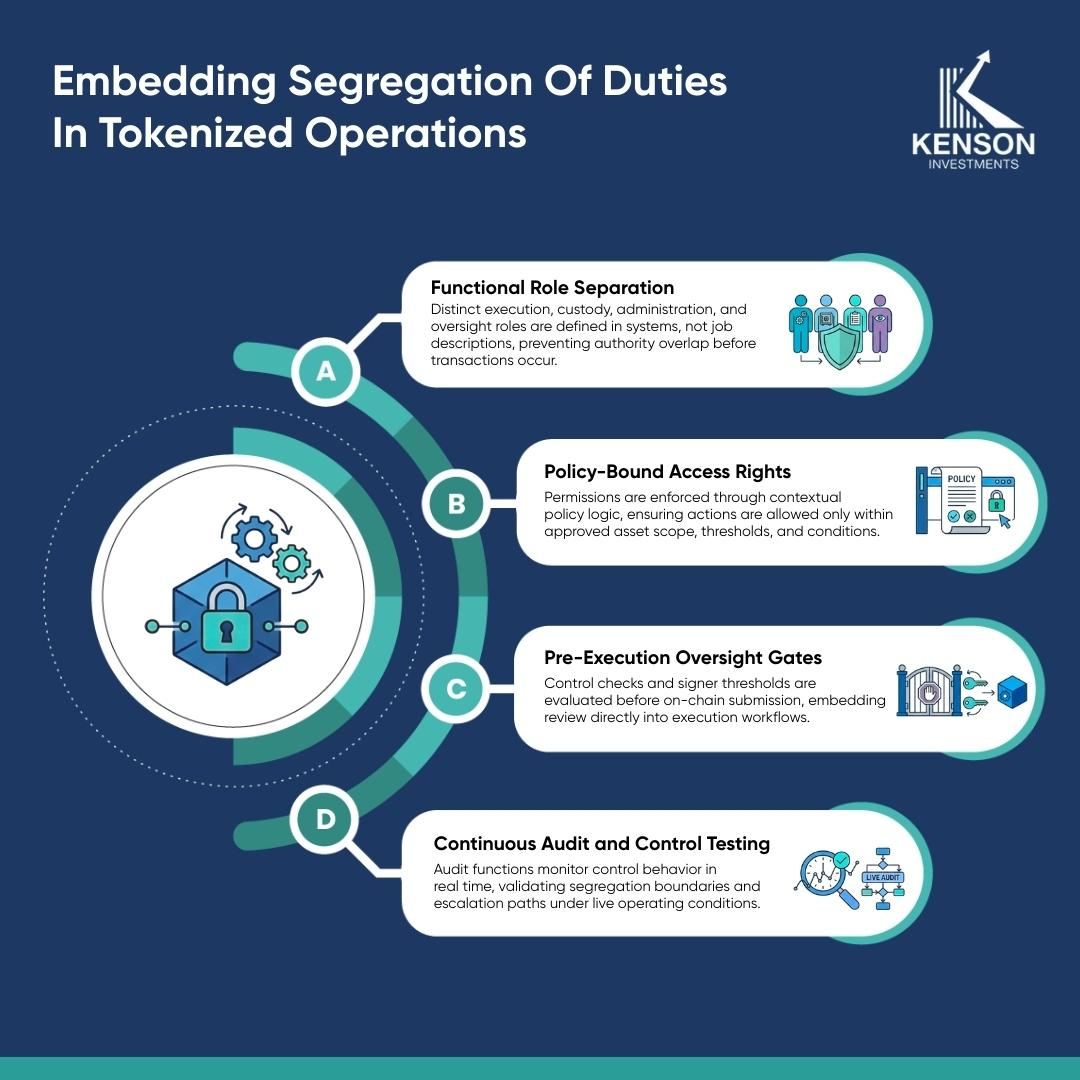
Execution teams initiate on-chain actions. Oversight teams define the conditions under which those actions are permitted. In tokenized systems, oversight cannot rely on retrospective review or exception handling. It must be encoded as enforceable, pre-execution constraints.
This often results in:
- Execution teams holding narrowly scoped signing authority
- Oversight teams defining policy engines, thresholds, and conditional logic
- Independent control layers that block actions outside defined parameters
The key shift is that authority becomes contextual rather than absolute. A signer may be permitted to act in one scenario and restricted in another, even within the same role. This structure supports security in digital asset management by ensuring that no single function can expand its authority through operational convenience or urgency.
Custody vs. Administration
Custody teams safeguard assets. Administration teams calculate positions, exposures, and valuations. Tokenization compresses the interaction between the two by making the asset state observable in real time.
To preserve segregation:
- Custody systems expose read-only states to administration desks
- Administrative adjustments cannot initiate or authorize asset movement
- Reconciliation logic is automated, but execution rights remain isolated
This separation ensures that transparency does not become implicit authority. Administration gains visibility without control, while custody retains responsibility without unilateral discretion. The result is operational clarity without dependency risk.

Access Rights as Organizational Expression
In tokenized systems, access rights define organizational reality. Job titles do not move assets. Keys do.
Institutions must therefore design access models that reflect actual responsibility rather than nominal hierarchy. This requires translating organizational intent into precise, enforceable permission structures.
Common patterns include:
- Role-based access combined with contextual restrictions
- Asset-specific permissions rather than platform-wide authority
- Time-bound or event-bound access for exceptional conditions
Access rights are reviewed continuously, not annually. Changes in role, geography, mandate, or regulatory exposure trigger immediate permission updates rather than deferred reviews.
Organizations working through digital asset consulting for compliance often formalize these access models as part of internal policy codification, ensuring that governance decisions are explicit, auditable, and reproducible across systems rather than embedded informally in tooling configurations.
Key Ceremonies and Authority Transitions
Key ceremonies are not symbolic. They are structural safeguards.
In tokenized environments, key generation, rotation, and retirement events represent moments of elevated systemic risk. Institutions treat these moments with the same rigor historically reserved for core system migrations or balance-sheet-impacting events.
Well-designed ceremonies include:
- Multi-party participation across technical, operational, and oversight functions
- Documented authorization trails that survive personnel changes
- Offline verification steps to reduce correlated failure risk
- Clearly defined rollback and contingency procedures
Authority transitions, such as onboarding a new desk, launching a new strategy, or decommissioning an exposure, often involve temporary parallel controls. These transitional states allow continuity while preventing authority gaps or unintended expansion.
Such practices are frequently standardized through best practices in digital asset consulting, particularly for institutions scaling operations across regions, legal entities, or asset types.
Segregation of Duties Within Smart Contract Operations
Smart contracts introduce a new layer of operational complexity by automating actions that once required multi-party coordination.
Institutions must explicitly define:
- Who can deploy contracts
- Who can modify parameters or upgrade logic
- Who can pause or terminate execution
- Who can observe behavior without intervention capability
These roles are rarely assigned to a single team. Instead, authority is distributed across technical operators, business owners, and oversight functions. This distribution ensures that contract behavior reflects institutional intent rather than individual discretion.
Segregation within smart contract operations is especially critical because changes propagate instantly. Without clear boundaries, a single misconfiguration can alter system behavior globally.

Internal Audit in Continuous Systems
Audit functions evolve significantly in tokenized environments because control failures are immediate, not discoverable days later.
Rather than sampling historical transactions, internal audit teams test control logic directly. They evaluate whether systems behave as intended under stress, exception scenarios, and boundary conditions that mirror real operational pressure. The focus shifts from what happened to what could happen if assumptions fail.
Audit programs often include:
- Permission boundary testing across roles, assets, and transaction types
- Escalation path validation under simulated urgency and degraded conditions
- Policy engine simulation against extreme market or operational scenarios
- Access revocation drills to test response timing and enforcement consistency
Increasingly, audit teams also validate control interactions—how multiple safeguards behave together rather than in isolation. A signer restriction may function correctly on its own but fail when combined with emergency overrides or cross-desk coordination.
Audit findings are fed back into system design rather than documented solely for reporting purposes. This feedback loop strengthens long-term resilience by turning audit into a design input rather than a post-hoc assessment.
Institutions relying on comprehensive digital asset consulting services often integrate audit teams early in architecture design to ensure that controls are native, observable, and testable rather than retrofitted after deployment.

Oversight Without Operational Friction
One of the most persistent misconceptions about segregation is that it slows operations. In tokenized systems, the opposite is often true when controls are designed correctly.
When authority is clearly defined and enforced by systems:
- Fewer exceptions require manual review
- Escalations follow predictable, pre-defined paths
- Oversight teams intervene only when thresholds are crossed
This shifts oversight from constant supervision to conditional engagement. Teams no longer pause to confirm informal approvals or interpret ambiguous authority, because the system already encodes what is permitted.
Operational velocity improves not because controls are loosened, but because uncertainty is removed. Participants act decisively within defined boundaries, while oversight remains confident that deviations will surface automatically.
This model also reduces informal workarounds, which often emerge when processes are unclear or slow. In tokenized environments, clarity is itself a control mechanism.
Organizational Readiness as a Structural Differentiator
Institutions at different stages of digital asset maturity often deploy similar technology stacks. What separates them operationally is governance design, not tooling.
Those who invest early in segregation frameworks:
- Scale activity without introducing hidden control gaps
- Experience fewer authority conflicts during periods of market stress
- Adapt more smoothly as regulatory expectations evolve
Organizational readiness shows up most clearly during transitions—new asset types, new desks, new jurisdictions, or new regulatory guidance. Institutions with well-defined segregation models absorb these changes through policy updates rather than structural rewrites.
This is why many institutions engage a global digital asset consulting firm not for tooling selection, but for organizational architecture that aligns teams, permissions, and oversight with irreversible execution environments.
In tokenized markets, resilience is less about reacting well and more about being structurally prepared before reaction is required.
The Structural Takeaway
Tokenization does not eliminate the need for institutional controls. It moves them closer to execution, where intent and action converge without delay.
Operational segregation becomes a system design problem rather than a policy document. Teams, access rights, and oversight mechanisms must be engineered to function in real time, under continuous market conditions, and without reliance on post-event intervention.
In this environment, organizational structure itself becomes a control surface. How authority is distributed, how exceptions are handled, and how transitions are governed directly shape operational resilience.
Institutions that treat organizational design as infrastructure rather than administration position themselves to operate with clarity, accountability, and durability as tokenized markets continue to scale and mature.
How Kenson Investments Approaches Operational Segregation
Kenson Investments works with institutions to examine how organizational structure, access design, and oversight frameworks intersect with tokenized operations. Our research-driven approach focuses on aligning teams, policies, and execution pathways with the realities of continuous digital markets.
Through education and structural analysis, Kenson supports institutions evaluating governance models, internal controls, and operational readiness across digital asset environments.
Organizations seeking deeper insight into segregation design, oversight frameworks, and operational architecture can connect with Kenson Investments to explore resources developed for institutional digital asset operations, including ai cloud mining, tokenfi rwa, nft investors, what is degen, derivative consultant, and water rights tokenization news.
Disclaimer: The information provided on this page is for educational and informational purposes only and should not be construed as financial advice. Crypto currency assets involve inherent risks, and past performance is not indicative of future results. Always conduct thorough research and consult with a qualified financial advisor before making investment decisions.
“The crypto currency and digital asset space is an emerging asset class that has not yet been regulated by the SEC and US Federal Government. None of the information provided by Kenson LLC should be considered as financial investment advice. Please consult your Registered Financial Advisor for guidance. Kenson LLC does not offer any products regulated by the SEC including, equities, registered securities, ETFs, stocks, bonds, or equivalents”