









Speed in digital asset markets is often framed as an unqualified advantage. Faster transactions, quicker arbitrage, and rapid execution across exchanges promise efficiency and reduced exposure to market movements. Yet in practice, high-speed execution carries hidden costs that can erode performance and increase operational risk. For institutional traders, these costs are not theoretical—they are measurable, persistent, and influence every aspect of digital asset execution.
Latency Risk in Crypto Markets
Latency in blockchain transactions refers to the delay between submitting an order and its confirmation on-chain. Even milliseconds can matter in highly liquid markets. For institutional participants, latency risk manifests in multiple ways:
- Price slippage:Executing a transaction slower than expected may result in a different execution price than intended.
- Transaction front-running:Competing participants may exploit known pending transactions, impacting market efficiency.
- Execution uncertainty:Delays can produce failed or partially filled orders, complicating reconciliation and reporting.
Unlike traditional markets, where centralized exchanges manage order books and execution priorities, decentralized systems rely on network propagation, mempool visibility, and miner or validator selection. Each introduces variable latency that institutions must anticipate and mitigate.
Failed Transactions and Opportunity Cost
A faster network does not guarantee successful execution. Transactions may fail for multiple reasons:
- Insufficient gas:If fees are misestimated, transactions may not confirm.
- Nonce conflicts:Re-submissions can create conflicting transactions, requiring manual or automated resolution.
- Contract errors:Executing complex smart contracts may fail due to logic conditions, state inconsistencies, or parameter misconfigurations.
For institutions, failed transactions introduce two forms of cost:
- Direct cost:The gas fees expended even when execution fails.
- Indirect cost:Opportunity loss from missed execution or reordering of trades.
Repeated failed attempts, particularly in volatile markets, compound cost exposure. Operational protocols such as pre-signing transactions or pre-validating smart contract interactions can reduce failure rates, but they cannot eliminate execution risk entirely.

Gas Volatility as a Cost Driver
Gas costs are highly dynamic, fluctuating with network congestion and activity. High-speed execution amplifies exposure to volatility:
- Bidding for priority:Participants may increase fees to prioritize transaction confirmation, raising execution costs.
- Opportunity cost:A delayed transaction during high congestion can be more expensive if repeated attempts are required.
- Budget planning challenges:Institutions need systems to monitor gas trends and adjust allocations dynamically.
Unlike traditional trading, where commissions and fees are largely predictable, digital asset execution requires continuous attention to network conditions, which directly influences cost efficiency.
Execution Certainty and Deterministic Outcomes
For institutional participants, certainty of execution is as important as speed. Deterministic execution ensures transactions are executed according to predefined parameters without unintended deviations. Key considerations include:
- Smart contract determinism:Contract logic must consistently produce the expected outcome under identical inputs.
- Validator reliability:Nodes responsible for confirming transactions must adhere to consensus rules consistently.
- Operational automation:Automated execution pipelines reduce human error but require robust monitoring and contingency planning.
Execution certainty reduces reconciliation complexity, mitigates operational risk, and supports regulatory alignment by ensuring all transactions are traceable and verifiable.
Trade-offs Between Speed and Cost
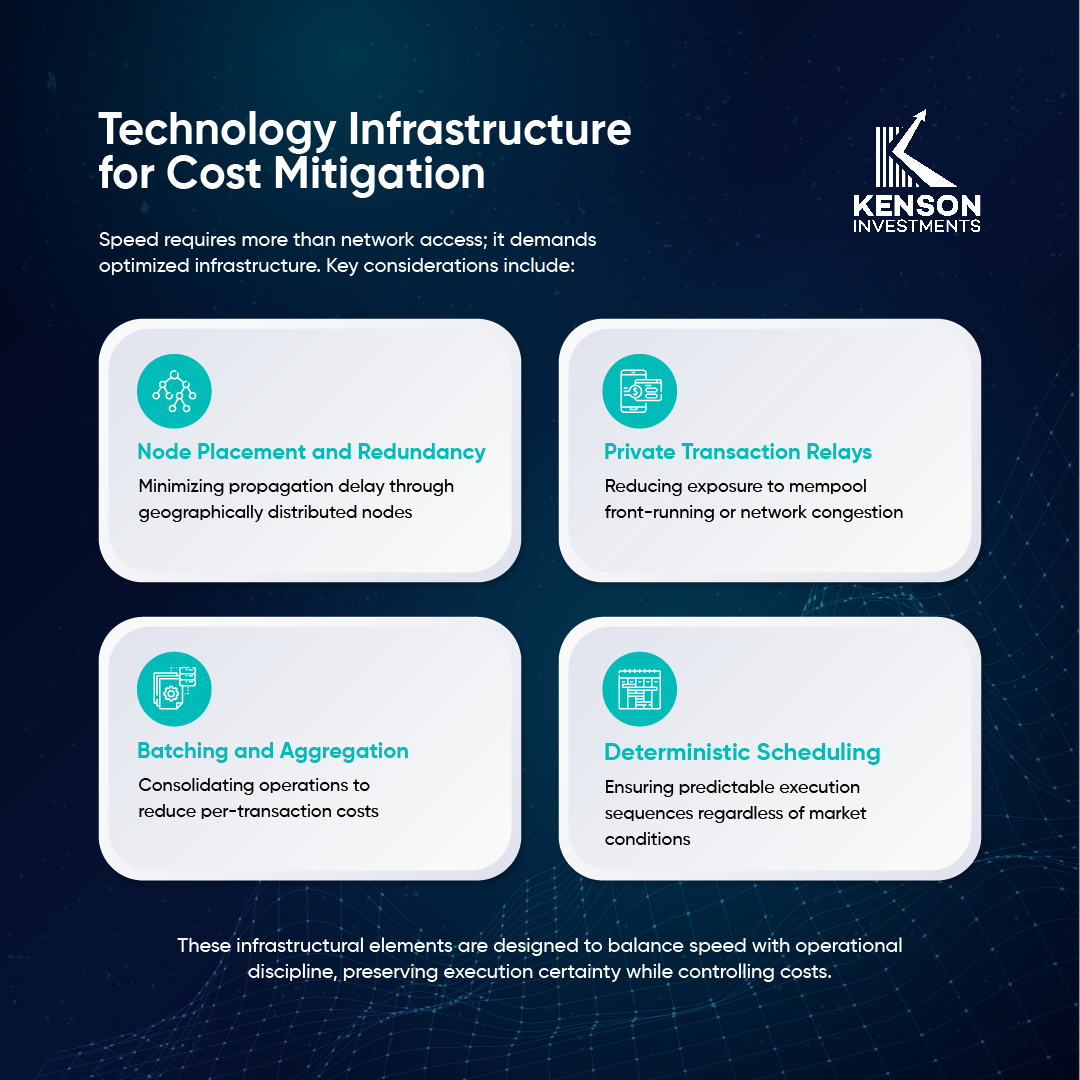
High-speed execution is not without trade-offs. Faster execution can increase direct transactional costs, operational overhead, and infrastructure requirements:
- Network fees:Paying higher gas or transaction fees for priority inclusion.
- System monitoring:Investment in monitoring tools to track network latency and failures.
- Risk management:Additional controls to prevent cascading errors during rapid transaction submissions.
Institutions must evaluate whether the marginal benefits of speed justify increased costs and operational exposure. Faster markets do not automatically create value if execution certainty or cost efficiency is compromised.
Latency as an Economic Variable
Institutions increasingly treat latency itself as a quantifiable cost variable. Unlike traditional transaction fees, latency cost is indirect but measurable:
- Price deviation between intended and executed orders
- Opportunity cost from partial fills or resubmissions
- Regulatory and compliance risk from unpredictable execution
By modeling latency as a cost factor, institutions can make data-driven decisions about acceptable trade-offs between speed and certainty. This approach embeds operational discipline into high-frequency digital asset strategies.
Systemic Considerations
Rapid execution amplifies systemic risk. Network congestion, blockchain forks, and contract-level delays can cascade across multiple orders, inflating execution cost unpredictably. Institutional approaches, therefore, emphasize:
- Multi-layer monitoring of network health
- Early warning systems for congested or stressed nodes
- Pre-validated contingency protocols for high-risk periods
Audit-ready design ensures that every decision path is traceable, even under high-speed execution conditions.
Optimize Execution With The Right Digital Asset Consulting Partners
Execution speed carries hidden costs that extend beyond fees. For institutions navigating high-frequency digital asset markets, understanding latency, gas volatility, and execution certainty is critical, which is why many organizations seek blockchain and digital asset consulting to better evaluate infrastructure and liquidity conditions.
Kenson Investments provides educational guidance and insight for institutions seeking to reconcile fast execution with deterministic processes and cost-effective governance, including perspectives related to digital asset consulting for compliance and operational risk alignment. As a leading digital asset strategy consulting firm, we help organizations evaluate infrastructure, metrics, and operational frameworks to optimize execution while maintaining traceable, audit-ready workflows, often alongside DeFi Finance consulting services and guidance from security tokens investment consultants when assessing tokenized market structures.
Call now to learn more about structured cryptocurrency investment solutions and execution-focused digital asset strategies.
Disclaimer: The information provided on this page is for educational and informational purposes only and should not be construed as financial advice. Crypto currency assets involve inherent risks, and past performance is not indicative of future results. Always conduct thorough research and consult with a qualified financial advisor before making investment decisions.
“The crypto currency and digital asset space is an emerging asset class that has not yet been regulated by the SEC and US Federal Government. None of the information provided by Kenson LLC should be considered as financial investment advice. Please consult your Registered Financial Advisor for guidance. Kenson LLC does not offer any products regulated by the SEC including, equities, registered securities, ETFs, stocks, bonds, or equivalents”