







Digital assets and blockchain technology have redefined how value moves across markets. Traditional trading systems operate within structured hours, governed by exchanges and intermediaries.
On-chain markets, however, function continuously, offering instantaneous settlement, global participation, and persistent price discovery. These structural shifts compress decision cycles and create an environment where participants experience time differently, perceive risk differently, and face constant operational pressure.
Understanding on-chain market dynamics and the implications of continuous settlement markets helps clarify why the perception of “fast” financial time is more than a metaphor—it is a structural reality of decentralized digital ecosystems, a shift increasingly examined through structured Blockchain and digital asset consulting.
Continuous Settlement Accelerates Perceived Time
Traditional financial systems operate with batch settlements, delayed reconciliations, and overnight processing. Securities, bonds, and derivatives usually settle on a T+2 or T+3 schedule, meaning transactions take two or three business days to finalize. These delays allow participants to pause, reflect, or intervene in case of mistakes.
By contrast, continuous settlement markets on blockchain networks process transactions instantly once confirmed. This immediacy compresses operational feedback loops: trades are final, balances are updated in real-time, and liquidity shifts are immediate.
Behavioral studies suggest that when outcomes are visible instantly, individuals perceive events as occurring faster, even if clock time remains unchanged.
In on-chain markets, every second matters, and every transaction carries consequences that manifest immediately. Errors that might be corrected in intermediated environments can escalate without intervention, altering the participant’s sense of operational urgency.
Instant Settlement and Risk Perception
In traditional intermediated systems, settlement lags provide a window for review and error correction. Payment reversals, trade disputes, and regulatory oversight often slow the process. Participants develop a mental model of time that assumes some buffer exists between decision and consequence.
On-chain markets remove these buffers. Transactions confirmed on a blockchain are generally irreversible. While this improves transparency and finality, it also compresses the psychological interval between decision and outcome.
This instant settlement feature reshapes risk perception, often requiring deeper Digital asset consulting for compliance to properly align operational processes with irreversible execution environments. The immediacy of confirmation amplifies the stakes of operational mistakes, magnifying their perceived impact. Users experience errors more acutely, and even minor miscalculations can feel more consequential than they would in slower, intermediated markets.
Global Access and Behavioral Pressure
Accessibility is another differentiator. On-chain markets operate 24/7 and accept participation from anywhere with an internet connection. There is no physical gatekeeping or time-zone restriction.
Global availability accelerates information flow. Participants are exposed to price changes, network events, and community activity in real time, without temporal buffering.
This constant exposure introduces behavioral pressure. Human cognition is sensitive to the frequency and immediacy of stimuli. A continuous stream of market signals can create a perception of urgency, even when long-term outcomes remain unchanged. Users may experience heightened stress, a sense of accelerated time, and increased cognitive load while monitoring positions or planning transactions.
Feedback Loops in Continuous Settlement Markets
The design of continuous settlement markets creates inherent feedback loops. Market events happen continuously, and each action immediately updates the network state. Participants can see confirmations, transfers, and price shifts almost instantaneously.
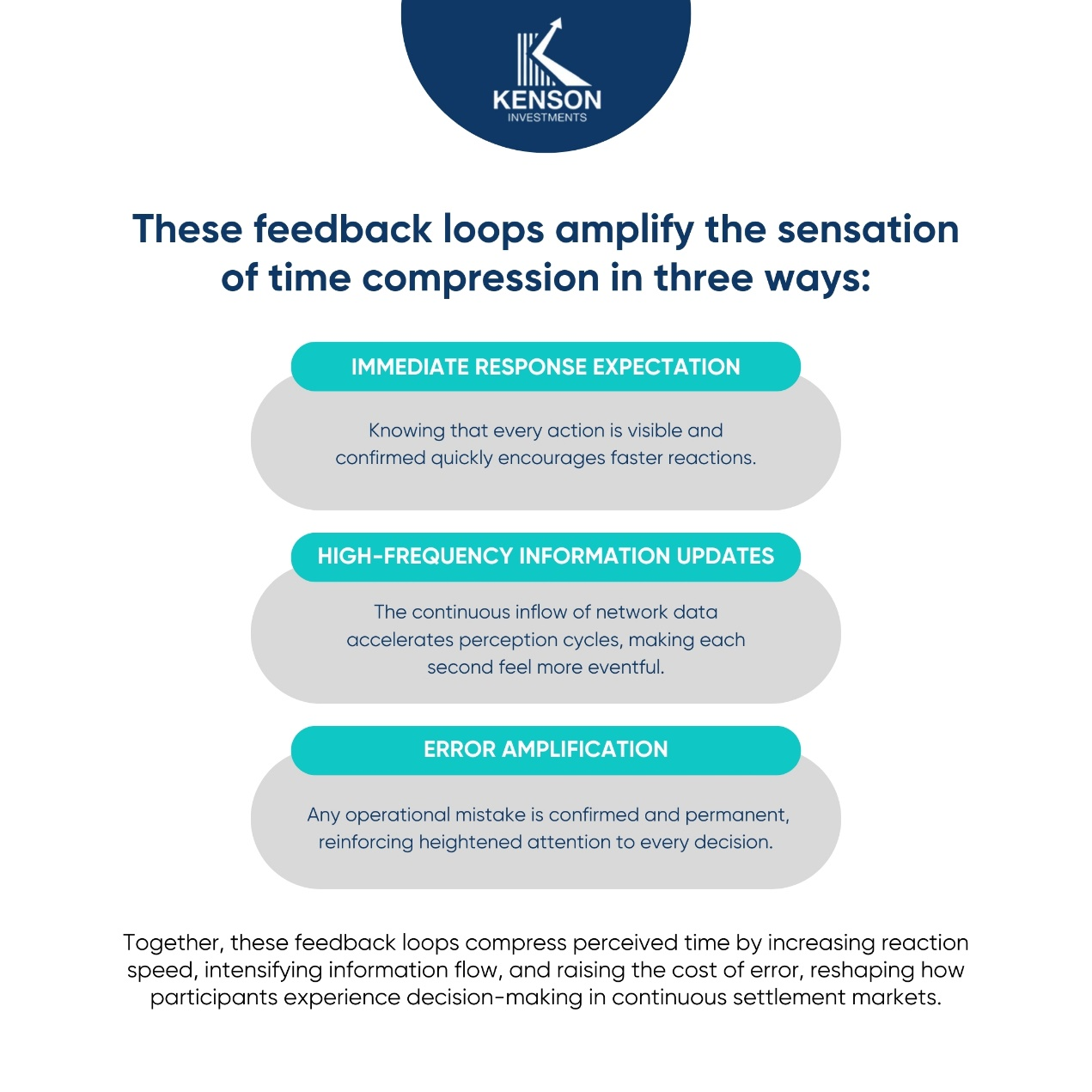
Even minor missteps, such as incorrectly initiating a transfer or selecting an unsupported network, compound this psychological pressure. Human perception interprets the network’s continuous rhythm as a faster-moving environment.
Cognitive Load and Decision Fatigue
Human cognitive capacity is limited. In traditional systems, pauses between trading sessions, batch settlements, or intermediary interventions allow mental recovery. On-chain markets offer no such downtime.
The combination of continuous trading, instant settlement, and global accessibility imposes a higher cognitive load on participants. Constant monitoring, transaction verification, and reaction to immediate outcomes can lead to decision fatigue.
Behavioral studies in digital environments indicate that continuous exposure to immediate feedback loops increases mental strain, shortens attention spans, and intensifies perceived urgency. While the technology is neutral, human perception interprets continuous signals as accelerated temporal experience, often referred to as “financial time feeling faster.”
Operational Accuracy Becomes Critical
Because of the immediate nature of on-chain confirmations, operational precision is essential. Every transaction is irreversible once confirmed. Errors such as sending to the wrong wallet, failing to account for network fees, or mismanaging keys are more impactful in continuous settlement markets.
This structural characteristic emphasizes self-custody responsibility, reinforcing the growing relevance of Digital asset management services in continuous trading ecosystems. Operational mistakes cannot be easily corrected, and behavioral pressure is heightened by the immediacy of consequences. Awareness of this dynamic is a core aspect of understanding how human perception interacts with digital asset ownership.
Liquidity and Volatility in Continuous Markets
Continuous settlement markets also influence the flow and distribution of liquidity. Unlike intermediated systems, where market makers, clearinghouses, and regulated trading desks provide structured buffers, on-chain markets allow instantaneous shifts in supply and demand.
Rapid liquidity changes can amplify perceived speed. Even modest transactions can cause immediate adjustments in market pricing, particularly in less liquid digital assets. Participants observing these changes experience a sense of acceleration: price discovery, portfolio rebalancing, and potential exposure all occur in near real-time.
This constant flux requires participants to maintain operational discipline and awareness. While intermediated environments may absorb minor errors or allow delayed adjustments, continuous settlement markets magnify the consequences of any oversight.

Behavioral Pressure in Continuous Systems
One of the most distinct features of on-chain markets is the persistent behavioral pressure they exert. Continuous visibility of positions, prices, and network activity creates cognitive demands that differ from traditional trading.
Psychology research suggests that when participants perceive time as accelerated, decision-making can become more reactive. The combination of instant settlement, continuous access, and persistent transparency produces a sense of urgency that influences behavior.
Participants may:
- Act on incomplete information due to perceived time scarcity
- Respond to minor market fluctuations more aggressively
- Experience stress from the inability to pause or defer decisions
This behavioral compression amplifies the operational demands of self-directed ownership and highlights the importance of systematic preparation, verification, and process discipline in managing digital asset exposure.
Time Compression and Operational Errors
Time compression in on-chain markets also interacts with operational complexity. Transactions involve multiple steps:
- Selecting network paths
- Confirming wallet addresses
- Monitoring transaction fees and congestion
- Executing trades across multiple protocols
Small procedural mistakes can escalate faster than in intermediated systems. In traditional finance, intermediaries might catch misdirected instructions or halt erroneous transfers. On-chain, once an instruction is broadcast and confirmed, it is irreversible.
Studies from blockchain analytics firms highlight that operational errors in continuous settlement markets compound quickly because participants cannot rely on external remediation, underscoring the importance of structured Digital asset portfolio management frameworks.
Each subsequent action, if taken hastily, may amplify the initial error, demonstrating the interactive effect of perceived time acceleration and operational responsibility.
Cognitive Load and Market Transparency
Transparency is often cited as a benefit of blockchain systems, but it also contributes to cognitive load. Every transaction is visible and verifiable. Participants are exposed to both micro-level details and macro-level activity in real-time.
While this transparency supports accountability, it also:
- Reduces the natural decision-making buffer
- Increases mental fatigue
- Promotes hyper-attentive monitoring behaviors
The combination of continuous settlement, global access, and full visibility leads participants to perceive that financial time moves faster, even though the underlying clock has not changed. The cognitive load reinforces operational discipline as the primary risk management tool.
Frictionless Execution vs. Responsibility
On-chain markets provide frictionless execution: transactions settle instantly, assets are accessible, and information is open. While this creates efficiency, it also places full responsibility on participants for verifying accuracy.
In traditional markets, friction in the form of batching, delayed settlements, and intermediated review serves as a form of error mitigation. Removing these layers accelerates the consequences of mistakes, making time feel compressed and errors more impactful.
Gain More Insights on On-Chain Market Dynamics
Kenson Investments provides the resources and insights needed to better understand on-chain market dynamics and the operational realities of continuous settlement markets through its role as a Global digital asset consulting firm.
Our digital asset management consultants focus on how continuous trading affects decision cycles, operational responsibilities in self-custodied environments, risk awareness practices for digital asset participation, and more general insights into network structure, transaction mechanics, and market transparency.
Join now to gain clearer insights into how on-chain systems operate and how continuous settlement markets influence operational decision-making.
Disclaimer: The information provided on this page is for educational and informational purposes only and should not be construed as financial advice. Crypto currency assets involve inherent risks, and past performance is not indicative of future results. Always conduct thorough research and consult with a qualified financial advisor before making investment decisions.
“The crypto currency and digital asset space is an emerging asset class that has not yet been regulated by the SEC and the US Federal Government. None of the information provided by Kenson LLC should be considered as financial investment advice. Please consult your Registered Financial Advisor for guidance. Kenson LLC does not offer any products regulated by the SEC, including equities, registered securities, ETFs, stocks, bonds, or equivalents.”