


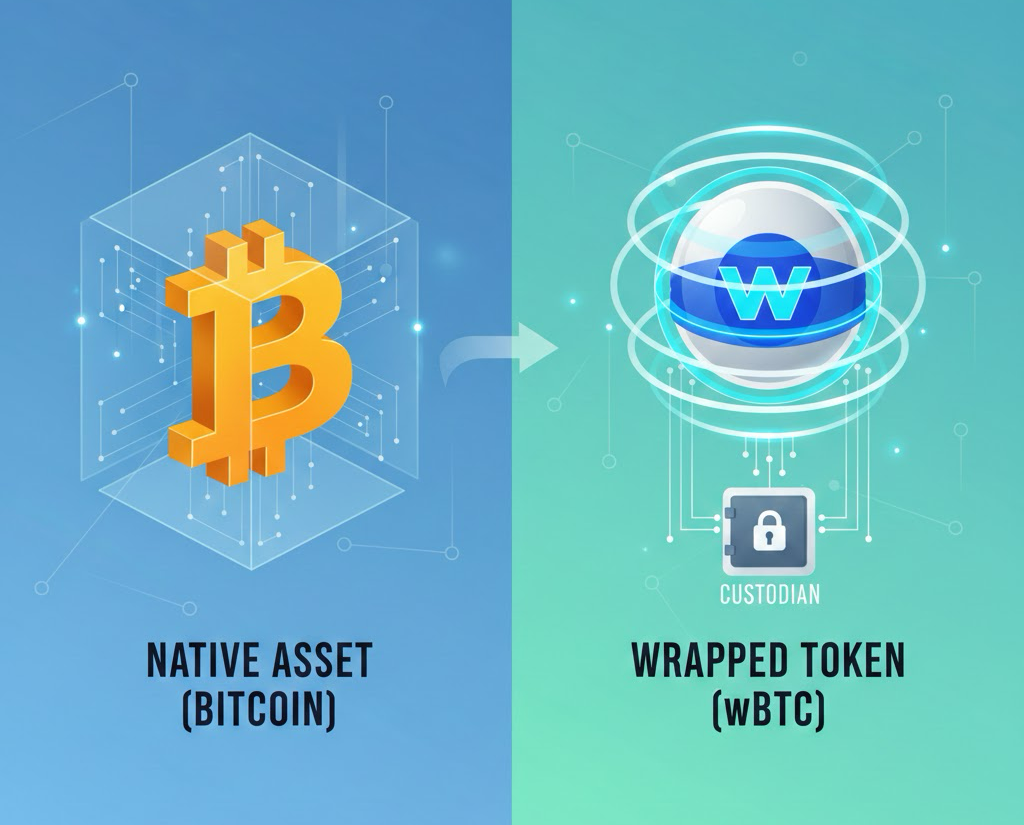
When allocating capital in digital assets, we constantly evaluate not only the market value but the operational and structural integrity of the assets themselves. One area that presents a subtle but material risk is the distinction between native assets and their wrapped or synthetic counterparts.
Wrapped tokens and synthetic assets create the appearance of direct exposure, yet they introduce dependencies on custodians, issuers, and redemption mechanisms. These dependencies can result in delayed access, operational uncertainty, or enforceability gaps.
For high-net-worth investors and institutional allocators, understanding these structural differences is essential: even a technically sound wrapped asset can pose risk to capital if control and redemption certainty are compromised.
Defining the Core Risk
Representation risk arises whenever economic exposure is separated from direct control. Native assets, such as Bitcoin on its own blockchain, provide unambiguous access and self-contained governance. Wrapped or synthetic tokens, however, depend on an issuer or custodian to maintain parity, process redemptions, or enforce contractual obligations.
From a capital protection standpoint, these dependencies matter. Redemption delays, insolvency of the custodian, or misalignment between onchain records and offchain obligations can create exposure that is not immediately visible on a ledger. Technical reliability alone does not eliminate operational or legal risk; disciplined evaluation requires a full understanding of the mechanisms underpinning any token that represents an underlying asset.
Native Assets vs Wrapped Assets
The contrast between native and wrapped assets is straightforward but carries meaningful implications for risk management:
- Native assetsexist independently on their own blockchain, with ownership and transfer governed directly by consensus rules. No intermediary is required to access, transfer, or redeem these assets. Control is immediate and transparent, providing investors with confidence in the reliability of their allocations.
- Wrapped assetsrequire a trusted custodian or issuer to maintain parity with the underlying asset. These structures rely on operational, legal, and custodial frameworks to function as intended. Redemption processes, contractual obligations, and transparency practices are central to ensuring that economic exposure aligns with actual access and control.
While wrapped assets can provide efficiency and composability across networks, they introduce layers of dependency that must be actively assessed. For long-term capital allocation, the structural risks associated with representation must be weighed alongside technical considerations. Ledger balances alone cannot indicate whether an allocation is fully accessible or operationally resilient.
Operational and Legal Anchors
Operational and legal controls are essential when dealing with wrapped or synthetic tokens. Custodial arrangements, contractual agreements, and offchain reconciliation processes provide the framework through which economic exposure can be reliably converted into actionable access.
Without these anchors, investors face uncertainty. A technically functioning wrapped asset may appear liquid, but operational delays, legal ambiguity, or lack of enforceability could impede access or create misalignment between economic and operational outcomes.
For us, assessing these frameworks is a central part of protecting investor capital and ensuring that allocations remain secure under varying operational conditions.
Market and Liquidity Considerations
Liquidity for wrapped and synthetic assets is fundamentally tied to the reliability of redemption processes and the operational capacity of the issuing entity. Even when market trading is active, access to the underlying asset can be delayed or restricted if redemption mechanisms are constrained or paused.
From a capital stewardship perspective, this introduces an additional layer of exposure. Investors must understand that a token’s technical liquidity does not automatically equate to guaranteed operational access. Evaluating market activity in conjunction with redemption reliability allows for more accurate risk management and informed allocation decisions.
The Kenson Perspective
At Kenson Investments, we approach representation risk through a disciplined framework that considers technical, operational, and legal dimensions. By mapping dependencies across issuance, custody, and redemption, we identify potential points of operational or enforceability risk. This allows us to evaluate wrapped and synthetic assets based on the robustness of the supporting structures rather than just onchain characteristics.
Protecting Capital Through Disciplined Allocation

Representation risk arises whenever economic exposure is separated from control or redemption certainty. We manage this by assessing structural dependencies, monitoring custodial and legal frameworks, and maintaining disciplined operational oversight.
For investors seeking a measured, risk-conscious approach, Kenson Investments offers a framework built on transparency, control, and repeatable processes. Explore our services to protect your digital asset allocations and maintain confidence in your capital.
Disclaimer: The information provided on this page is for educational and informational purposes only and should not be construed as financial advice. Crypto currency assets involve inherent risks, and past performance is not indicative of future results. Always conduct thorough research and consult with a qualified financial advisor before making investment decisions.
“The crypto currency and digital asset space is an emerging asset class that has not yet been regulated by the SEC and the US Federal Government. None of the information provided by Kenson LLC should be considered as financial investment advice. Please consult your Registered Financial Advisor for guidance. Kenson LLC does not offer any products regulated by the SEC, including equities, registered securities, ETFs, stocks, bonds, or equivalents.”