






A cash distribution from a cryptocurrency fund can appear straightforward. Money leaves the fund and reaches a participant. However, the payment alone does not explain where the cash came from or how the fund’s overall value changed.
Understanding crypto fund distributions requires examining several factors. These include income recognized by the fund, gains realized when digital assets are sold, changes in net asset value (NAV), and potential returns of contributed capital. Each component describes a different aspect of fund activity.
A distribution does not automatically indicate positive performance. The fund may have realized gains, received income, sold assets, or returned part of its capital. Its remaining assets may also have increased or decreased in value.
Learning to distinguish these factors helps readers interpret fund reporting more accurately. It also supports a more measured approach to understanding digital asset activity without relying on cash payments as a standalone performance indicator.
What Does a Crypto Fund Distribution Represent?
A fund distribution is a payment made from a fund to its eligible participants. Depending on the fund’s structure, governing documents, and accounting policies, the payment may reflect different sources of cash.
For example, a fund might sell a portion of its Bitcoin holdings to meet a distribution obligation. Alternatively, it might distribute cash generated by asset sales or other recognized receipts.
The source matters because a cash payment and the fund’s underlying economic performance are separate considerations.
When reviewing cryptocurrency fund reporting, readers should distinguish three questions:
- Where did the cash come from? Identify the transactions or receipts that funded the payment.
- How was the distribution classified? Review whether the fund reports income, realized gains, return of capital, or another applicable category.
- What happened to the fund’s value? Examine NAV before and after the distribution, accounting for other changes during the period.
These questions provide context that a distribution amount alone cannot supply.
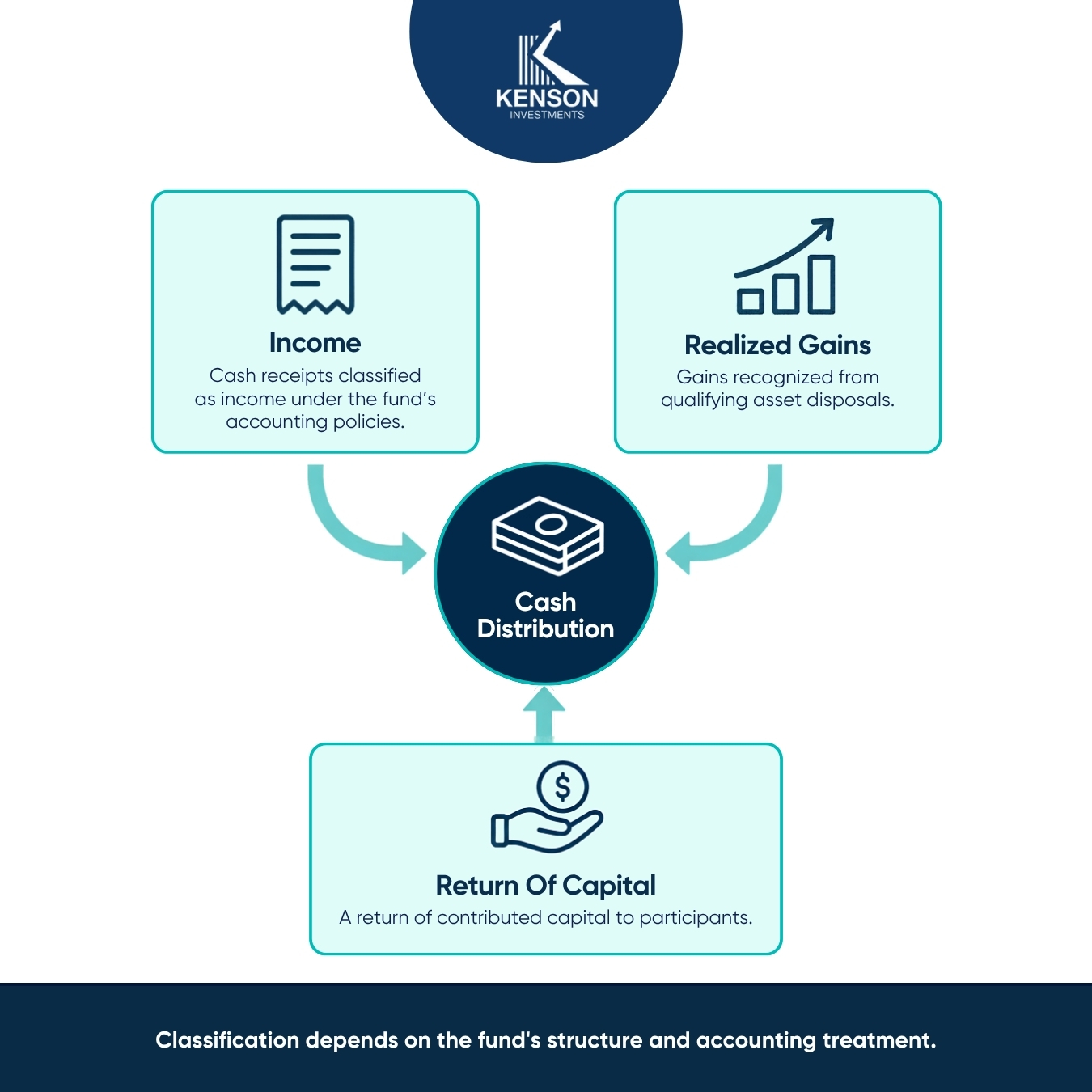
Income, Realized Gains, and Return of Capital
Fund distributions can involve different accounting categories. Their precise treatment depends on the fund’s legal structure, accounting framework, and governing documents.
1. Income
Income refers to amounts recognized as income under the fund’s applicable accounting policies. Depending on the structure and permitted activities, a fund may receive certain protocol-related rewards or other receipts.
However, not every digital asset receipt qualifies as income. Classification depends on the transaction’s nature and the applicable accounting treatment.
Readers examining digital asset investments should therefore check the fund’s financial statements and distribution disclosures. A cash payment should not be assumed to represent recurring income simply because it arrives periodically.
2. Realized Gains
A realized gain generally arises when an asset is disposed of for more than its recognized cost basis, subject to the applicable accounting treatment. A realized loss occurs when the recognized proceeds are lower than that basis.
Consider a simplified example. A fund acquires Bitcoin for $40,000 and later sells that holding for $50,000. Before considering fees and other adjustments, the transaction produces a realized gain of $10,000.
The fund might use some available cash to fund a distribution. That does not mean the entire payment represents the gain from this transaction. Other transactions, expenses, liabilities, and fund policies may affect the amount available for distribution.
Realized gains also differ from unrealized gains. If Bitcoin increases in market value but the fund continues holding it, the increase generally remains unrealized until a qualifying disposal occurs.
3. Return of Capital
A return of capital generally represents the return of some portion of contributed capital rather than income or a realized gain. The exact classification depends on the fund’s structure and applicable accounting rules.
This distinction matters because a distribution funded by returning capital can reduce the assets remaining in the fund. The payment itself does not establish that the fund generated additional economic value.
For example, a fund with $1 million in NAV might distribute $50,000 from available assets. If no other changes occur, its NAV would decline to $950,000 following the payment.
The participant receives cash, but the fund retains fewer assets. This is why distribution classifications and NAV changes should be evaluated together.
How NAV Changes After a Distribution
Net asset value represents the value of a fund’s assets minus its liabilities. It offers a useful snapshot of the fund’s financial position at a particular point in time.
When a fund distributes cash, its NAV generally decreases by the amount distributed, assuming all other factors remain unchanged. Actual NAV movement also reflects asset price changes, expenses, liabilities, and transactions during the reporting period.
Consider a simplified example:
- Opening NAV: $1,000,000
- Realized gain from asset sales: $30,000
- Other expenses: $5,000
- Cash distribution: $25,000
- Other asset value changes: $10,000 increase
Assuming these figures represent separate items and the realized gain is already reflected in the asset valuation, the closing NAV would be $1,010,000.
The calculation is:
Opening NAV + realized gain + other asset changes − expenses − distribution = closing NAV.
This example illustrates why a distribution cannot be interpreted in isolation. A fund can make a cash payment while its NAV rises, falls, or remains relatively stable. The outcome depends on the combined effect of its activities during the period.
Reading Distribution Reports More Effectively
Fund reports may use different classifications and reporting formats. Readers should examine the underlying documentation rather than assume that similar labels always mean the same thing.

When reviewing a distribution statement, consider these questions:
- What period does the report cover? Confirm the reporting dates and payment date.
- How is the distribution classified? Check the stated breakdown and supporting accounting disclosures.
- What explains the NAV movement? Review asset valuations, realized transactions, expenses, and liabilities.
- Does the report reconcile? Confirm that the opening balance, reported changes, distributions, and closing balance are consistent.
- Are there limitations? Identify estimates, valuation assumptions, fees, and any information the report does not provide.
These checks also apply when reviewing crypto asset management reports or assessing the reporting practices of a fund management company.
A distribution statement may not provide enough information to determine the fund’s complete financial position. Additional statements, governing documents, and accounting disclosures may be necessary.
Why Distribution Size Does Not Tell the Whole Story
A larger cash payment does not necessarily indicate stronger underlying performance. Two funds may distribute similar amounts while experiencing very different changes in NAV.
One fund might distribute cash following realized gains while retaining most of its underlying assets. Another might make a payment funded partly through asset sales that reduce its remaining holdings.
The distinction becomes especially relevant when evaluating cryptocurrency investment strategies or reviewing historical fund reports. Payment frequency and payment size are only two pieces of information.
Readers should also consider operating expenses, valuation methods, liquidity constraints, and the effect of distributions on remaining assets. Digital asset prices can change sharply between reporting dates, making comparisons particularly sensitive to the measurement period.
No single metric fully explains a fund’s financial position. A more complete review combines distribution classifications, NAV reconciliation, and the disclosures describing how the fund operates.
The Kenson Perspective
Kenson Investments approaches digital asset education with an emphasis on transparency, preparation, and awareness of associated risks. Understanding the source of a cash distribution is part of examining how digital asset structures operate.
The distinction between income, realized gains, and return of capital helps readers interpret fund reporting without treating cash payments as a standalone measure of performance. Reviewing NAV alongside transaction activity provides additional context about what happened to the assets that remain in a fund.
Kenson’s educational approach encourages careful examination of reporting methods, accounting classifications, and the limitations of available information. Digital asset markets remain volatile, and accounting figures may depend on valuation assumptions and the reporting framework used.
To learn more about Kenson’s approach, visit the About Us page, explore the Knowledge Centre, or contact Kenson Investments to speak with a Digital Asset Specialist.
Disclaimer
The information provided on this page is for educational and informational purposes only and should not be construed as financial advice. Cryptocurrency assets involve inherent risks, and past performance is not indicative of future results. Always conduct thorough research and consult with a qualified financial advisor before making investment decisions.
The cryptocurrency and digital asset space is an emerging asset class that has not yet been regulated by the SEC and US Federal Government. None of the information provided by Kenson LLC should be considered financial investment advice. Please consult your Registered Financial Advisor for guidance. Kenson LLC does not offer any products regulated by the SEC, including equities, registered securities, ETFs, stocks, bonds, or equivalents.



