









Digital assets promise a level of control that traditional finance rarely allows. Holding private keys and managing assets directly removes intermediaries and gives participants full authority over their funds.
But with this freedom comes a heightened responsibility: every decision, every transaction, and every interaction on-chain carries real, irreversible consequences.
Unlike bank accounts or brokerage services, where errors can often be corrected or insurance may provide coverage, mistakes in self-custodied systems accumulate rapidly. A single misconfigured permission, a misplaced transaction, or a compromised key can trigger a cascade of issues, amplifying losses in ways that traditional systems would usually contain.
Financial autonomy is empowering—but only when paired with disciplined operational practices. Without structure, control becomes exposure, and autonomy can quickly erode the very assets it is meant to protect.
Financial Autonomy in Crypto
Financial autonomy in crypto refers to the ability to hold, transfer, and manage digital assets without relying on intermediaries such as exchanges, custodians, or banks. Participants have direct control over private keys, which act as the sole authority for accessing and moving funds. This autonomy enables immediate execution of transactions, participation in decentralized governance, and interaction with smart contracts or tokenized systems on-chain.
While autonomy eliminates counterparty dependence, it also transfers full operational responsibility to the holder. Every mistake—whether a mis-typed address, an overlooked approval, or a compromised device—can have permanent consequences. Unlike traditional finance, where reconciliations, fraud protections, or customer support may correct errors, self-custody systems provide no safety net.
This shift in responsibility changes how participants must approach asset management. Operational discipline, process control, and structured routines are no longer optional—they are essential. Autonomy is not merely freedom from intermediaries; it is a framework that demands awareness, accountability, and consistent vigilance to prevent compounding errors that could permanently erode value.
Why Operational Discipline is Non-Negotiable
Operational discipline in digital asset management refers to the structured practices, checks, and routines that ensure assets are managed safely, securely, and efficiently. In self-custodied systems, operational discipline is not optional—it is the backbone that transforms autonomy into sustainable control.
Without disciplined processes, minor mistakes can compound rapidly. On-chain transactions are typically irreversible, automated protocols execute without pause, and private keys confer absolute authority.
A single error—such as granting an unlimited token allowance, misconfiguring a multisignature wallet, or sending funds to the wrong address—can trigger cascading losses that traditional financial systems would normally contain.
Key areas where discipline is essential include:
- Key Management and Access Controls:Private keys determine ultimate control. Losing them, exposing them, or failing to implement redundancy can lead to immediate, permanent loss. Tools such as multisignature wallets, air-gapped backups, and verified recovery protocols are critical components of disciplined practice.
- Permission Hygiene:On-chain approvals persist until explicitly revoked. Unchecked permissions or outdated integrations can leave assets vulnerable to exploitation. Regular audits and revocations prevent latent exposure from compounding.
- Protocol Interaction Awareness:Many digital assets participate in complex, composable systems. Automated rebalancers, liquidation engines, and protocol interdependencies execute without human intervention. Understanding these interactions and their triggers is essential to prevent errors from cascading across multiple contracts.
- Monitoring and Alerts:Continuous oversight is necessary to detect anomalous activity, such as unauthorized transfers or abnormal contract calls. Automated alerts allow timely intervention, reducing the window for errors to escalate into permanent losses.
Operational discipline bridges the gap between freedom and risk. It ensures that participants’ autonomy does not translate into exposure, preserving the integrity of assets and the value of direct ownership over time.
How Lack of Discipline Erodes Autonomy
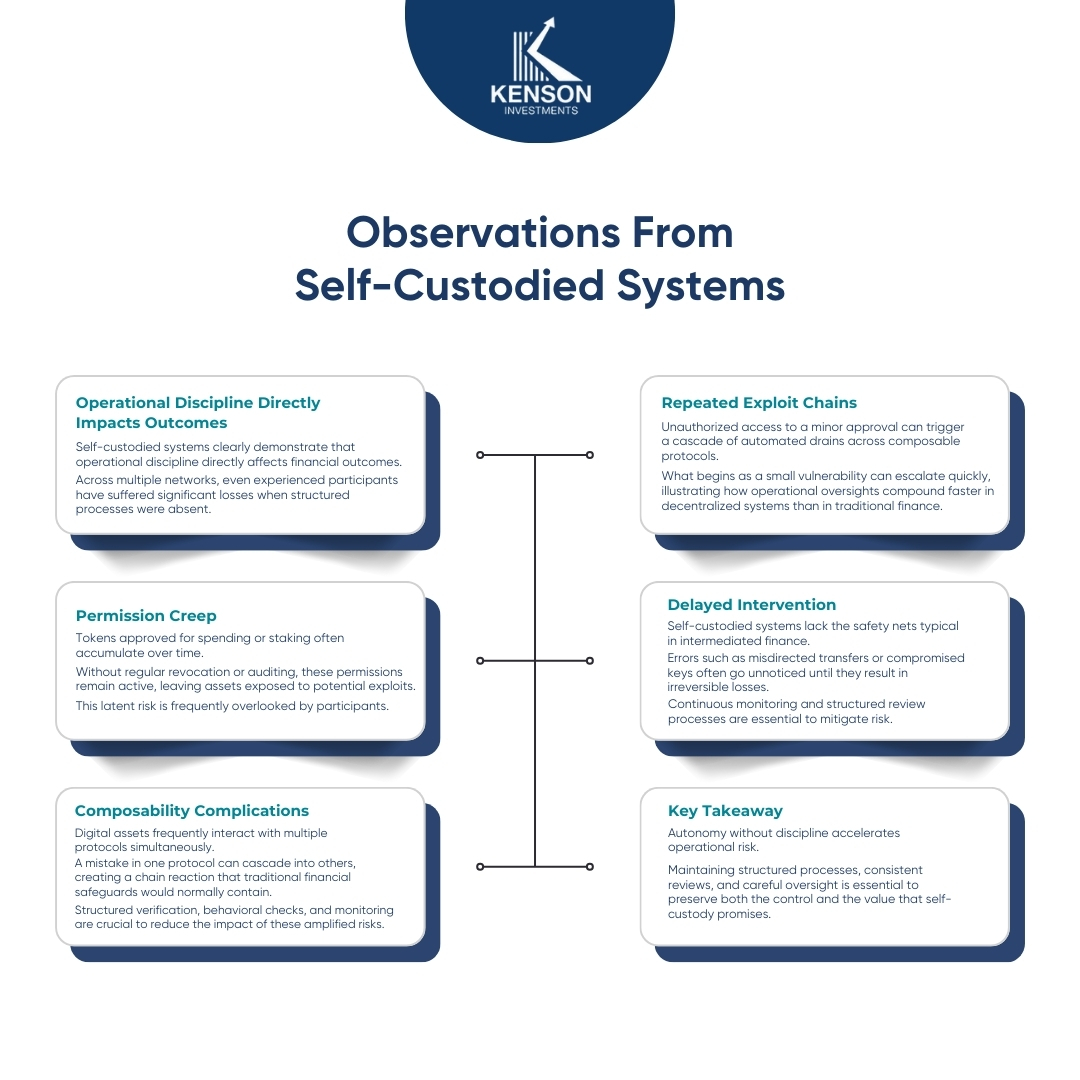
Even experienced participants can see their autonomy erode quickly when operational discipline is insufficient. In self-custodied digital asset systems, small errors or lapses compound faster than in traditional finance, often with irreversible consequences.
Compounding Operational Errors
A minor misconfiguration, such as an outdated multisignature setup or a forgotten token approval, may initially seem inconsequential. On-chain, however, automated protocols and composable systems amplify these errors.
For example, a single erroneous permission can be exploited across multiple platforms, draining assets far beyond the original scope of the mistake.
Behavioral Drift and Complacency
Autonomy increases the frequency and ease of interactions with digital assets. Participants may become overconfident after repeated, uneventful transactions, gradually neglecting checks or bypassing verification steps. Over time, this behavioral drift can create latent vulnerabilities that remain unnoticed until exploited.
Latency in Recovery
Unlike traditional financial systems, self-custodied assets have limited remediation pathways. Errors are often detected too late to reverse transactions or prevent losses. Without structured monitoring, even small mistakes—like sending tokens to a wrong address or exposing a private key—can permanently reduce asset value.
Amplified Exposure in Composable Systems
Many digital assets interact with multiple protocols simultaneously. A lapse in one protocol—such as a misapproved contract interaction—can cascade across connected systems, compounding losses and magnifying the operational risk. Composable design multiplies the impact of minor missteps, turning isolated errors into systemic issues.
The lack of disciplined operational practices is not just an inconvenience—it directly undermines the benefits of financial autonomy. Self-custody offers control and empowerment, but without structure, it becomes a vector for avoidable losses and systemic exposure.
Operational Discipline as a Structural Requirement
Operational discipline is not merely a set of best practices—it is the structural framework that enables financial autonomy to function safely in digital asset systems. Without it, direct control over assets can quickly become a source of risk rather than empowerment.
Segmentation of Duties and Assets
Dividing funds across different wallets reduces exposure. Cold storage can hold long-term assets, hot wallets manage daily transactions, and multisignature vaults oversee treasury or high-value holdings. Segmentation ensures that a single operational mistake does not jeopardize the entire portfolio.
Defined Processes for Key Operations
Every action, from granting permissions to signing transactions, should follow documented procedures. Structured workflows prevent ad-hoc decision-making that can introduce errors, particularly in multi-user setups or institutional environments.
Periodic Reviews and Audits
Regular assessment of wallet balances, token allowances, and protocol interactions identifies vulnerabilities before they escalate. Audits and governance checks are critical to maintaining operational integrity in autonomous systems.
Automation with Oversight
Automated processes—such as yield farming, staking, or liquidity rebalancing—increase efficiency but also multiply risk if left unchecked. Oversight mechanisms, including monitoring and alerting, ensure that automation remains aligned with operational intent and does not create unmonitored exposure.
By embedding these structured practices, operational discipline transforms autonomy from a theoretical benefit into a tangible advantage. It allows participants to retain full control while minimizing the risk that small mistakes compound into significant, irreversible losses.
Integrating Operational Discipline into Organizational Practice
For organizations managing digital assets, operational discipline is not just a technical requirement—it is a fundamental component of risk management. Embedding structured practices into day-to-day operations ensures that autonomy does not translate into unnecessary exposure.
Documented Key Management Policies
Organizations should define clear procedures for key generation, storage, rotation, and recovery. These policies reduce the risk of loss due to human error and provide a standardized approach for all participants involved in asset management.
Segmentation Strategies
Separating assets across multiple wallets—such as operational wallets, treasury holdings, and long-term storage—limits exposure in the event of mistakes or breaches. Segmentation ensures that errors or unauthorized access in one area do not compromise the entire portfolio.
Monitoring Protocols
Continuous oversight of wallet activity, permissions, and protocol interactions is essential. Automated alerts and analytics platforms help organizations detect anomalies quickly, reducing the time between error detection and response.
Periodic Audits and Governance Checks
Regular review cycles for approvals, balances, and contract interactions identify vulnerabilities before they escalate. Governance checks, especially in multi-user or institutional setups, maintain operational integrity and accountability.
Operational Playbooks
Predefined response plans for potential errors—such as compromised keys, misconfigured permissions, or automated protocol failures—enable organizations to act decisively and prevent minor incidents from becoming systemic issues.
By integrating these practices, organizations transform operational discipline from a reactive measure into a proactive framework. This structured approach ensures that the autonomy granted by self-custody and direct control does not become a source of compounding risk, preserving both control and asset value over time.

Strengthen Financial Autonomy Through Operational Discipline
Financial autonomy in digital assets offers unmatched control, but control alone is not enough. Without operational discipline, even small errors can compound rapidly, undermining both security and value. Structured processes, defined workflows, permission audits, and continuous monitoring are essential to transforming autonomy into sustainable empowerment, as emphasized in Digital asset consulting for compliance.
Kenson Investments provides advanced educational resources, operational checklists, and guidance tailored for participants and organizations managing digital assets, including strategies for Digital asset portfolio management and consultancy for DeFi finance investments. Our materials are designed to help maintain disciplined practices across custody, governance, and protocol interactions, reducing the compounding risks inherent in self-custodied systems and exploring structured Cryptocurrency investment solutions or Altcoin investment options.
Follow Kenson Investments for practical operational frameworks, tools, and insights to ensure your financial autonomy is both empowered and resilient. Strengthen your ability to manage digital assets with confidence, structure, and long-term stability.
Disclaimer: The information provided on this page is for educational and informational purposes only and should not be construed as financial advice. Crypto currency assets involve inherent risks, and past performance is not indicative of future results. Always conduct thorough research and consult with a qualified financial advisor before making investment decisions.
“The crypto currency and digital asset space is an emerging asset class that has not yet been regulated by the SEC and the US Federal Government. None of the information provided by Kenson LLC should be considered as financial investment advice. Please consult your Registered Financial Advisor for guidance. Kenson LLC does not offer any products regulated by the SEC, including equities, registered securities, ETFs, stocks, bonds, or equivalents.”