




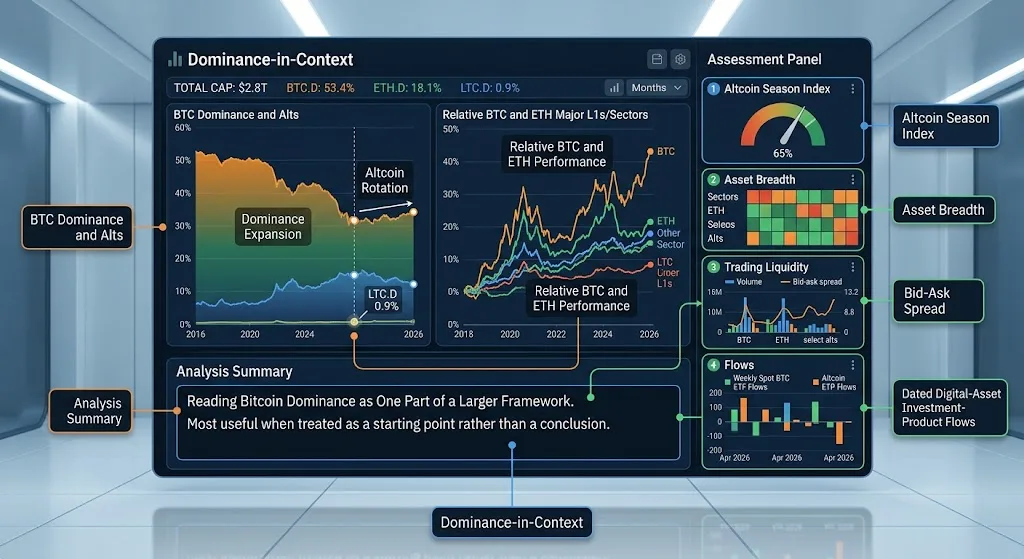
Bitcoin dominance is one of the clearest measures of how cryptocurrency market capitalization is distributed. It can help show whether Bitcoin is gaining or losing relative market share, but it does not provide a complete picture of altcoin participation.
A stronger assessment considers Bitcoin dominance alongside market breadth, relative performance, liquidity, and capital flows. These measures can help distinguish a broad shift in market participation from gains concentrated in a limited number of digital assets.
As of October 2026, Bitcoin represents approximately 58.7% of total cryptocurrency market capitalization. The figure provides current market context, but the more durable question is what is happening across the rest of the market alongside that level of dominance.
What Bitcoin Dominance Measures
Bitcoin dominance is Bitcoin’s market capitalization expressed as a percentage of the total cryptocurrency market capitalization. The calculation changes when Bitcoin’s market value changes relative to the rest of the market.
A rise in dominance can occur when Bitcoin appreciates faster than other digital assets. It can also occur when altcoin valuations decline more sharply while Bitcoin remains comparatively stable. A decline can similarly result from stronger altcoin performance, weaker Bitcoin performance, or a combination of both.
This means the direction of Bitcoin dominance requires context.
A higher percentage does not automatically mean capital is entering Bitcoin. A lower percentage does not automatically mean a broad altcoin rotation is underway. Market capitalization is a relative measure, and it should be interpreted alongside performance and participation data.

Why Bitcoin Dominance Does Not EqualAltcoin Season
A common market narrative describes crypto rotation as a sequence in which Bitcoin leads, capital moves into Ethereum, and gains eventually spread across smaller altcoins. Historical market cycles contain examples of this pattern, but it should not be treated as a fixed progression.
Bitcoin dominance alone cannot establish that an altcoin season has started.
A more useful assessment separates four questions:
- Is Bitcoin losing market share?
- Are a broad range of altcoins outperforming Bitcoin?
- Is liquidity expanding across the market?
- Are capital flows reaching assets beyond Bitcoin and Ethereum?
The answers can diverge.
For example, Bitcoin dominance may decline while only a small number of large-cap assets outperform. That would represent a change in market share without necessarily demonstrating broad participation. Conversely, several altcoins can rally strongly while Bitcoin dominance remains relatively elevated if Bitcoin itself is also appreciating.
The distinction between relative market share and market breadth is therefore central to interpreting an altcoin season.
How to Read the Altcoin Season Index
Market breadth looks at how widely performance is distributed across assets.
A broad participation pattern can involve several groups of digital assets outperforming Bitcoin over a sustained period. A narrow market can produce strong returns in individual assets or sectors while the majority of the market remains comparatively inactive.
Breadth can be examined through several measures:
- the percentage of major assets outperforming Bitcoin;
- the number of sectors participating in an advance;
- the relative performance of large-, mid-, and smaller-cap assets;
- trading activity across different segments;
- the persistence of outperformance over a defined period.
The measurement period matters. A one-week rally can look very different from a three-month shift in relative performance.
This is also why different altcoin-season indicators can produce different readings. Each methodology reflects a particular asset universe and observation period. The underlying principle remains consistent: broader participation provides more information than an isolated outperformer.
Relative Performance Can Reveal Selective Rotation
Bitcoin dominance should also be considered alongside the relative performance of major digital assets.
Ethereum can provide useful context because of its size and role across digital asset infrastructure, but its performance does not represent the entire altcoin market. Strength in Ethereum or another large-cap asset can coexist with weak performance elsewhere.
The same applies to sector-specific rallies.
An increase in activity across decentralized finance, infrastructure, tokenization, or another segment can change the distribution of market capitalization without producing a broad-based altcoin cycle.
Current market conditions have continued to demonstrate this uneven participation. Market research during the year has identified periods in which major assets and selected altcoins behaved differently, reinforcing the importance of separating individual asset strength from market-wide breadth.
For institutions analyzing market structure, the useful distinction is between relative strength in selected assets and sustained participation across the wider market.
Liquidity Helps Put Market Performance in Context
Liquidity provides another way to evaluate whether market participation is becoming broader.
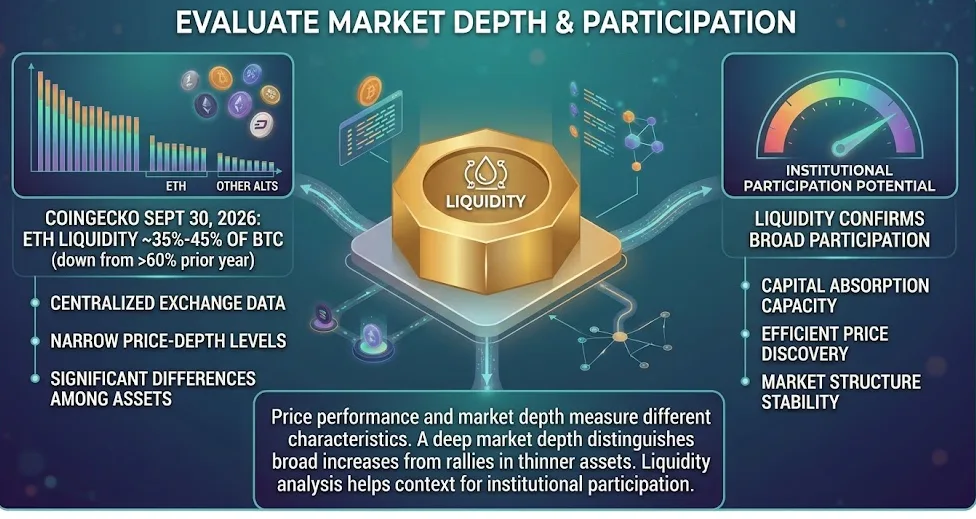
An asset can post strong returns while still having relatively shallow market depth. That distinction matters because market capitalization and trading liquidity measure different characteristics.
CoinGecko’s September 30, 2026 liquidity report found that Ethereum’s measured centralized-exchange liquidity was approximately 35% to 45% of Bitcoin’s at comparable narrow price-depth levels, down from at least 60% in its prior-year comparison. The report also found substantial differences among other major assets.
This does not determine whether an altcoin season will occur. It does show why price performance and market depth should be considered separately.
For institutions and other market participants assessing market structure, liquidity can help distinguish a broad increase in participation from a rally concentrated in assets with thinner trading conditions.
Recommended Read: Assessing Digital Asset Liquidity: The Hidden Risk in Crypto Investments.
Capital Flows Can Change Quickly
Capital-flow data provide another layer of context, particularly when examining institutional digital-asset investment products.
Flows can move toward Bitcoin, Ethereum, or selected alternative assets at different points in the market. They can also reverse rapidly during periods of changing risk appetite.
2026 has included both strong inflow and significant outflow periods across digital-asset investment products. This reinforces a durable principle: flow data should be treated as dated market evidence rather than a permanent indication of where capital is headed.
Flow data also have a defined scope. Investment-product flows do not capture every transaction across spot markets, decentralized protocols, private vehicles, or other channels. They therefore provide one perspective on capital allocation rather than a complete measurement of the entire digital asset market.
When combined with dominance, breadth, and liquidity, however, they can help provide a more complete picture of market participation.
Selective Altcoin Strength Is Different From Broad Market Rotation
An altcoin can outperform Bitcoin for reasons specific to its network, ecosystem, market structure, or investor base. Several assets can do so at the same time without creating a market-wide rotation.
This distinction has become increasingly relevant as digital asset markets have developed into a collection of different sectors and use cases.
For example, a period of strong performance in one category can attract capital while other segments remain subdued. Similarly, large-cap assets can gain market share while smaller assets experience limited liquidity or weaker demand.
A broad altcoin phase would therefore involve evidence across several dimensions:
- performance extending beyond a small group of assets;
- sustained relative strength rather than a brief price move;
- improving participation across market segments;
- adequate liquidity to support increased activity;
- capital flows reaching a wider range of assets.
No single indicator confirms all of these conditions.
What Can Cause Bitcoin Dominance to Change?
Bitcoin dominance changes when Bitcoin’s market capitalization changes relative to the rest of the cryptocurrency market.
Several factors can contribute:
Relative asset performance: If alternative assets appreciate faster than Bitcoin, their combined market capitalization can increase relative to Bitcoin.
Market liquidity: Changes in available liquidity can influence participation across different digital assets and trading venues.
Capital allocation: Market participants can change how exposure is distributed between Bitcoin, Ethereum, and other digital assets.
Market structure: Exchange access, institutional products, custody infrastructure, and other developments can affect how different assets are accessed and traded.
Macro conditions: Interest rates, broader financial-market liquidity, economic expectations, and geopolitical conditions can influence risk appetite across markets, including digital assets.
These factors interact rather than operating as a fixed sequence. Bitcoin dominance can therefore be useful for describing a market condition without serving as a reliable standalone predictor of what happens next.
Recommended Read: Crypto Market Cycles: Identifying Bull and Bear Phases in Digital Assets for broader analysis of bull, bear, and consolidation phases.
How to Read Bitcoin Dominance More Effectively
Bitcoin dominance becomes more useful when treated as one component of a broader market framework.
A practical analysis can move through several questions:
1. What is happening to Bitcoin’s market share?
This establishes the starting point.
2. How broadly are other digital assets performing?
This shows whether the move is concentrated or widespread.
3. Are major alternative assets gaining relative strength?
This helps identify whether participation is extending beyond Bitcoin.
4. Are liquidity conditions supporting the move?
This provides context for the quality and depth of market participation.
5. Are capital flows changing across asset groups?
This can help identify shifts in demand, while recognizing that flow data cover only specific market channels.
6. How persistent is the change?
A short-lived move provides different information from a sustained change across several measurement periods.
This framework helps separate a change in market share from a genuine expansion in participation.
Kenson Perspective on Bitcoin Dominance and Altcoin Season
Bitcoin dominance provides a useful view of where cryptocurrency market capitalization is concentrated, but it is only one part of the market structure.
A stronger analysis starts with dominance and works outward to breadth, relative performance, liquidity, and capital flows. That approach can distinguish isolated asset strength from a broader change in market participation without relying on a single indicator to explain the entire market.
Current market readings will change. The analytical framework can remain useful across those changing conditions.
Explore More from Kenson Investments
Continue exploring practical insights on market structure, liquidity, and capital flows in the Kenson Investments Knowledge Center.
Register Now to access the latest educational resources.
Disclaimer: The information provided on this page is for educational and informational purposes only and should not be construed as financial advice. Cryptocurrency assets involve inherent risks, and past performance is not indicative of future results. Always conduct thorough research and consult with a qualified financial advisor before making investment decisions.
“The cryptocurrency and digital asset space is an emerging asset class that has not yet been regulated by the SEC and the US Federal Government. None of the information provided by Kenson LLC should be considered as financial investment advice. Please consult your Registered Financial Advisor for guidance. Kenson LLC does not offer any products regulated by the SEC, including equities, registered securities, ETFs, stocks, bonds, or equivalents.”



