





Bitcoin investment requires more than an understanding of Bitcoin’s price. A complete evaluation considers the asset itself, the method used to obtain exposure, custody arrangements, liquidity, portfolio concentration, operational controls, regulatory conditions, and the investor’s time horizon.
Bitcoin is a decentralized digital asset that operates on a distributed network without a central issuer controlling the protocol. Its monetary design includes a maximum supply of 21 million bitcoin, with new units introduced through the network’s issuance process. Those characteristics are durable features of the protocol, but they do not establish a guaranteed market value or investment outcome.
The structure surrounding Bitcoin exposure has also become more developed. Investors can hold Bitcoin directly, use third-party custodial arrangements, access exchange-traded products where available, or obtain exposure through derivatives and other financial instruments. Each structure creates a different combination of market, custody, counterparty, liquidity, operational, and regulatory considerations.
The regulatory environment also continues to develop. In March 2026, the U.S. Securities and Exchange Commission (SEC), joined by the Commodity Futures Trading Commission (CFTC), issued a Commission-level interpretation addressing the application of federal securities laws to certain crypto assets and transactions.
The framework distinguishes categories including digital commodities, digital collectibles, digital tools, stablecoins, and digital securities. The classification of a particular asset or transaction remains dependent on its characteristics and circumstances.
For beginners, the central objective is therefore not simply understanding Bitcoin as a technology or tracking its market price. A more durable approach is to understand how Bitcoin exposure fits into a broader financial structure and how the associated risks can be evaluated.
What Is Bitcoin?
Bitcoin is a digital asset that operates through a decentralized blockchain network. Transactions are recorded on a public ledger, while network participants use cryptographic mechanisms and consensus rules to validate and secure transactions.
Unlike traditional currencies issued by central banks, Bitcoin does not depend on a central monetary authority to create or settle units. The protocol establishes rules governing issuance, transaction validation, and the maximum supply.
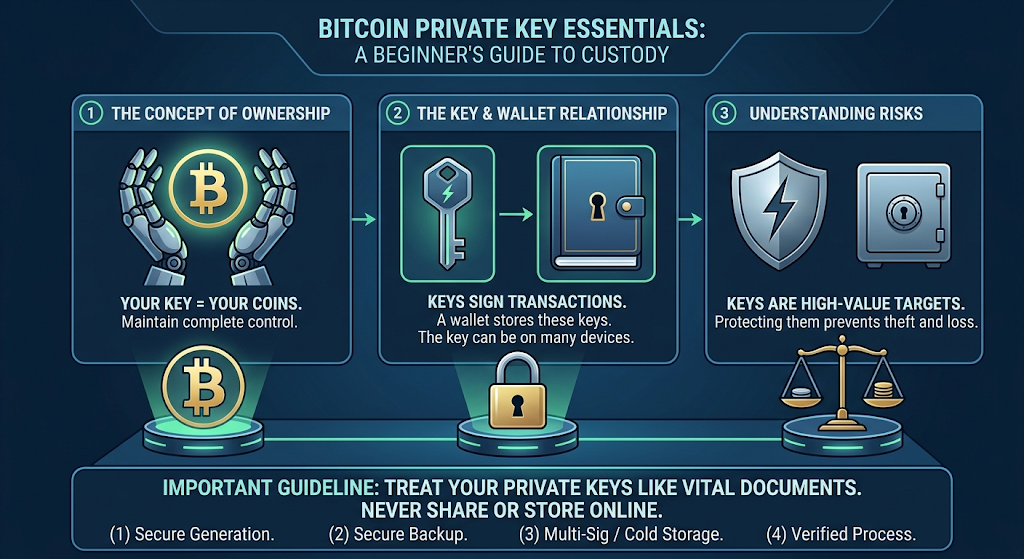
Bitcoin ownership is represented through control of private cryptographic keys. The person or institution controlling the relevant private keys can authorize transactions involving the associated bitcoin. This makes custody an important part of Bitcoin ownership.
Bitcoin is also divisible into smaller units called satoshis. One bitcoin contains 100 million satoshis, allowing transactions and holdings to be represented without requiring ownership of a whole bitcoin.
The network’s monetary structure is one of the most frequently discussed characteristics of Bitcoin. The protocol’s 21 million maximum supply is known in advance under its existing rules. The existence of a fixed maximum supply does not, by itself, determine demand, market price, liquidity, or future investment results.
Bitcoin’s market value is established through buying and selling activity across markets where it is traded. That market structure can change rapidly, particularly during periods of stress, leverage reduction, regulatory developments, or changes in investor positioning.

Why Is Bitcoin Sometimes Called Digital Gold?
The comparison between Bitcoin and gold generally reflects similarities that investors sometimes identify in their monetary characteristics.
Both assets have limited supply characteristics, can be held outside traditional bank deposits, and are frequently discussed in relation to long-term stores of value. Bitcoin can also be transferred digitally across a global network, while gold requires physical handling or financial infrastructure for many forms of transfer and custody.
The comparison has important limitations.
Gold has thousands of years of established use as a physical commodity and monetary asset. Bitcoin has a much shorter operating history and depends on digital infrastructure, cryptographic systems, network participation, exchanges, custodians, wallets, and other technology.
Bitcoin also trades in a market that can experience substantial price movements. The asset’s digital nature introduces operational and cybersecurity considerations that do not have direct equivalents in physical gold ownership.
The term “digital gold” can therefore be useful as a conceptual comparison, but it should not be treated as evidence that Bitcoin will behave like gold or provide the same portfolio characteristics.

What Gives Bitcoin Market Value?
Bitcoin’s market value is determined by market participants rather than by a fixed redemption value.
Several factors influence the price at which Bitcoin trades:
- Supply and issuance dynamics
- Market demand
- Liquidity and trading activity
- Investor positioning
- Institutional participation
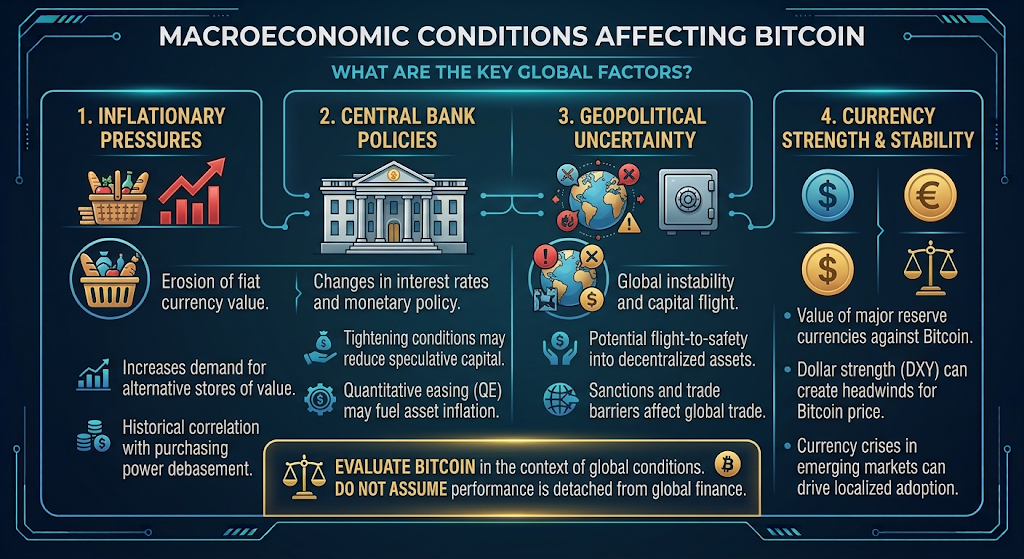
- Macroeconomic conditions
- Regulatory developments
- Network adoption
- Market structure
- Leverage and derivatives activity
- Sentiment and expectations
The interaction between these factors can produce large changes in market value over relatively short periods.
Bitcoin’s fixed maximum supply is often presented as a central part of its monetary design. Scarcity alone, however, does not establish an investment return. An asset can have limited supply while experiencing weak demand or declining market value.
A sound Bitcoin investment framework therefore treats supply characteristics as one component of the analysis rather than as a standalone investment thesis.
Bitcoin Supply and Issuance
Bitcoin’s protocol establishes a maximum supply of 21 million bitcoin.
New bitcoin enters circulation through the network’s issuance mechanism associated with block production and mining. The issuance rate declines over time through programmed reductions in the block subsidy.
This structure differs from conventional monetary systems in which central banks can change the supply of base money through monetary policy operations.
The predictable nature of Bitcoin’s issuance is relevant to understanding the asset, but it should not be confused with predictable market performance. Supply can be relatively transparent while demand remains uncertain.
Market price is determined by the interaction between available supply and demand across trading venues. Changes in investor participation, liquidity, regulation, market structure, and broader economic conditions can influence that interaction.
Is Bitcoin Investment Different From Bitcoin Ownership?
Bitcoin ownership and Bitcoin investment exposure are related but distinct concepts.
Direct ownership involves holding bitcoin itself. Depending on the arrangement, the owner may control the private keys or may rely on a third-party custodian.
Investment exposure can also be obtained through financial products that reference Bitcoin without requiring the investor to personally hold the underlying asset.
The distinction matters because the risks associated with the underlying asset can differ from the risks associated with the structure used to obtain exposure.
For example, direct ownership creates responsibility for wallet security and key management. A custodial structure shifts some of those responsibilities to another organization but introduces counterparty and operational considerations.
Exchange-traded products can provide a different operational experience again. Investors may gain market exposure through a regulated financial product while avoiding direct private-key management, but product structure, fees, tracking considerations, liquidity, custody arrangements, and regulatory status still require evaluation.
The investment vehicle should therefore be assessed separately from the underlying Bitcoin exposure.
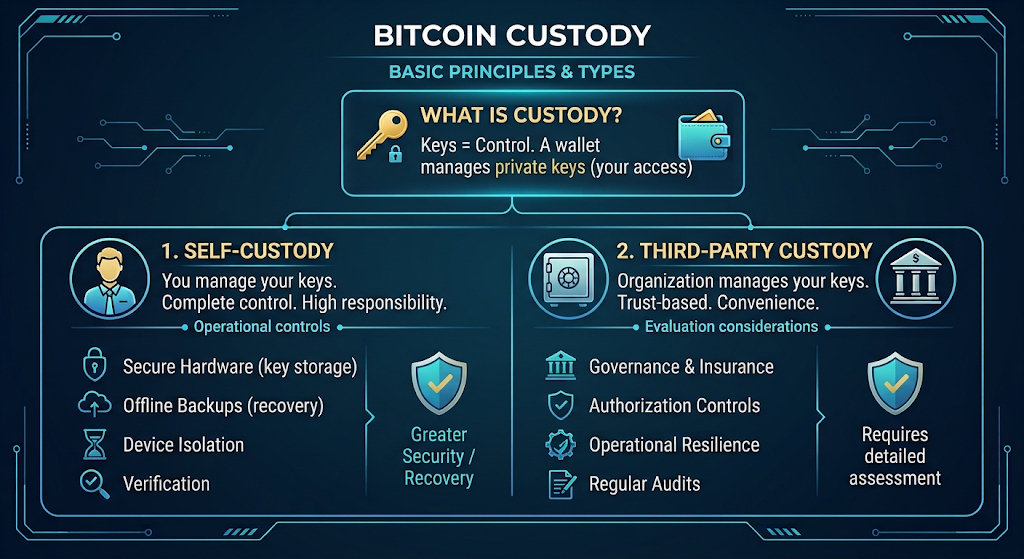
How Does Bitcoin Custody Work?
Custody is one of the most important practical components of Bitcoin ownership.
Bitcoin itself does not sit inside a physical wallet. The blockchain records balances associated with addresses, while private keys provide the authority required to authorize transactions.
A wallet is therefore better understood as a tool for managing cryptographic credentials than as a physical container holding coins.
Self-Custody
Under self-custody, the owner maintains control over the private keys.
Advantages can include direct control and reduced dependence on a centralized custodian. The trade-off is greater responsibility for security and recovery.
Operational controls can include:
- Hardware-based key storage
- Secure backups
- Offline recovery procedures
- Multi-signature arrangements
- Device isolation
- Transaction verification
- Access-control policies
- Inheritance procedures
The security process should account for both digital threats and ordinary human error.
Third-Party Custody
Third-party custody transfers key-management responsibilities to an external organization.
Evaluation should extend beyond cybersecurity marketing claims. Relevant considerations include governance, segregation arrangements, authorization controls, recovery procedures, insurance terms where applicable, operational resilience, audit practices, access controls, and incident-response procedures.
The legal rights associated with the assets should also be understood before relying on a custodial structure.
What Are the Main Risks of Bitcoin Investment?
Bitcoin investment involves multiple layers of risk. Market volatility is only one component.
Market Risk
Bitcoin can experience substantial price movements over short periods.
The Bank for International Settlements reported a sharp decline in Bitcoin during the first quarter of 2026 and noted that leveraged liquidations can amplify movements in crypto markets. This illustrates how market structure and leverage can intensify periods of stress.
Historical performance does not establish a predictable future path. An investor should be able to withstand material market-value changes without relying on short-term forecasts.
Liquidity Risk
Liquidity refers to the ability to transact without creating an unacceptable effect on market price or experiencing substantial execution friction.
Bitcoin is traded across multiple venues, but liquidity is not uniform across markets, products, jurisdictions, or periods.
Stress conditions can alter order-book depth, spreads, execution quality, and available counterparties.
Liquidity should therefore be assessed in relation to the specific exposure structure rather than treated as a permanent characteristic of the asset.
Custody Risk
Custody risk concerns the security and availability of Bitcoin or Bitcoin-related assets.
Self-custody creates key-management responsibilities. Third-party custody creates reliance on an external organization. Exchange-traded products create reliance on the product’s legal and operational structure.
Each arrangement requires a different control framework.
Counterparty Risk
Counterparty risk arises when an investor depends on another organization to provide access, settlement, custody, financing, execution, or another service.
The existence of Bitcoin’s decentralized network does not eliminate counterparty risk from the surrounding financial infrastructure.
Technology and Cybersecurity Risk
Bitcoin depends on cryptographic systems, software, hardware, networks, wallets, exchanges, custodians, and other infrastructure.
Cybersecurity failures can affect access to assets, trading accounts, custody systems, or related services.
A strong investment review therefore considers both Bitcoin’s protocol and the technology used to access or hold exposure.
Regulatory Risk
Regulatory frameworks can affect how Bitcoin and Bitcoin-related products are classified, offered, traded, held, or reported.
The SEC’s 2026 interpretation provides a current federal framework for analyzing certain crypto assets and transactions under federal securities laws. SEC staff subsequently published FAQs explaining aspects of the interpretation while noting that the FAQs represent staff views and do not have the force of a rule or regulation.
Regulatory analysis should therefore distinguish between final rules, proposed rules, Commission interpretations, staff statements, and jurisdiction-specific requirements.
In 2026, the SEC also proposed amendments concerning custody of certain crypto assets by registered investment advisers and regulated funds. The proposal remains a proposal rather than a final rule and should not be treated as settled regulatory requirements.
Operational Risk
Operational risk can arise from transaction errors, inadequate access controls, poor recordkeeping, weak backup procedures, incorrect wallet addresses, system failures, or inadequate internal processes.
Operational mistakes can be particularly significant because blockchain transactions generally cannot be reversed through a conventional bank-style dispute process.
How Should Bitcoin Exposure Be Evaluated?
A structured investment decision framework can help separate the underlying asset from the circumstances surrounding the exposure.
The framework below is educational and does not establish an appropriate allocation for any individual investor.
1. Define the Investment Objective
The intended role of Bitcoin exposure should be established before selecting an investment structure.
An objective may relate to portfolio diversification, exposure to a specific digital asset, participation in a particular market structure, or another defined financial purpose.
The objective should be stated independently from an expected price target.
A price target can change as market conditions change. A clearly defined portfolio objective provides a more durable basis for evaluation.
2. Identify the Main Risk Drivers
The risk assessment should include the factors most relevant to the selected exposure.
These can include:
- Market volatility
- Liquidity
- Custody
- Counterparty exposure
- Cybersecurity
- Technology
- Regulation
- Operational processes
- Leverage
- Product structure
- Concentration
The relative importance of each risk depends on how the exposure is established.
3. Evaluate Liquidity Requirements
Liquidity requirements should be established before exposure is created.
Capital that may be needed for near-term obligations should generally be evaluated differently from capital that can remain exposed through extended periods of market stress.
The relevant analysis includes both the liquidity of Bitcoin itself and the liquidity of the chosen investment vehicle.
Stress scenarios should also be considered because market liquidity can deteriorate when volatility rises.
4. Establish the Investment Time Horizon
Bitcoin exposure should be evaluated against the period during which the investor can tolerate market volatility.
A short-term capital requirement creates a different risk profile from capital that can remain invested for a longer period.
The time horizon should also account for the possibility of prolonged weak performance rather than assuming that market declines will quickly reverse.
5. Assess Portfolio Concentration
Concentration analysis should extend beyond direct Bitcoin holdings.
Related exposures can arise through Bitcoin-related products, companies whose financial results are highly dependent on digital assets, derivatives, or other correlated positions.
A portfolio may therefore have greater Bitcoin sensitivity than its direct Bitcoin allocation suggests.
Concentration should be evaluated across the full portfolio rather than by examining one account in isolation.
6. Conduct Scenario Analysis
Scenario analysis provides a way to evaluate the consequences of different market and operational conditions without relying on a single forecast.
Relevant scenarios include:
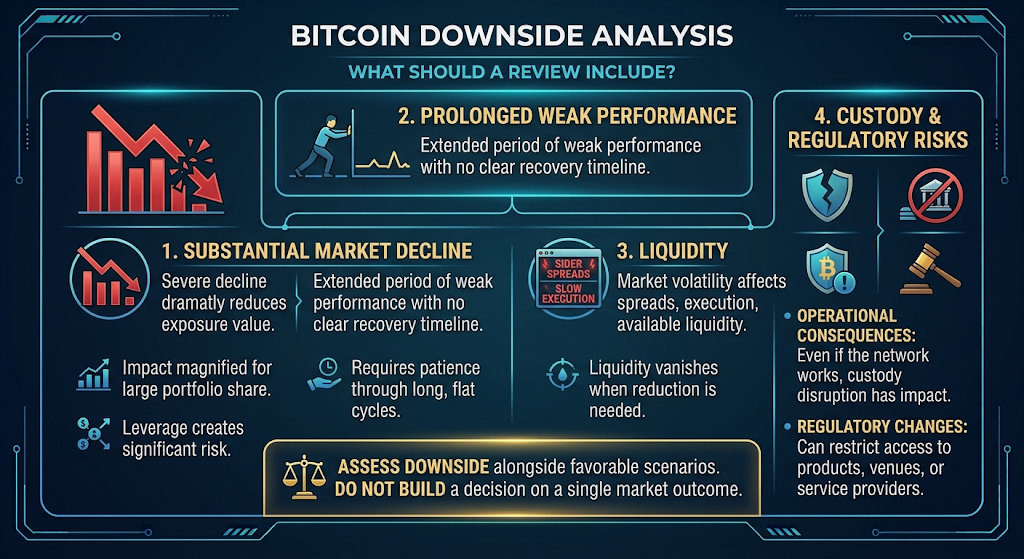
Severe market decline: A substantial reduction in Bitcoin’s market value creates pressure on portfolio risk and liquidity.
Extended weak market: Bitcoin remains below previous valuation levels for a prolonged period, testing the original investment thesis and time horizon.
Liquidity stress: Market depth deteriorates, spreads widen, and execution becomes more difficult.
Custody disruption: Access to assets is interrupted because of a security incident, operational failure, account restriction, or other custody problem.
Regulatory change: A new rule, interpretation, enforcement development, or jurisdictional restriction changes the conditions surrounding Bitcoin exposure.
Operational failure: A transaction, access, recordkeeping, or security process fails.
Significant appreciation: A substantial increase in market value creates greater portfolio concentration and changes the relative weight of the exposure.
The purpose of scenario analysis is not to predict which outcome will occur. It is to establish whether the exposure remains consistent with the defined risk framework across different conditions.
7. Establish Monitoring Criteria
Monitoring should focus on predefined factors rather than constant reactions to short-term price movements.
Relevant monitoring categories can include:
- Portfolio concentration
- Market liquidity
- Custody arrangements
- Counterparty condition
- Regulatory developments
- Product structure
- Operational controls
- Cybersecurity incidents
- Changes in the original investment objective
Monitoring criteria should specify the type of development that warrants further review.
8. Establish Rebalancing Criteria
Rebalancing should be based on predefined portfolio or risk criteria rather than short-term market predictions.
A framework can establish thresholds for concentration, liquidity requirements, changes in the original objective, or material changes to the exposure structure.
The purpose of rebalancing is to maintain the intended portfolio framework rather than to predict the next market movement.
How Important Is Liquidity Before Bitcoin Investment?
Liquidity should be considered at several levels.
The first level is market liquidity for Bitcoin itself. The second is liquidity at the venue or platform used for execution. The third is liquidity associated with the specific investment vehicle.
An exchange-traded product may have trading characteristics that differ from the underlying Bitcoin market. A derivatives position may involve margin requirements that create liquidity demands during periods of volatility. A custodial arrangement may involve withdrawal procedures or operational controls that affect access.
Liquidity analysis should therefore consider the full chain between the investor and the underlying exposure.
Stress conditions deserve particular attention. Liquidity that appears adequate during normal market conditions may behave differently during sharp price movements.
Does Bitcoin Improve Portfolio Diversification?
Bitcoin’s relationship with traditional assets can change across market environments.
Correlation is not a fixed property. Relationships between Bitcoin, equities, bonds, commodities, currencies, and other assets can vary depending on liquidity conditions, macroeconomic developments, investor positioning, and broader market stress.
Bitcoin should therefore not be classified as permanently uncorrelated or permanently diversified.
A diversification analysis should examine the actual portfolio rather than relying on a generalized description of Bitcoin.
Historical correlation statistics can also be sensitive to the measurement period. A short sample can produce a materially different result from a longer period.
For this reason, diversification should be treated as an empirical portfolio question rather than a permanent characteristic of Bitcoin.
How Does Bitcoin Fit Into Broader Crypto Market Cycles?
Bitcoin often occupies a central position within digital asset markets, but Bitcoin investment should not automatically become a broad cryptocurrency market analysis.
Market-cycle analysis can provide useful context for understanding liquidity, leverage, investor positioning, and changes in digital asset participation.
The relationship between Bitcoin and other crypto assets can change during different market conditions. Bitcoin dominance, for example, can rise or fall as capital shifts between Bitcoin and other digital assets.
That information can be useful for understanding the broader market, but it should not replace asset-specific analysis.
For deeper discussion of market-cycle behavior, Bitcoin dominance, and related digital asset conditions, the Kenson Investments Knowledge Center contains separate educational material. Internal links should point readers to those pages rather than duplicating their full analysis here.
What Should Investors Evaluate in Bitcoin-Related Products?
A Bitcoin-related product should be evaluated independently from Bitcoin itself.
Important considerations include:
- Legal structure
- Regulatory status
- Custody arrangements
- Fees and expenses
- Trading liquidity
- Tracking methodology
- Creation and redemption mechanics where applicable
- Counterparty exposure
- Tax treatment where relevant and appropriate to obtain from qualified professionals
- Reporting requirements
- Geographic availability
A product can provide Bitcoin exposure while creating risks that do not exist in the same form through direct ownership.
Product documentation should therefore be reviewed before exposure is established.
How Should an Existing Bitcoin Investment Be Monitored?
Monitoring should begin with the original investment framework.
The objective, time horizon, liquidity requirements, concentration limits, and custody structure should remain visible after the initial investment decision.
Market price can be monitored, but it should not become the only indicator.
Other review triggers can include:
- A material change in portfolio concentration
- A significant change in liquidity requirements
- Changes to custody arrangements
- Changes in the product structure
- Material regulatory developments
- Significant cybersecurity incidents
- Changes in counterparty condition
- Changes to the original investment objective
A monitoring process is more useful when the criteria are established before periods of market stress.
What Does a Complete Bitcoin Investment Review Contain?
A complete Bitcoin investment review should connect the asset, exposure structure, portfolio, and operating environment.
A practical review can include:
- Investment objective: Define the intended role of Bitcoin exposure.
- Exposure structure: Identify whether exposure is direct, custodial, exchange-traded, derivative-based, or another form.
- Market risk: Assess the potential for substantial changes in market value.
- Liquidity: Evaluate normal and stressed liquidity conditions.
- Custody: Review control of assets, access procedures, and security arrangements.
- Counterparty risk: Identify dependencies on external organizations.
- Operational risk: Review transaction, access, reporting, and recovery procedures.
- Regulatory context: Assess applicable rules and current developments.
- Concentration: Evaluate Bitcoin exposure relative to the broader portfolio.
- Time horizon: Establish the period over which capital can remain exposed.
- Scenario analysis: Test severe decline, prolonged weakness, liquidity stress, custody disruption, and regulatory change.
- Monitoring: Establish conditions that trigger review.
- Rebalancing: Define portfolio-based criteria for maintaining the intended structure.
This framework provides a more durable foundation than relying on a single price forecast or market narrative.
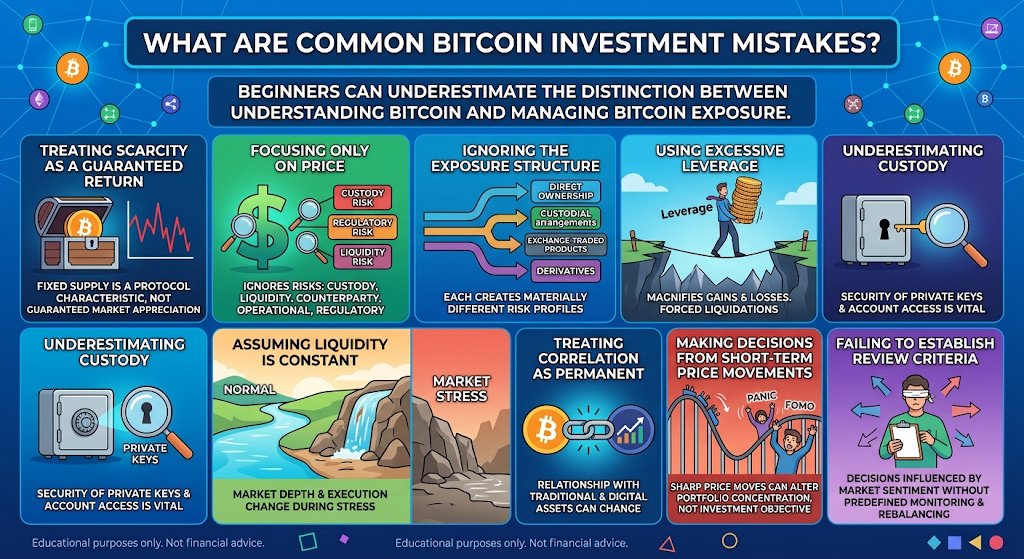
Bitcoin Investment Evaluation Checklist
A structured review can be summarized through the following checklist:
- Investment objective: Establish the intended role of Bitcoin exposure.
- Exposure structure: Identify the method used to obtain and hold exposure.
- Risk drivers: Assess market, liquidity, custody, counterparty, technology, cybersecurity, regulatory, and operational risks.
- Liquidity: Match the exposure structure with expected capital-access requirements.
- Time horizon: Establish the period during which the capital can remain exposed.
- Concentration: Evaluate direct and indirect Bitcoin-related exposure across the portfolio.
- Scenario analysis: Test severe declines, prolonged weak markets, liquidity stress, custody disruption, regulatory changes, and significant appreciation.
- Monitoring: Establish objective conditions that warrant a portfolio review.
- Rebalancing: Define criteria based on portfolio structure and risk rather than short-term price forecasts.
- Documentation: Record the assumptions and framework used for the decision.
This checklist is designed as an educational framework rather than a recommendation for any specific allocation or investment product.
Continue Your Digital Asset Research
Bitcoin investment is part of a broader digital asset market that includes different forms of exposure, market cycles, liquidity conditions, custody structures, and evolving regulatory considerations. Each area has distinct characteristics and risks, making it useful to evaluate Bitcoin within the wider context of digital asset markets.
Market-cycle analysis can provide context for changing conditions across Bitcoin and other digital assets, while liquidity analysis focuses on trading depth, spreads, and execution. Custody considerations address how digital assets are held and accessed, and regulatory developments can influence the structure and availability of certain products and services.
A structured Bitcoin investment approach brings these factors together with the investment objective, time horizon, portfolio concentration, scenario analysis, monitoring criteria, and rebalancing framework. This provides a practical foundation for evaluating Bitcoin exposure without relying solely on short-term market forecasts.
Register now to access additional educational research covering Bitcoin, digital assets, market structure, liquidity, custody, and related investment topics.
Disclaimer: The information provided on this page is for educational and informational purposes only and should not be construed as financial advice. Crypto currency assets involve inherent risks, and past performance is not indicative of future results. Always conduct thorough research and consult with a qualified financial advisor before making investment decisions.
“The cryptocurrency and digital asset space is an emerging asset class that has not yet been regulated by the SEC and the US Federal Government. None of the information provided by Kenson LLC should be considered as financial investment advice. Please consult your Registered Financial Advisor for guidance. Kenson LLC does not offer any products regulated by the SEC, including equities, registered securities, ETFs, stocks, bonds, or equivalents.”



