




Bitcoin’s market structure has changed considerably as institutional participation, derivatives activity, regulated market access, and broader financial-market connections have developed. At the same time, Bitcoin remains capable of sharp repricing when liquidity changes or leveraged positions are unwound.
That combination makes Bitcoin investment strategies highly dependent on market conditions. A strategy built around long-term exposure behaves differently from one that responds to momentum, volatility, liquidity, or derivatives positioning. The same market signal can also have different implications depending on how an allocation is structured.
In 2026, this distinction is particularly relevant. Bitcoin experienced a substantial selloff during the first quarter as markets rotated away from growth assets, with the Bank for International Settlements noting that leveraged liquidations likely intensified the decline. Later in the year, broader financial markets continued to contend with changing interest-rate expectations, geopolitical uncertainty, fiscal concerns, and shifts in risk appetite.
Bitcoin Investment Strategies Have Different Market Dependencies
The label attached to a strategy can sometimes obscure what actually drives its results. Two Bitcoin allocations may have the same underlying asset but very different decision rules.
A long-term allocation is primarily exposed to Bitcoin’s longer-term market value and the investor’s ability to tolerate extended periods of volatility.
A systematic strategy reduces reliance on selecting individual entry points by following predetermined purchasing or allocation rules.
A tactical strategy places greater emphasis on changing market conditions. Volatility, liquidity, momentum, derivatives positioning, macroeconomic developments, or market structure may influence when exposure is increased, reduced, or maintained.
A trend-following strategy depends more heavily on the persistence of market direction. Its signals can weaken when Bitcoin moves sideways or rapidly reverses.
A volatility-oriented strategy focuses on the size and persistence of price movements rather than simply whether Bitcoin is rising or falling.
These approaches should not be evaluated solely by comparing historical returns. Their assumptions, trading frequency, liquidity requirements, transaction costs, and tolerance for false signals can be very different.

Supply Is Only One Part of the Bitcoin Market
Bitcoin’s predetermined issuance schedule remains an important structural feature, but supply alone does not explain short- and medium-term price behavior.
Market participants also need to consider:
- The amount of Bitcoin actively available for trading
- Changes in investor demand
- Institutional flows
- Derivatives positioning
- Stablecoin and broader market liquidity
- Exchange and market-maker activity
- Long-term holder behavior
- Changes in risk appetite
The distinction between protocol supply and market liquidity is particularly important.
Bitcoin can have a constrained issuance schedule while still experiencing periods of significant selling pressure. Conversely, limited immediately available supply does not guarantee upward price movement if demand weakens.
For strategy purposes, supply is therefore better treated as a structural variable than as a standalone price signal.
Liquidity Can Change Faster Than the Headline Price
Bitcoin is traded continuously across a global market structure, but continuous trading does not mean liquidity is constant.
Market depth can change as participants adjust risk, market makers reduce exposure, or volatility increases. During periods of stress, the cost of executing larger transactions can rise even when trading volume remains substantial.
This matters for strategy design.
A strategy that requires frequent position changes has greater dependence on execution conditions than one designed for infrequent allocation decisions. Similarly, a large position may face different implementation constraints from a smaller position even when both use the same underlying Bitcoin exposure.
Liquidity analysis should therefore consider how much needs to be traded, how quickly, and under what market conditions.
Bitcoin Derivatives Have Become a Major Market Signal
Derivatives provide another layer of information about Bitcoin markets.
Open interest, funding conditions, futures positioning, options activity, and liquidations can reveal how participants are positioning around the underlying asset.
The CFTC’s trader-position data demonstrates the breadth of participation across dealer/intermediary, asset-manager/institutional, leveraged-fund, and other categories in Bitcoin futures.
That information can be useful, but it should not be converted into a simplistic directional forecast.
For example, rising open interest can accompany a strengthening market, but it can also indicate a buildup of leveraged positions that becomes vulnerable if prices reverse. Similarly, large liquidations show that positions were forcibly closed; they do not establish that a market has reached a durable bottom.

Volatility Is a Strategy Variable
Bitcoin volatility should not simply be described as a risk to be avoided.
It affects the way different strategies function.
For a long-term allocation, a sharp drawdown may primarily raise questions about concentration and the ability to maintain the intended position.
For a tactical strategy, volatility can alter execution, signal reliability, position sizing, and the frequency with which a strategy changes direction.
For derivatives strategies, volatility can have an even more direct effect through margin requirements and option pricing.
The same percentage move can therefore have completely different consequences depending on the strategy being used.
Bitcoin and the Broader Macro Environment
Bitcoin increasingly trades within a financial environment influenced by interest rates, liquidity, equities, credit markets, currencies, and geopolitical developments.
The first quarter of 2026 provided a clear example. The BIS described a broad rotation away from growth assets and noted that Bitcoin’s decline occurred alongside weakness in technology stocks.
By September, the BIS was still highlighting uncertainty around inflation, monetary policy, fiscal burdens, geopolitical tensions, and asset valuations.
This does not establish a permanent relationship between Bitcoin and traditional risk assets. Correlations can change.
It does, however, reinforce the value of monitoring the broader financial environment when evaluating Bitcoin market conditions.
A Bitcoin strategy based exclusively on Bitcoin-specific indicators can miss information coming from outside the asset class.
Institutional Participation Changes the Way Bitcoin Trades
Institutional involvement has become a more significant component of Bitcoin’s market structure.
The expansion of regulated products and derivatives markets has created additional channels through which institutional investors can obtain exposure, hedge positions, or express views on Bitcoin without using the same structures available to early market participants.
Institutional participation can contribute to deeper markets and broader price discovery. It can also increase Bitcoin’s sensitivity to developments in traditional financial markets.
Institutional activity should therefore be viewed as a market-structure variable, rather than automatically interpreted as bullish or bearish.
The more useful questions concern the type of participation, its persistence, the instruments being used, and whether the activity represents outright exposure, hedging, arbitrage, or leveraged positioning.
Regulation Became a More Relevant Market Variable in 2026
Regulatory analysis also requires more precision than simply describing Bitcoin as “regulated” or “unregulated.”
On March 17, 2026, the SEC issued an interpretation addressing the application of federal securities laws to certain crypto assets and transactions, with the CFTC providing related guidance under the Commodity Exchange Act.
The interpretation introduced categories including digital commodities, digital collectibles, digital tools, stablecoins, and digital securities and addressed circumstances involving non-security crypto assets and investment contracts.
In August 2026, the SEC also proposed a new Regulation Crypto Assets framework for certain investment contracts involving crypto assets. The proposal included tailored exemptions and a proposed conditional safe harbor, but it remained a proposal rather than final law.
For Bitcoin market analysis, the significance is broader than terminology.
Regulatory developments can influence:
- Market access
- Product structures
- Institutional participation
- Trading venues
- Custody arrangements
- Disclosure requirements
- Market infrastructure
They should therefore be monitored as part of the market environment, while proposed rules should be distinguished clearly from rules already in effect.
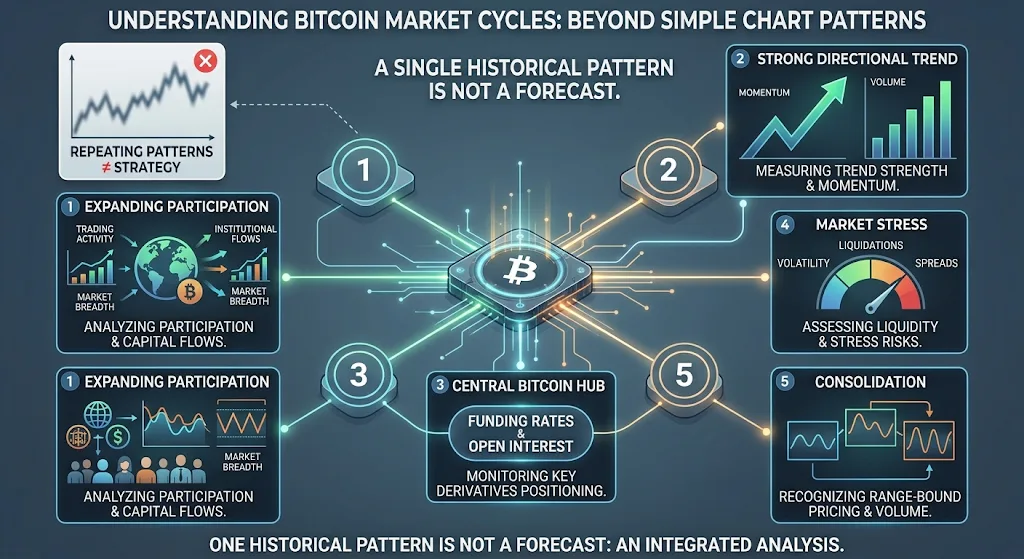
A Bitcoin Strategy Should Define Its Decision Rules Before the Market Moves
The most useful strategy framework is not a prediction about where Bitcoin will trade next. It is a set of conditions that determines whether the existing approach still makes sense.
Objective
Define what the Bitcoin exposure is intended to accomplish within the broader portfolio.
The objective should remain distinguishable from a price target.
Risk Drivers
Identify which market conditions could materially affect the strategy.
For some strategies, volatility is dominant. For others, leverage, liquidity, concentration, or execution may be more important.
Liquidity
Establish how quickly the position might need to be reduced and whether available market liquidity is consistent with that requirement.
Time Horizon
A short-duration strategy and a long-duration allocation should not use identical decision criteria.
Concentration
Measure Bitcoin exposure against the broader portfolio rather than evaluating the position independently.
Scenario Analysis
Test the strategy against several conditions:
- A sharp Bitcoin drawdown
- A prolonged sideways market
- A rapid volatility increase
- A deterioration in market liquidity
- A leverage-driven selloff
- A significant change in regulation or market access
- A substantial increase in portfolio concentration following a price increase
Monitoring Criteria
Define the indicators that warrant review before they become urgent.
These may include volatility, liquidity, derivatives positioning, portfolio concentration, macroeconomic conditions, and material regulatory developments.
Rebalancing Criteria
Rebalancing should be based on predetermined portfolio or strategy conditions rather than an emotional response to a single market move.
The objective is to establish decision discipline before the market creates pressure to act.
Downside Scenarios Are Part of Strategy Design
A Bitcoin strategy should be tested against conditions that are uncomfortable, not only conditions that support the original thesis.
A rapid decline accompanied by leveraged liquidations can behave differently from a gradual decline in an orderly market. A liquidity shock can create different execution problems from a normal correction. A regulatory development can affect market access without necessarily changing Bitcoin’s underlying network characteristics.
The distinction matters because risk does not always arrive in the form of a falling price.
A strategy may face problems through:
- Increased execution costs
- Reduced market depth
- Forced deleveraging
- Margin requirements
- Counterparty stress
- Operational disruption
- Changes in market access
- Greater portfolio concentration
The purpose of downside analysis is to determine whether the strategy remains workable when several of these factors appear together.
Reading Market Signals Without Turning Them Into Forecasts
Bitcoin market data is most useful when individual signals are placed into context.
| Observation | Reasonable interpretation | Avoid assuming |
|---|---|---|
| Bitcoin price rises rapidly | Momentum has strengthened | The trend must continue |
| Open interest rises sharply | Derivatives exposure is increasing | Buyers necessarily dominate |
| Liquidations spike | Leveraged positions are being closed | A market bottom has formed |
| Volatility increases | Price uncertainty has expanded | Exposure must automatically be reduced |
| Institutional activity increases | Market participation is changing | Future performance is assured |
| Liquidity deteriorates | Execution conditions have weakened | The deterioration will persist |
| Regulatory proposal emerges | Future market structure may change | The proposal is already law |
This distinction between market evidence and market prediction is central to disciplined Bitcoin analysis.
Learn More About Bitcoin Investments
Bitcoin’s market reflects a more developed and interconnected financial structure, but greater market infrastructure has not removed volatility, leverage, liquidity risk, or uncertainty.
Understanding the interaction between derivatives, institutional participation, macroeconomic conditions, regulation, liquidity, and market positioning can provide a stronger basis for evaluating Bitcoin investment strategies than relying on historical price patterns alone.
Register now for updated educational research and insights on Bitcoin and digital asset markets.
Disclaimer: The information provided on this page is for educational and informational purposes only and should not be construed as financial advice. Crypto currency assets involve inherent risks, and past performance is not indicative of future results. Always conduct thorough research and consult with a qualified financial advisor before making investment decisions.
“The cryptocurrency and digital asset space is an emerging asset class that has not yet been regulated by the SEC and the US Federal Government. None of the information provided by Kenson LLC should be considered as financial investment advice. Please consult your Registered Financial Advisor for guidance. Kenson LLC does not offer any products regulated by the SEC, including equities, registered securities, ETFs, stocks, bonds, or equivalents.”



