




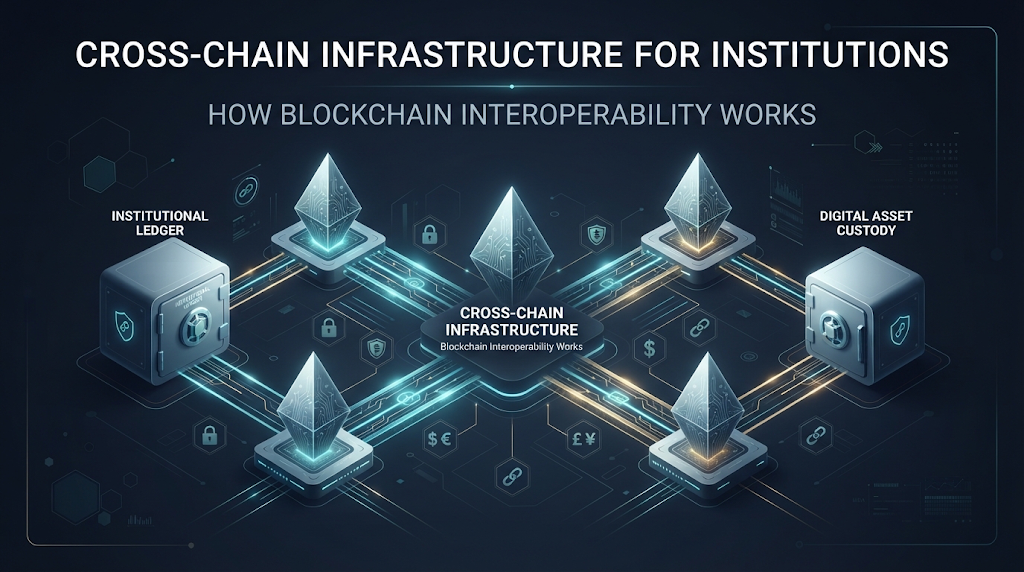
Institutional digital-asset infrastructure is increasingly becoming multi-network. A tokenized security may sit on one distributed ledger, cash or collateral may operate on another, and an institution’s identity, compliance, custody, and reporting systems may remain outside blockchain infrastructure entirely.
The infrastructure challenge is therefore not simply moving a token between two chains. It is coordinating assets, instructions, identity, ownership, settlement status, and compliance conditions across systems that were not necessarily designed to work together.
That is the specific role of blockchain interoperability.
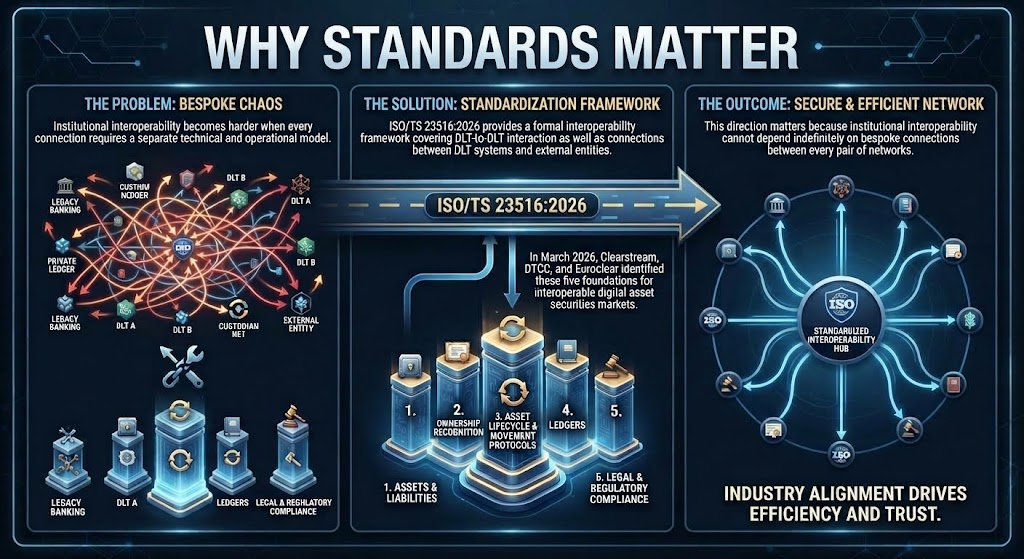
In March 2026, ISO published ISO/TS 23516:2026, establishing a framework for interoperability between DLT systems and between DLT systems and external entities. The standard reflects a shift toward treating interoperability as an infrastructure and standards issue rather than simply a feature of individual blockchain networks.
For institutions, the practical question is more specific: What should connect, how should it connect, where can the architecture fail, and how can an institution determine whether a cross-chain design is appropriate for a particular use case?
What Institutional Interoperability Actually Connects
Cross-chain infrastructure can connect several different types of information and value.
The connection may involve:
- Asset state: Where an asset exists and who owns or controls it
- Transaction instructions: What an institution wants another network to execute
- Identity and permissions: Whether a participant is authorized to transact
- Settlement information: Whether the required conditions for final settlement have been met
- Compliance data: Restrictions or conditions attached to an asset or participant
- Lifecycle events: Issuance, transfer, redemption, corporate actions, collateral movements, or other events
- External data: Information originating outside a blockchain
This distinction is important because cross-chain interoperability is not synonymous with asset bridging.
A bridge may transfer or represent an asset across networks. An institutional interoperability architecture may instead coordinate an instruction on one network with a state change on another, while retaining the information needed to verify what happened.
That difference becomes increasingly relevant as tokenized securities and digital cash move toward production environments.
The Architecture Behind Cross-Chain Connectivity
A typical institutional interoperability architecture can be understood as several connected layers rather than one universal “bridge.”
1. Source Network
The source network contains the original asset, instruction, or transaction state.
This could be a public blockchain, permissioned DLT, tokenization platform, or another digital-asset infrastructure.
2. Interoperability Layer
The interoperability layer receives information from the source environment and communicates it to another network.
Depending on the architecture, this can involve messaging protocols, relayers, validators, or other verification mechanisms.
3. Verification Layer
The receiving environment needs to determine whether the message or state transition can be trusted.
This is one of the most important architectural questions.
If the receiving chain accepts an incorrect message, the problem is no longer simply a communication failure. It can become an ownership, settlement, or financial-integrity problem.
4. Destination Network
The destination network processes the instruction or state change.
The receiving system may need to interpret the incoming information differently from the source network, making data standards and transaction semantics important.
5. Institutional Control Layer
Around these technical components sit the controls that institutions require:
- Identity and authorization
- Policy enforcement
- Transaction monitoring
- Audit records
- Risk controls
- Operational approvals
- Exception handling
- Recovery procedures
The architecture therefore extends beyond blockchain-to-blockchain communication.

Messaging, Asset Movement, and State Synchronization Are Different
One of the most important distinctions when evaluating cross-chain infrastructure is what is actually being transferred.
Asset Movement
The system moves or represents value across networks.
This approach can be useful where an asset genuinely needs to become available on another chain.
Messaging
The system communicates instructions or information without necessarily moving the underlying asset.
For example, one network could communicate that a particular settlement condition has been satisfied while another system performs the corresponding action.
State Synchronization
The systems coordinate their understanding of an event or asset state.
This becomes important when a transaction on one network should trigger a related event elsewhere.
These models can also be combined.
Recommended Read: institutional blockchain interoperability and messaging standards goes deeper into why messaging can be preferable to simple asset-bridge architecture for certain institutional workflows.

Where Cross-Chain Architecture Can Fail
Interoperability creates additional technical dependencies. Connecting two networks does not simply combine their strengths; it can also connect their weaknesses.
Message Verification Failure
If a receiving network accepts an invalid message, the resulting state change may be incorrect.
The relevant control is therefore not simply whether messages are transmitted, but how their authenticity and validity are established.
Validator or Relayer Failure
Some architectures depend on a defined set of validators, relayers, or infrastructure operators.
A failure, compromise, outage, or collusion within that layer can affect the reliability of cross-chain communication.
Smart-Contract Failure
Interoperability systems frequently depend on smart contracts or other programmable components.
A flaw in transaction logic can create risks that do not exist in the underlying blockchain independently.
Finality Mismatch
Different networks can have different concepts and timing of transaction finality.
An interoperability system needs to account for what happens if the source transaction is reversed, reorganized, delayed, or otherwise changes after another network has already acted on it.
Compliance Context Loss
A transaction may be valid on one blockchain while failing an institution’s requirements when transferred into another environment.
Identity, transfer restrictions, permissions, and other conditions therefore need to remain available where they are required.
Operational Failure
A cross-chain system can also fail outside the blockchain itself.
API outages, key-management problems, monitoring failures, incorrect configuration, network congestion, or delayed human approvals can interrupt an otherwise technically sound workflow.
Interoperability Tradeoffs Institutions Need to Measure
There is no universal architecture that maximizes every desirable characteristic.
| Evaluation area | What to measure | Tradeoff |
|---|---|---|
| Security | Verification model, validator independence, audit history | More controls can increase complexity |
| Speed | Confirmation and cross-chain completion time | Faster execution can involve additional infrastructure assumptions |
| Finality | Confidence and timing of irreversible settlement | Networks may use different finality models |
| Availability | Uptime and recovery performance | Redundancy can increase infrastructure cost |
| Liquidity | Number and depth of connected venues | Wider connectivity does not guarantee market depth |
| Compliance | Identity, permission, screening, and audit capabilities | Strong controls can limit permissionless access |
| Cost | Transaction, messaging, validation, and integration costs | Lower transaction cost does not necessarily mean lower total operating cost |
| Governance | Upgrade authority and emergency controls | Centralized controls may improve intervention capability while increasing dependency |
| Interoperability scope | Supported networks and standards | Greater coverage can increase integration complexity |
This creates a more useful institutional evaluation than asking whether a protocol is simply “secure,” “fast,” or “scalable.”
Measurable Criteria for Cross-Chain Infrastructure
An institution evaluating interoperability should turn architectural claims into measurable tests.
Transaction Integrity
Measure the rate of successfully verified cross-chain transactions and investigate rejected, duplicated, delayed, or inconsistent messages.
Settlement Latency
Measure the time between initiation on the source network and confirmed completion on the destination environment.
Failure Recovery
Test how the system behaves when a connected network becomes unavailable, a message fails, or an intermediary component stops responding.
Finality Handling
Determine whether the architecture waits for appropriate source-chain finality before triggering an irreversible downstream action.
Availability
Track infrastructure uptime, message delivery failures, recovery time, and unresolved exceptions.
Reconciliation Accuracy
Compare source and destination records to identify mismatches in balances, ownership, transaction status, or lifecycle events.
Control Coverage
Test whether required identity, permission, compliance, and audit information remains available throughout the transaction.
Integration Burden
Measure the number of bespoke integrations required to connect networks, custodians, compliance systems, reporting platforms, and internal infrastructure.
The important point is that interoperability should be assessed through observable operating characteristics, not only technical specifications.
Use-Case Decision Framework
Different institutional use cases can require very different interoperability designs.
Tokenized Securities
Priority: ownership integrity, lifecycle events, settlement, compliance, auditability.
A securities workflow may require interoperability between an issuance platform, ledger, settlement infrastructure, custody environment, and existing post-trade systems.
The architecture should prioritize consistency of ownership and transaction state over simply maximizing transaction speed.
Cross-Chain Payments
Priority: settlement reliability, message integrity, liquidity, timing, and compliance.
Payment infrastructure may need to connect tokenized deposits, stablecoins, bank systems, and distributed ledgers.
The critical measurement is whether value and payment instructions reach the correct destination under defined settlement conditions.
Collateral Mobility
Priority: availability, asset status, valuation information, transfer restrictions, and rapid movement.
A collateral workflow may require information to move between multiple venues while preserving a reliable view of which assets are encumbered, available, or transferred.
Multi-Network Digital Asset Operations
Priority: monitoring, reconciliation, permissions, and operational resilience.
An institution managing assets across several networks may benefit from interoperability primarily because it reduces disconnected operational processes.
In this case, the architecture should be evaluated on whether it creates a consistent operational view rather than simply whether assets can be transferred.
A Practical Selection Framework
Before selecting a cross-chain architecture, institutions can score the proposed design against five questions:
1. What needs to move?
Asset, message, ownership state, payment instruction, or lifecycle event?
2. What must remain synchronized?
Ownership, balances, compliance status, settlement state, or transaction history?
3. What happens if the connection fails?
Does the transaction pause, reverse, enter an exception queue, or create an inconsistent state?
4. Who controls recovery?
Identify the parties capable of pausing, reversing, upgrading, or restoring the system.
5. What evidence is retained?
A production system should provide enough information to reconstruct the transaction, verify authorization, and reconcile the outcome.
This framework helps prevent a common architectural mistake: selecting interoperability technology before defining the financial process it is expected to support.
Interoperability Is Becoming a Market Infrastructure Question
Recent institutional activity provides a practical indication of where the market is heading.
In July 2026, DTCC announced successful production trades using tokenized representations of DTC-held securities, including activity involving both its private Besu-based environment and the public Canton network.
In September 2026, DTCC, Citi, and Swift also emphasized interoperability as connective infrastructure for tokenized assets, digital cash, and data, describing the emerging environment as a hybrid model in which traditional systems, private networks, and public blockchains can operate together.
These developments reinforce a more specific institutional view of interoperability.
The objective is not necessarily to create one blockchain for all financial activity. It is to allow different systems to perform specialized functions while maintaining reliable connections between them.
Institutions Need Interoperability That Fits Their Operating Model
Counting the number of supported blockchains can make an interoperability solution appear broad without demonstrating that it is appropriate for institutional use.
A stronger evaluation asks whether the infrastructure can:
- Preserve transaction meaning across networks
- Verify messages and state changes
- Maintain ownership integrity
- Handle different finality models
- Carry required compliance information
- Reconcile records across systems
- Recover from failures
- Produce an auditable transaction history
- Scale without creating excessive integration dependencies
That is the difference between technical connectivity and institutional interoperability.
For institutions, the value of cross-chain infrastructure ultimately depends on whether it can connect fragmented environments without introducing unacceptable security, operational, compliance, or settlement risk.
Stay Informed on Digital Asset Developments
Blockchain interoperability is moving from a predominantly technical discussion toward a broader infrastructure question. As tokenized securities, digital cash, collateral, and other blockchain-based financial workflows expand, institutions need connections that preserve transaction integrity across different networks and existing financial systems.
The most useful evaluation therefore starts with the use case, maps the required asset and information flows, identifies failure points, and establishes measurable criteria before selecting an interoperability architecture.
Sign up now and explore the Kenson Investments Knowledge Center for additional research on blockchain infrastructure, tokenization, digital assets, and institutional market developments.
Disclaimer: The information provided on this page is for educational and informational purposes only and should not be construed as financial advice. Crypto currency assets involve inherent risks, and past performance is not indicative of future results. Always conduct thorough research and consult with a qualified financial advisor before making investment decisions.
“The cryptocurrency and digital asset space is an emerging asset class that has not yet been regulated by the SEC and the US Federal Government. None of the information provided by Kenson LLC should be considered as financial investment advice. Please consult your Registered Financial Advisor for guidance. Kenson LLC does not offer any products regulated by the SEC, including equities, registered securities, ETFs, stocks, bonds, or equivalents.”



