


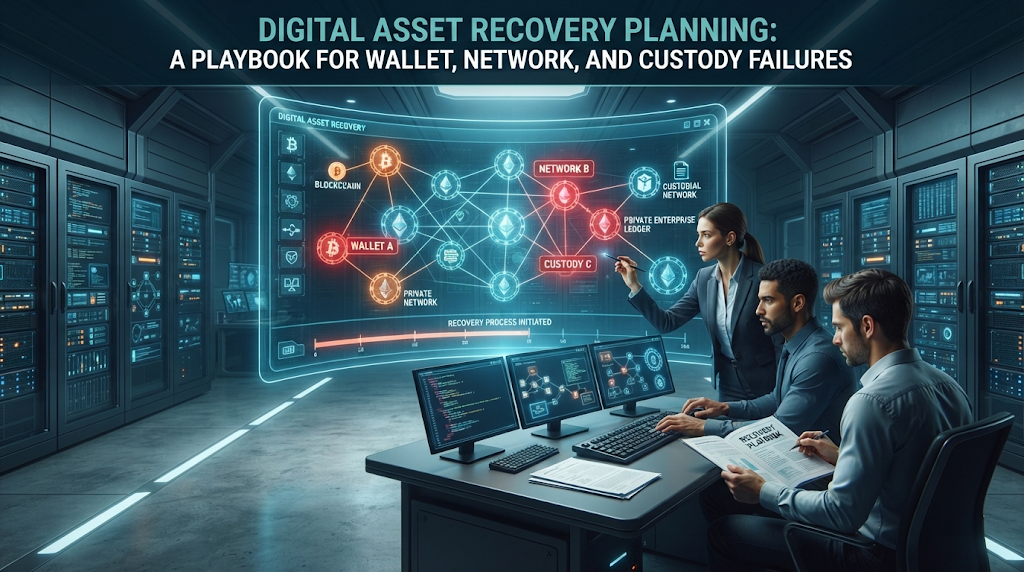
Digital asset operations can fail without the underlying asset itself being lost. A wallet may become inaccessible, a signing credential may be compromised, a blockchain network may become unavailable, a custodian may experience an outage, or internal records may no longer reconcile with on-chain activity.
Each condition requires a different response.
A useful digital asset recovery plan establishes what can fail, identifies the assets and control points at risk, assigns decision authority, defines containment and recovery actions, and establishes evidence and reconciliation requirements. It should also account for dependencies outside the organization, including custodians, sub-custodians, technology providers, authentication systems, blockchain infrastructure, and communication channels.
NIST SP 800-61 Rev. 3 places incident response within broader cybersecurity risk management and organizes response around preparation, detection, response, recovery, and continuous improvement. That structure provides a practical foundation for developing a digital asset recovery playbook.
What Is at Risk During a Digital Asset Failure?
A recovery plan should identify more than the digital assets themselves. Access to those assets depends on a wider control environment.
Potentially affected components include:
- Private keys and signing authority
- Wallet addresses and transaction permissions
- Authentication credentials
- Privileged accounts
- Recovery shares and backup materials
- Custody accounts
- Sub-custody relationships
- Blockchain nodes and network-access infrastructure
- RPC or infrastructure providers
- Transaction approval systems
- Internal books and records
- On-chain transaction history
- Custodian records and statements
- Monitoring and alerting systems
- Emergency communication channels
These components create different failure conditions.
A compromised private key creates a different risk from a custodian outage. A delayed blockchain confirmation differs from an unauthorized transaction. A reconciliation discrepancy does not automatically establish that assets have been lost.
The first recovery decision should therefore be classification, not immediate remediation.
Threat Model: Who or What Can Fail?
The threat model should distinguish between self-custody, institutional control environments, and third-party custody.
Individual and Self-Custody Risks
With self-custody, the holder retains direct responsibility for access and recovery.
Common failure scenarios include:
- Lost private-key material
- Exposed seed phrases
- Compromised devices
- Lost authentication credentials
- Phishing or social engineering
- Incorrect transaction authorization
- Lost recovery material
- Unusable or untested backups
The central risk is loss or compromise of the mechanism that authorizes transactions.
A recovery plan should therefore establish how access can be restored, when a compromised key must be replaced, where recovery material is maintained, and which actions can be taken if the original signing mechanism is no longer trusted.
NIST key-management guidance distinguishes between recovering inaccessible keying material and recovering from suspected compromise. Where compromise is suspected, the response should include replacement rather than simply restoring the potentially compromised key.
Institutional Custody Risks
Institutional environments introduce multiple layers of authorization, personnel, systems, and controls.
Potential failure points include:
- Compromised administrator credentials
- Incorrect transaction approvals
- Broken authorization workflows
- Loss of signing capability
- Key-management failure
- Excessive privileges
- Segregation-of-duties failures
- Internal system outages
- Incomplete transaction records
- Reconciliation failures
The recovery problem is therefore both technical and operational.
The organization needs to know who can:
- Freeze affected activity
- Revoke access
- Authorize emergency transactions
- Replace signing mechanisms
- Approve asset migration
- Contact external providers
- Validate recovery
- Declare normal operations restored
These authorities should be documented before an incident occurs.
Third-Party Custody Risks
Third-party custody introduces dependencies that may remain outside the institution’s direct control.
- Custodian service outages
- Withdrawal restrictions
- Custodian technology failures
- Sub-custodian disruption
- Vendor cybersecurity incidents
- Delayed incident notification
- Loss of access to provider records
- Failure of a critical technology supplier
- Insufficient alternative custody arrangements
The Basel Committee’s 2026 operational-resilience framework specifically addresses governance, business-continuity planning and testing, critical interdependencies, third-party dependency management, incident management, and resilient ICT. It also calls for due diligence and contingency planning when third-party disruption could affect critical operations.

Control Architecture for Digital Asset Recovery
A recovery playbook should connect preventive controls with the actions required when those controls fail.
Identity and Privileged Access
Controls should establish who can access critical systems and what each person or service is authorized to do.
Operational controls can include:
- Multi-factor authentication
- Role-based access
- Privileged-account restrictions
- Separate administrative and transaction permissions
- Access reviews
- Credential rotation
- Immediate revocation procedures
- Emergency-access procedures
- Monitoring of privileged activity
The recovery plan should specify which roles can suspend access and which roles can authorize restoration.
Key Management
Key management should cover the entire lifecycle of signing material, including generation, storage, use, backup, recovery, replacement, and retirement.
Relevant controls can include:
- Segregated signing authority
- Multi-party authorization
- Protected backup material
- Controlled recovery procedures
- Key-compromise procedures
- Documented replacement processes
- Restricted access to recovery material
- Periodic recovery testing
NIST SP 800-57 specifically addresses key recovery and compromise recovery. Its guidance calls for procedures covering recognition and reporting of compromise, replacement of compromised keys, and documentation of recovery actions.
A backup should not be considered an operational recovery control until it has been tested.
Transaction Authorization
Transaction controls should reduce the likelihood and impact of unauthorized or erroneous transfers.
Depending on the operating model, controls can include:
- Transaction limits
- Address allowlisting
- Dual approval
- Multi-party authorization
- High-value transaction delays
- Independent destination verification
- Velocity thresholds
- Anomaly detection
- Emergency transaction suspension
Each control should have an associated response procedure. Knowing that a transaction limit exists is less useful than knowing who can change it, who can suspend transactions, and what evidence is required to restore normal permissions.
Failure Scenarios and Response Procedures
Scenario 1: Wallet or Signing-Key Compromise
A suspected key compromise requires containment before normal operations continue.
- Identify suspicious transactions or access activity.
- Suspend affected signing authority where technically possible.
- Stop nonessential transactions.
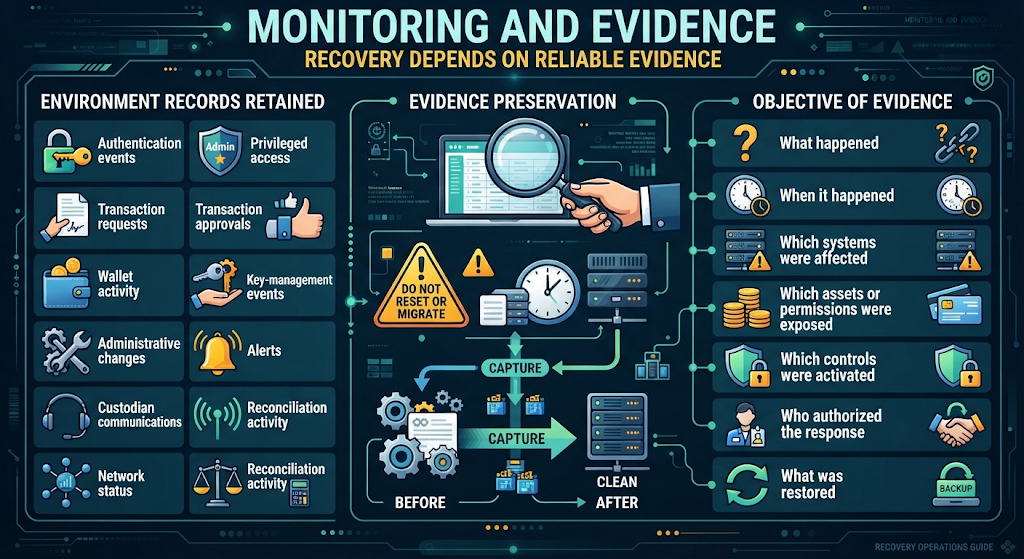
- Preserve transaction and access evidence.
- Identify affected wallets, credentials, permissions, and addresses.
- Activate the designated incident authority.
- Determine whether authorized asset migration is required.
- Revoke or replace compromised credentials and signing mechanisms.
- Reconcile balances and transaction history.
- Validate the replacement control environment.
Recovery should not simply restore a compromised credential. Where compromise is suspected, the organization needs a controlled replacement process. NIST’s key-management guidance specifically distinguishes compromise recovery from ordinary recovery of inaccessible keying material.
Scenario 2: Custodian Outage
A custodian outage requires a different assessment.
The organization should establish:
- Whether assets remain verifiable
- Whether withdrawals are unavailable
- Whether custodian records remain accessible
- Whether the disruption affects selected networks or the entire account
- Whether sub-custodians are involved
- Whether contractual escalation procedures have been activated
- Whether an alternative custody route exists
- Whether independent records can confirm balances
An outage does not automatically justify an immediate asset transfer. The first objective is to establish asset status, provider status, authorization, and available recovery routes.
Scenario 3: Blockchain Network Disruption
A blockchain disruption can create uncertainty even when assets remain intact.
- Confirmation delays
- Network congestion
- Node failure
- RPC-provider outage
- Chain disruption
- Uncertain transaction finality
- Failed or pending transactions
- Inconsistent network data
The response should establish network state before repeating transactions.
If a transaction appears unsuccessful but its final status has not been independently confirmed, repeating the transaction can create an unintended duplicate transfer.
Scenario 4: Internal Authorization Failure
A recovery event may originate inside the organization’s approval architecture.
- Compromised employee credentials
- Unauthorized administrator activity
- Incorrect destination address
- Broken approval workflow
- Excessive permissions
- Conflicting authorization roles
The response should restrict affected access, preserve evidence, review transaction history, verify authorization records, and independently validate restored permissions.
Incident Response and Recovery Steps
A practical digital asset recovery playbook can use nine stages.
1. Detect
Identify the event through monitoring, reconciliation, personnel reports, custodian notifications, or external alerts.
2. Classify
Determine whether the event involves a wallet, key, credential, network, custody provider, transaction process, internal system, or multiple dependencies.
3. Contain
Restrict affected access and pause transactions where continued activity could increase exposure.
4. Preserve
Secure logs, transaction identifiers, approvals, communications, system records, and third-party evidence.
5. Assess
Determine the scope, affected assets, compromised controls, remaining exposure, and operational dependencies.
6. Recover
Restore authorized access, replace compromised controls, migrate assets where appropriate, or activate an alternate operational route.
7. Reconcile
Compare on-chain balances and transaction activity with internal records, custodian statements, and independent evidence.
8. Validate
Confirm that assets, permissions, signing mechanisms, records, monitoring, and controls are operating as intended.
9. Improve
Document the root cause, recovery performance, control weaknesses, evidence gaps, and required remediation.
NIST SP 800-61 Rev. 3 places Detect, Respond, and Recover within the incident-response lifecycle while emphasizing continuous improvement across the broader cybersecurity risk-management process.
Recovery Objectives and Performance Measures
A recovery plan should establish measurable objectives rather than relying on general statements about resilience.
Recovery Time Objective (RTO): Maximum acceptable time to restore a critical operation.
Recovery Point Objective (RPO): Acceptable amount of data or operational information that may need to be reconstructed following an incident.
Time to detect: Duration between the incident and initial identification.
Time to contain: Time required to restrict affected access or activity.
Time to authorize recovery: Time required for designated decision-makers to approve emergency action.
Time to restore signing capability: Time required to establish verified transaction authority.
Time to reconcile: Time required to validate balances and transaction history.
Recovery-test success rate: Percentage of planned recovery procedures successfully completed during exercises.
These measurements can expose operational weaknesses that a generic business-continuity statement would not reveal.
Due-Diligence Checklist
Before relying on a wallet architecture, institutional custody arrangement, or third-party provider, evaluate the recovery environment.
Governance
- Recovery authority is documented
- Emergency decision-makers are identified
- Escalation contacts are current
- Responsibilities are separated appropriately
- Emergency decisions require documented authorization
- Recovery procedures have named owners
Key Management
- Key-generation procedures are documented
- Backup and recovery mechanisms are established
- Recovery material is protected
- Signing authority is appropriately segmented
- Key-compromise procedures are documented
- Replacement procedures are defined
- Recovery procedures have been tested
Transaction Controls
- Transaction limits are defined
- Approval requirements are documented
- High-value transactions receive additional verification
- Destination-address controls are established where appropriate
- Emergency transaction suspension procedures exist
- Transaction monitoring is operational
Custodian and Third-Party Risk
- Critical providers are identified
- Sub-custodian dependencies are documented
- Business-continuity arrangements have been reviewed
- Incident-notification requirements are documented
- Escalation contacts are maintained
- Withdrawal and recovery procedures are understood
- Critical records can be obtained during an outage
- Alternative providers or recovery routes have been assessed
- Concentration and single-provider dependencies are documented
- Exit or transition procedures have been considered
Recovery Testing
- Wallet recovery has been tested
- Key-replacement procedures have been tested
- Custodian outage scenarios have been exercised
- Network disruption scenarios have been exercised
- Emergency contacts have been validated
- Reconciliation has been tested after simulated recovery
- Recovery evidence has been reviewed
- Lessons from exercises have been incorporated into controls
Individual, Institutional, and Third-Party Custody Require Different Recovery Models
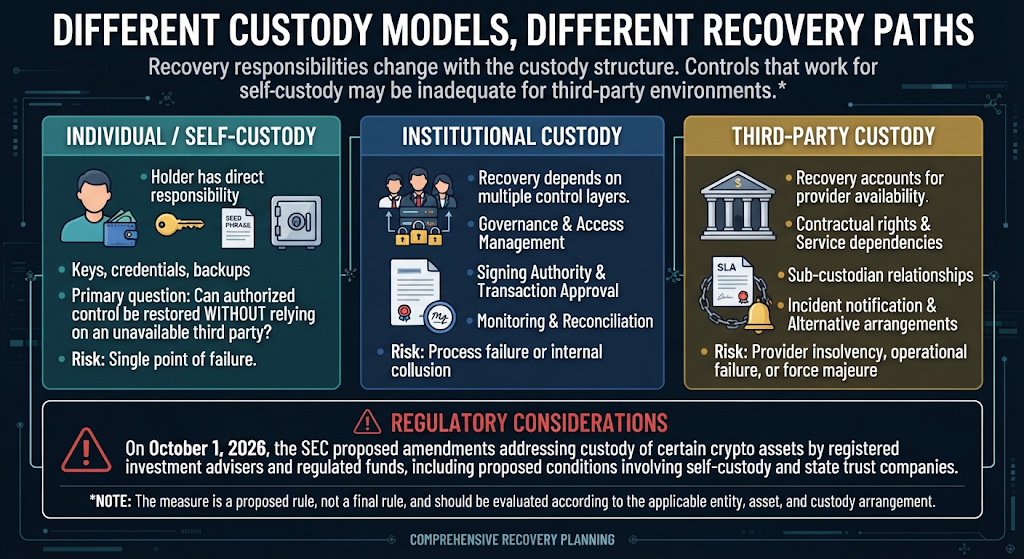
Recovery responsibilities change with the custody structure.
Individual or self-custody: The holder has direct responsibility for keys, credentials, backups, and recovery mechanisms. The primary recovery question is whether authorized control can be restored without relying on an unavailable third party.
Institutional custody: Recovery depends on multiple control layers, including governance, access management, signing authority, transaction approval, monitoring, and reconciliation.
Third-party custody: Recovery must account for provider availability, contractual rights, sub-custodian relationships, service dependencies, incident notification, and alternative arrangements.
The distinction is important because a control that works for self-custody may be inadequate when assets depend on a third-party operational environment.
Regulatory considerations can also differ by entity and arrangement. On October 1, 2026, the SEC proposed amendments addressing custody of certain crypto assets by registered investment advisers and regulated funds, including proposed conditions involving self-custody and state trust companies. The measure is a proposed rule, not a final rule, and should be evaluated according to the applicable entity, asset, and custody arrangement.
Test the Recovery Plan Before a Failure Occurs
A documented procedure is not evidence of recovery capability until it has been tested.
Testing can begin with tabletop exercises and progress toward controlled operational simulations.
- Compromised signing authority
- Lost access to recovery credentials
- Custodian outage
- Blockchain network disruption
- Authentication-system failure
- Unavailable recovery personnel
- Incorrect transaction authorization
- Reconciliation discrepancy
- Technology-provider outage
- Detection time
- Escalation time
- Decision authority
- Controls activated
- Dependencies that became unavailable
- Recovery time
- Reconciliation results
- Evidence gaps
- Control failures
- Required remediation
The Basel Committee’s operational-resilience principles similarly emphasize testing business continuity under severe but plausible scenarios and assessing critical interconnections and third-party dependencies.
Digital Asset Recovery Is an Operational Control
A digital asset recovery plan should connect custody, key management, authorization, network dependencies, third-party providers, monitoring, evidence, and reconciliation into a defined response process.
The objective is not simply to maintain backups or designate an emergency contact. A usable playbook establishes:
- What can fail
- What becomes exposed
- Who has authority to act
- Which controls can contain the event
- How compromised access is replaced
- How assets and records are restored
- How recovery is independently validated
- What evidence confirms that normal operations can resume
NIST’s incident-response and key-management guidance provides a foundation for structuring these controls, while the Basel operational-resilience framework adds useful considerations around critical operations, testing, interdependencies, and third-party continuity.
For institutions operating across multiple wallets, networks, custody providers, and technology dependencies, recovery planning should remain an active operational discipline. Access rights, recovery procedures, provider dependencies, emergency contacts, and technical controls should be reviewed and tested as the operating environment changes.
Continue Your Digital Asset Research
Kenson Investments provides educational market analysis covering digital asset infrastructure, custody, blockchain networks, operational controls, and evolving market developments. Register now for additional resources to build a broader understanding of the systems, risks, and infrastructure shaping digital assets.
Disclaimer: The information provided on this page is for educational and informational purposes only and should not be construed as financial advice. Crypto currency assets involve inherent risks, and past performance is not indicative of future results. Always conduct thorough research and consult with a qualified financial advisor before making investment decisions.
“The cryptocurrency and digital asset space is an emerging asset class that has not yet been regulated by the SEC and the US Federal Government. None of the information provided by Kenson LLC should be considered as financial investment advice. Please consult your Registered Financial Advisor for guidance. Kenson LLC does not offer any products regulated by the SEC, including equities, registered securities, ETFs, stocks, bonds, or equivalents.”