











A stablecoin LP position is a deposit of two or more stablecoins into an automated market maker pool. The depositor receives a token representing a pro-rata share of the pool’s assets plus accrued trading fees. Yield comes from traders swapping between stablecoins; the main risk is one stablecoin losing its peg.
Key takeaways
An LP token is a claim on a changing basket of pool assets, not on a fixed amount of any one stablecoin.
Fee yield depends on trading volume relative to pool size; it is variable and can fall quickly.
If one stablecoin depegs, the pool tends to fill up with the weaker coin, so LPs absorb the loss.
Institutional access typically involves qualified custody, permissioned pools or allowlists, and documented controls.
Stablecoin pools appeal to institutions because they offer on-chain income with limited exposure to volatile crypto prices. But the structure is not a deposit, and the risks are specific: depeg contagion, smart contract failure and custody complexity. This guide explains the legal and economic claim, the mechanics and cash flows, a pool-specific example, and a diligence checklist. For broader DeFi yield concepts, see yield farming strategies.
What the Investor Actually Owns
Depositing into a pool mints LP tokens that entitle the holder to withdraw a proportional share of whatever assets the pool holds at that moment, including fees earned. There is usually no issuer standing behind the LP token; the claim is enforced by smart contract code.
| Element | Stablecoin LP position | Diligence question |
| Claim | Pro-rata share of pool assets plus accrued fees | What can the pool hold after a depeg? |
| Issuer / obligor | None; enforced by smart contract | Who can upgrade or pause the contract? |
| Underlying assets | Two or more stablecoins (each a claim on its issuer) | What backs each stablecoin, and under which regulator? |
| Custody | LP tokens held in the investor’s wallet or with a custodian | Does the custodian support the protocol and LP tokens? |
| Transfer restrictions | Open pools: none. Permissioned pools: allowlisted addresses | Are counterparties KYC-verified? |
| Legal recourse | Generally limited to protocol terms | Which jurisdiction, if any, applies? |
Each underlying stablecoin carries its own issuer and reserve risk. In the US, the GENIUS Act sets reserve and redemption rules for permitted payment stablecoin issuers from January 18, 2027 (Decrypt); see our guide to stablecoins for payments and treasury.
How Yield Is Generated and Serviced
Traders pay a small fee on each swap, and the fee is added to the pool, increasing the value of each LP token. LPs realize the income when they withdraw or claim. Annualized fee yield is roughly fee rate × daily volume ÷ pool size × 365.
Deposit: stablecoins are added to the pool; LP tokens are minted.
Accrual: each swap adds fees to the pool (or to a claimable balance in some designs).
Rebalancing: as traders swap, the pool’s mix of stablecoins shifts toward whichever coin traders are selling.
Optional incentives: some pools add governance-token rewards, which carry token-price risk.
Withdrawal: LP tokens are burned and the holder receives their share of current pool assets.
Pool-Specific Example: A USDC/USDT Stable Pool
Illustrative only. An institution deposits $5 million into a USDC/USDT pool with $200 million in total liquidity, a 0.01% swap fee and average daily volume of $150 million.
| Calculation | Result |
| Daily pool fees: $150M × 0.01% | $15,000 |
| Annualized fee yield: $15,000 × 365 ÷ $200M | ~2.74% |
| Institution’s share: $5M ÷ $200M | 2.5% |
| Institution’s annual fees (if volume holds) | ~$137,000 |
| Less network, custody and monitoring costs | Varies |
Depeg stress case
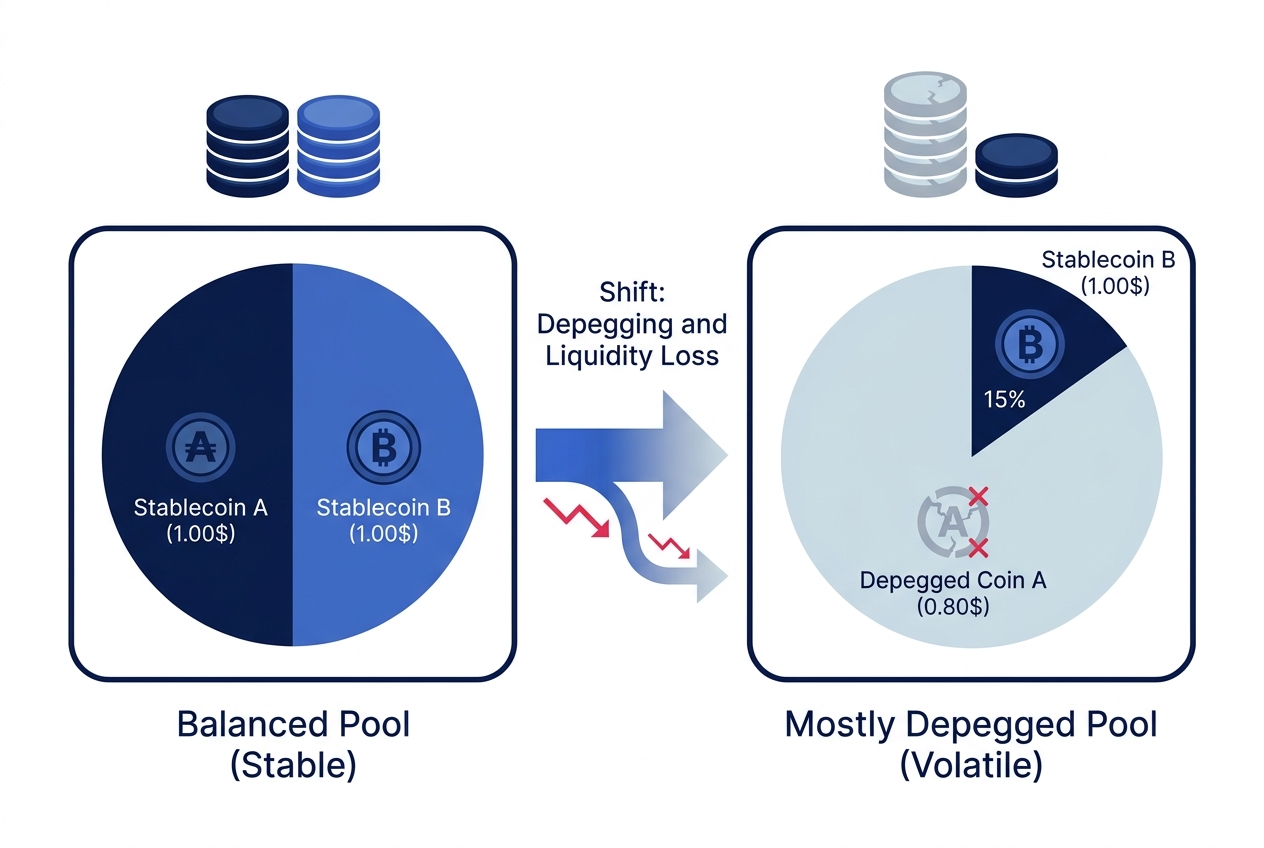
Suppose USDT temporarily trades at $0.95 and the pool rebalances to roughly 90% USDT and 10% USDC as traders sell USDT into it. The position would be worth about 0.90 × $0.95 + 0.10 × $1.00 ≈ $0.955 per dollar deposited, a loss of about 4.5% ($225,000), wiping out more than a year and a half of fee income. If the peg recovers, much of the loss reverses; if not, it is realized.
This is not hypothetical in shape: in March 2023, when USDC briefly traded near $0.88 after its issuer disclosed exposure to a failed bank, major stablecoin pools filled with USDC as holders swapped out of it.
Investors should compare the net yield, after costs and a reasonable allowance for depeg and smart contract risk, with alternatives such as tokenized Treasury funds, which reached about $15.7 billion by September 2026 per rwa.xyz data (Eco).
Free educational tool
Stress-test a stable-yield position
Use the Digital Asset Scenario Tool to model how adverse scenarios could affect a digital asset allocation before committing capital.
Educational tool. Results are not investment advice.
Key Risks
| Risk | How it arises | Mitigation |
| Depeg / counterparty | One stablecoin’s issuer or reserves come into question | Pair only stablecoins meeting reserve and regulatory criteria; set exit triggers |
| Smart contract | Bug or exploit in pool, router or gauge contracts | Mature, audited protocols; exposure caps |
| Liquidity | Large withdrawals receive more of the weaker asset | Size position relative to pool; monitor pool balance |
| Oracle / data | External price feeds used by integrated protocols are manipulated | Avoid strategies stacking LP tokens as collateral |
| Custody and key management | Signing errors, approval risk | Qualified custodian with DeFi support; policy-based approvals |
| Jurisdictional and compliance | Unknown counterparties; sanctions exposure | Permissioned pools; address screening |
| Incentive token | Reward token falls in value | Treat incentives as a bonus, not base yield |
Institutional Diligence Checklist
Which stablecoins are in the pool, and do their issuers meet our reserve and regulatory criteria?
What is the pool’s size, volume history and fee yield over time, excluding incentives?
Which protocol, which audits, what incident history, and who controls upgrades?
Is the pool permissioned, and how are counterparties screened?
Can our custodian hold the LP tokens and sign protocol transactions under our approval policy?
What are the exit triggers (e.g. pool imbalance or a peg deviation threshold)?
How will LP positions be valued, accounted for and reported?
How does the net yield compare with tokenized Treasury alternatives?
Frequently Asked Questions
Is a stablecoin LP position risk-free?
No. It avoids most crypto price volatility but carries depeg, smart contract, custody and liquidity risks.
Do stablecoin pools suffer impermanent loss?
Normally very little, because the assets trade near the same price. Impermanent loss becomes significant if one coin depegs.
What are permissioned pools?
Pools restricted to verified, allowlisted participants, designed to meet compliance requirements for regulated institutions.
Work With Kenson Investments
Kenson Investments’ digital asset specialists focus on education around institutional DeFi structures. Explore our DeFi consultation services or contact the team to learn more.
Disclaimer: The information provided on this page is for educational and informational purposes only and should not be construed as financial advice. Digital assets involve significant risk, including the possible loss of principal, and past performance is not indicative of future results. Always conduct thorough research and consult a qualified financial advisor before making investment decisions.
Digital asset regulation in the United States is still developing. Some areas, such as payment stablecoins, now have a federal framework, but comprehensive market-structure legislation has not yet been enacted. None of the information provided by Kenson LLC should be considered financial investment advice. Please consult your Registered Financial Advisor for guidance. Kenson LLC does not offer any products regulated by the SEC, including equities, registered securities, ETFs, stocks, bonds, or equivalents.



