








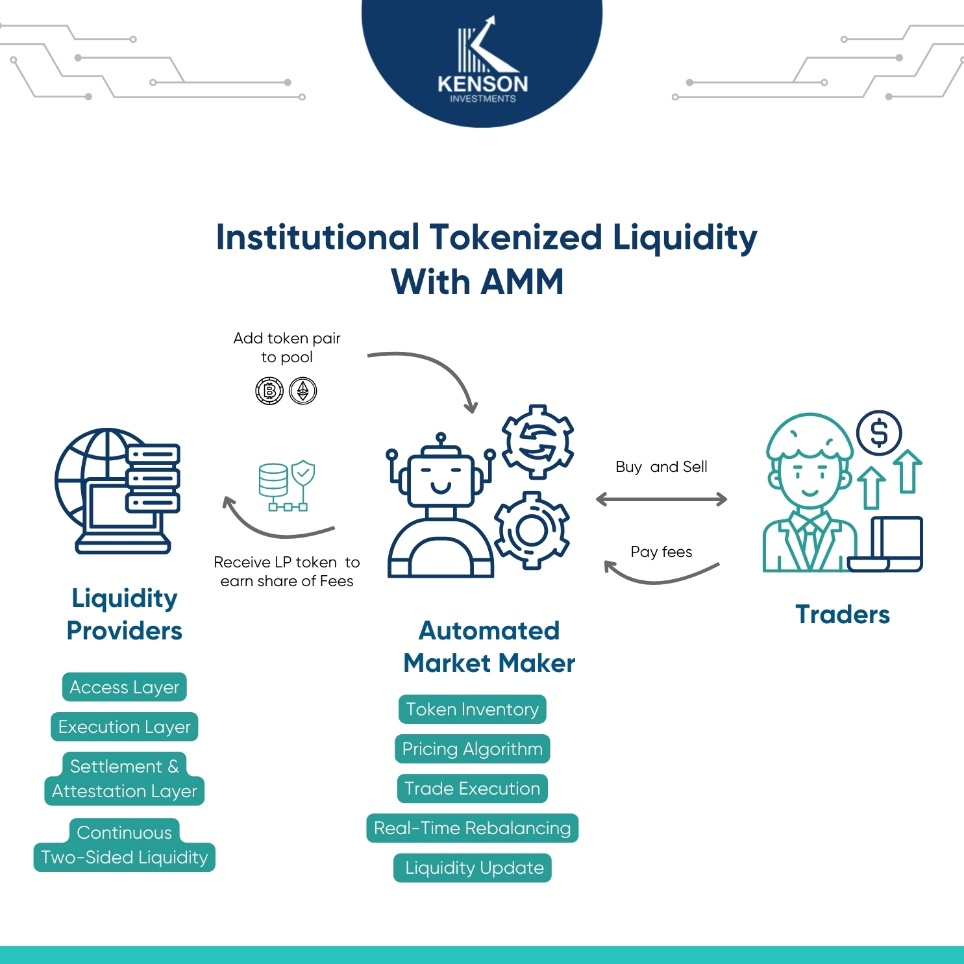
Institutional market makers are evolving to meet the operational demands of tokenized financial markets. Providing two-sided liquidity for tokenized funds, treasuries, corporate credit, and commodities requires more than quoting prices—it demands integrated infrastructure that handles settlement, compliance, and collateral verification seamlessly.
Institutional tokenized liquidity is emerging as a critical layer, allowing market makers to maintain efficiency, transparency, and operational control while navigating the complexities of onchain assets.
Tokenized Markets Require Two-Sided Liquidity
Tokenized instruments, whether representing fund shares, government securities, or corporate credit, introduce operational complexities beyond conventional trading. Each tokenized asset carries metadata defining eligibility, ownership, and compliance constraints, which market makers must respect when quoting prices or executing trades.
Two-sided liquidity in this context is not simply about providing bid and ask quotes—it also entails:
- Ensuring instant settlement readiness, so counterparties can move tokens without delay.
- Maintaining collateral and margin integrity, embedding attestation and eligibility verification into quote flows.
- Synchronizing liquidity provision across multiple venues, networks, and token standards.
These requirements make liquidity provision more operationally intensive, but tokenization introduces efficiencies through programmable assets, onchain settlement verification, and integrated compliance controls.
Operational Design for Institutional Tokenized Liquidity
Providing liquidity in tokenized markets requires a layered operational architecture designed for speed, transparency, and risk management.
Access Layer
This layer ensures that only authorized trading entities interact with tokenized instruments. Institutional ID systems, policy-enforced wallets, and permissioned access controls define the boundaries of eligible participants. Liquidity providers leverage this layer to validate counterparties, enforce regulatory constraints, and integrate with internal risk management systems.
Execution Layer
The execution layer abstracts token-specific protocols into unified quote and trade formats. Routing engines evaluate liquidity across multiple networks, taking into account token-specific settlement constraints, credit limits, and eligibility rules. Automated engines calculate pricing, monitor inventory, and adjust quotes dynamically based on token demand, network congestion, and risk thresholds.
Settlement and Attestation Layer
Settlement synchronization is critical. Once a trade is executed, the system must confirm that tokens have moved as intended, margin requirements are satisfied, and ownership metadata remains consistent.
Attestation mechanisms verify that collateral backing tokenized instruments meets contractual and regulatory requirements. Multi-party computation and cryptographic proofs maintain trust while reducing operational complexity.

Tokenized Asset Classes and Market Making Strategies
Institutional market makers are extending two-sided liquidity to multiple tokenized asset classes:
Tokenized Funds
Market makers provide continuous bids and offers for tokenized fund shares, enabling real-time portfolio rebalancing for asset managers and liquidity for investors. Automated engines can adjust pricing based on net asset values, subscription/redemption flows, and aggregate fund exposure.
Treasuries
Tokenized sovereign bonds demand ultra-low latency quoting. Market makers leverage aggregated order books, onchain settlement rails, and deterministic settlement finality to provide liquidity without disrupting portfolio hedging strategies. Haircut transparency and instant attestations reduce disputes over collateralized positions.
Corporate Credit
Tokenized corporate debt instruments require credit eligibility checks, dynamic risk-adjusted pricing, and programmable settlement schedules. Liquidity providers embed credit rules and margin models directly into tokenized collateral structures, reducing the need for manual reconciliation.
Commodities
Tokenized commodity contracts introduce supply chain metadata and regulatory reporting tags. Market makers must manage inventory, settlement logistics, and cross-chain token standards while ensuring continuous two-sided liquidity.
Automation and Risk Management in Tokenized Liquidity
Institutional tokenized liquidity relies on advanced automation to manage operational, market, and credit risks.
Automated Market Making Engines
Liquidity providers deploy algorithms that continuously quote bid-ask spreads, adjust for market depth, and monitor inventory positions. These engines factor in network latency, token settlement finality, and embedded collateral constraints to ensure execution integrity.
Risk-Adjusted Quoting
Dynamic pricing algorithms adjust spreads based on credit exposure, concentration limits, and volatility of the underlying tokenized instruments. This prevents excessive inventory risk and maintains operational solvency.
Real-Time Reconciliation
Onchain data allows immediate verification of executed trades, token movements, and collateral eligibility. Reconciliation cycles are reduced from end-of-day batch processes to real-time ledger alignment. Automated alerts flag discrepancies before they impact liquidity operations.
Interoperability Across Token Standards
Liquidity provision is complicated by fragmented token standards and multiple ledger networks. Institutional market makers address this through chain abstraction layers, which:
- Standardize trade instructions across different blockchains.
- Manage cross-chain settlement risks.
- Consolidate reporting and analytics into a single operational dashboard.
This interoperability ensures that liquidity remains fungible and accessible, even across disparate tokenized instruments or networks.
Operational Benefits for Institutions
Tokenized market making brings measurable operational improvements:
- Shorter quote-to-settlement cycles, reducing counterparty exposure windows.
- Lower reconciliation overheaddue to harmonized, onchain evidence.
- Transparent pricing rules, enforced through programmable logic attached to tokens.
- Integrated collateral checks, preventing failed settlements caused by eligibility mismatches.
- Immutable trade recordsthat simplify audits and regulatory reporting.
These benefits improve the reliability of two-sided markets without implying performance guarantees or investment advice.
Integration With Institutional Workflows
Market makers do not operate in isolation. Tokenized liquidity must interface with internal order management systems (OMS), execution management systems (EMS), risk engines, and fund administration platforms.
Key integration points include:
- API-driven trade instructions and confirmations.
- FIX-compatible messaging for compatibility with legacy trading systems.
- Real-time dashboards for inventory, collateral, and margin tracking.
- Automated reporting to auditors and internal compliance teams.
By connecting tokenized liquidity rails to existing infrastructure, institutions retain operational control while benefiting from digital asset efficiencies.
Evaluate and Operationalize Tokenized Liquidity Infrastructure with Kenson Investments
Institutional tokenized liquidity requires precise operational design, not generic solutions. Kenson Investments, your strategic digital asset consulting partner, is here to help institutions assess tokenized liquidity infrastructure, align execution workflows with internal risk controls, and integrate liquidity rails with trading and administration systems.
Get in touch with our digital asset consultants for all the insights you need to evaluate tokenized liquidity infrastructure and operationalize it within your trading operations.
Disclaimer: The information provided on this page is for educational and informational purposes only and should not be construed as financial advice. Crypto currency assets involve inherent risks, and past performance is not indicative of future results. Always conduct thorough research and consult with a qualified financial advisor before making investment decisions.
“The crypto currency and digital asset space is an emerging asset class that has not yet been regulated by the SEC and the US Federal Government. None of the information provided by Kenson LLC should be considered as financial investment advice. Please consult your Registered Financial Advisor for guidance. Kenson LLC does not offer any products regulated by the SEC, including equities, registered securities, ETFs, stocks, bonds, or equivalents.”