








Counterparty risk has always been a cornerstone of institutional market structure. From bilateral trading agreements to centrally cleared derivatives, decades of infrastructure have been built to manage the possibility that one party fails to perform. Tokenized markets are now testing those assumptions, not by eliminating counterparty risk, but by changing where it appears, how quickly it materializes, and how it must be managed.

As tokenized instruments and onchain settlement expand in 2025, institutions are discovering that traditional counterparty frameworks do not map cleanly onto smart contract–driven markets.
How Counterparty Risk Works in Traditional Markets
In conventional finance, counterparty risk is largely temporal. Trades execute, then settle later. The time between execution and settlement creates exposure. Clearing houses, margin requirements, and netting arrangements exist to manage that gap.
Central counterparties reduce bilateral exposure by mutualizing risk, while margin buffers absorb losses if one participant defaults. Identity is explicit. Legal agreements define obligations. Dispute resolution follows established paths.
This architecture works because time exists between promise and performance.
Atomic Settlement Collapses Time but Not Risk
Tokenized markets compress that timeline. With atomic settlement, delivery and payment occur simultaneously or not at all. On paper, that should reduce counterparty exposure. In practice, it shifts risk rather than removing it.
Atomic settlement minimizes settlement risk, but it introduces new dependencies. Smart contracts must execute correctly. Oracles must deliver accurate data. Custody and wallet controls must function without interruption. If any component fails, the trade does not partially settle. It fails outright.
This is the core of digital asset settlement risk. Exposure is no longer about days of credit risk. It is about seconds of operational and technical risk, often without the safety net of a central counterparty.
Pseudonymity Complicates Exposure Assessment
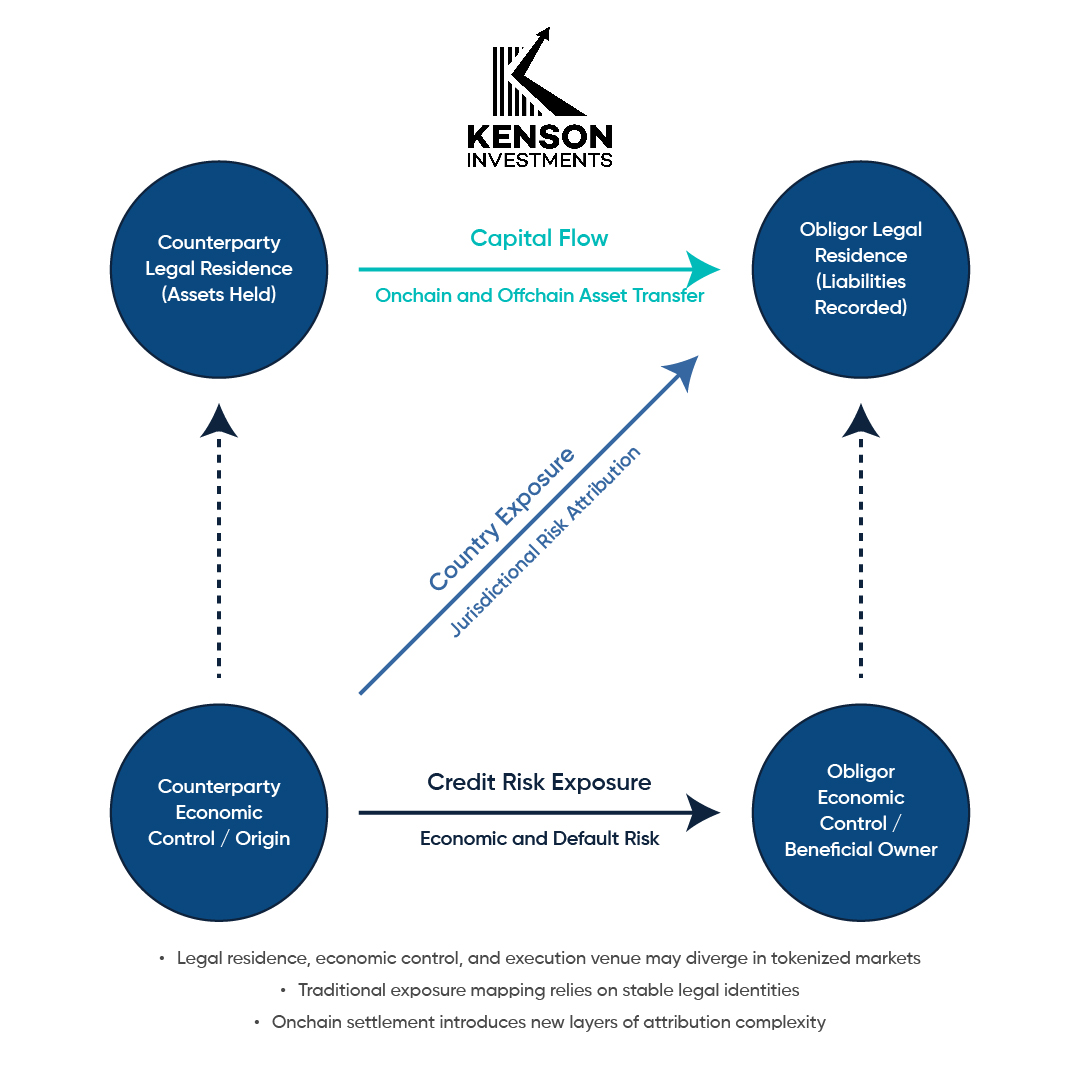
Another structural change is identity. Onchain execution is often pseudonymous. Wallet addresses do not map cleanly to legal entities unless additional controls are layered on top.
For institutions, this complicates due diligence. Traditional credit assessment relies on knowing who the counterparty is, where assets sit, and which legal remedies apply. In tokenized markets, counterparties may be represented by smart contracts or intermediated wallets rather than named entities.
This is why tokenized counterparty risk increasingly blends credit, operational, and legal dimensions. Institutions are responding by embedding identity frameworks, permissioning layers, and pre-trade checks into onchain workflows.
Smart Contracts Move Risk Into Code
In traditional markets, risk resides in agreements and processes. In tokenized markets, much of it resides in code. Smart contracts enforce margin rules, liquidation logic, and settlement conditions automatically.
That automation reduces discretion, but it raises stakes. A flawed contract does not misinterpret terms. It executes exactly as written. The industry has learned this lesson repeatedly through high-profile exploits and protocol failures.
As a result, security in digital asset management has become inseparable from counterparty risk management. Institutions increasingly treat smart contract audits, upgrade controls, and kill-switch mechanisms as credit risk mitigants, not just technical hygiene.
Cleared Markets Versus Composable Markets
Cleared markets concentrate risk in known institutions. Tokenized markets distribute risk across interconnected protocols. Composability allows assets and contracts to interact across platforms, but it also creates exposure chains that are harder to model.
A counterparty’s risk profile may depend on upstream protocols, liquidity pools, or governance decisions outside any single institution’s control. During stress, these dependencies can unwind quickly.
This is why risk management in crypto investments looks different from traditional derivatives risk. Stress testing now includes protocol dependencies and liquidity fragmentation, not just price moves.
How Institutions Are Adapting
Institutions are not abandoning risk discipline. They are retooling it.
Many now separate execution risk from credit risk explicitly. Atomic settlement reduces one, but heightens the other. Permissioned environments, pre-funded models, and collateralized smart contracts are being used to limit exposure.
Demand for blockchain and digital asset consulting has grown accordingly. Institutions want help translating established counterparty frameworks into onchain equivalents. This includes custody design, governance structures, and fallback procedures when automation fails.
Firms engaging digital asset consulting services for businesses are focusing less on token issuance and more on risk topology, mapping how exposure propagates through onchain systems.
What This Means for Investors and Market Structure
For investors evaluating infrastructure rather than individual assets, counterparty design matters. Platforms that surface risk clearly, limit hidden dependencies, and align onchain execution with legal frameworks are better positioned to scale.
This is not about avoiding risk. It is about understanding where it lives. In tokenized markets, risk is faster, more binary, and more technical. Institutions that treat it as such are building more resilient operating models.
Looking Forward
As tokenized securities, collateral, and funds move closer to mainstream adoption, counterparty risk will continue to evolve. Expect clearer standards around identity, settlement finality, and protocol governance. Expect also a continued blurring of the line between technology risk and financial risk.
Tokenization does not eliminate counterparty exposure. It forces a more precise conversation about it.
Navigating Risk In Tokenized Markets
Kenson Investments provides research and analysis on how institutional risk frameworks are adapting to tokenized market infrastructure. Our work focuses on clarity, operating resilience, and understanding how new settlement models reshape exposure in practice.Reach out to us.