







The digital economy has reshaped how institutions manage intellectual property (IP), legal compliance, and sensitive records. Yet, with these advancements comes a heightened risk: tampering, disputes over ownership, and questions about authenticity.
Institutions, from multinational corporations to universities and law firms, face growing challenges in protecting their intellectual property and meeting increasingly stringent regulatory standards.
Bitcoin’s immutable ledger has emerged as a groundbreaking solution. Beyond its role as a decentralized currency, Bitcoin’s blockchain provides institutions with the ability to timestamp sensitive documents, records, and intellectual property assets. By anchoring data into Bitcoin’s distributed ledger, organizations gain a verifiable, tamper-resistant proof of existence that can be used for compliance, litigation, and global IP protection.
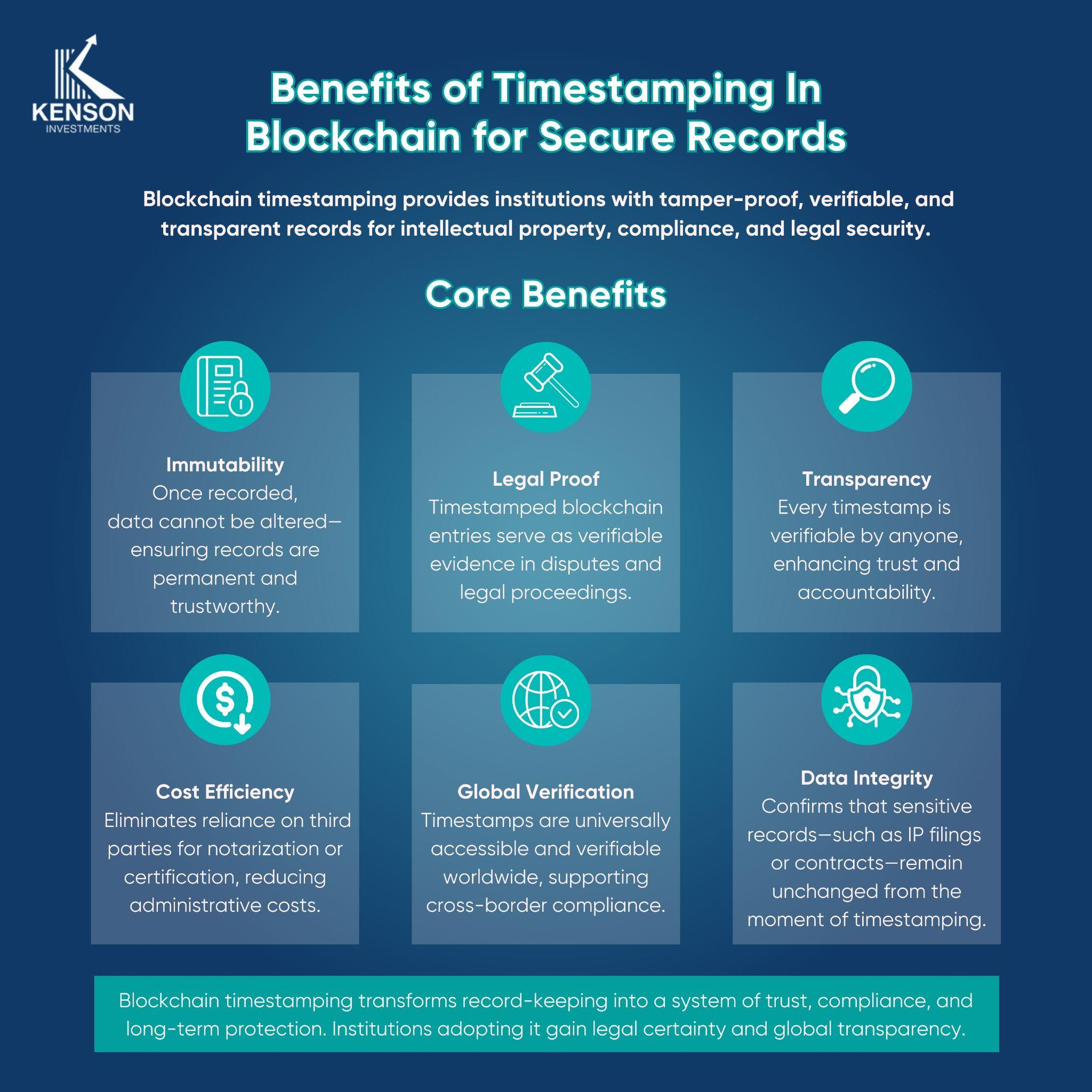
Bitcoin Timestamping in Institutional Settings
Timestamping itself is not new. Legal and business sectors have long relied on notaries, registries, and centralized digital signatures to prove when a document or record came into existence. The weakness of these systems lies in centralization—records can be manipulated, lost, or challenged in court.
Bitcoin changes this dynamic. Each transaction is immutably recorded on a global network of nodes, providing a decentralized time-stamped proof of existence. When institutions anchor a document’s digital fingerprint (hash) onto the Bitcoin blockchain, they create an independently verifiable and permanent record that cannot be altered retroactively.
For institutions navigating intellectual property disputes or regulatory audits, this innovation provides a level of integrity and neutrality unmatched by traditional systems.
Protecting Intellectual Property with Bitcoin Timestamping
Intellectual property disputes cost companies billions annually. In the U.S. alone, trade secret theft is estimated to cost businesses over $225 billion every year, according to the Commission on the Theft of American Intellectual Property. Institutions in sectors like pharmaceuticals, technology, and publishing must establish indisputable evidence of ownership to defend their assets.
Bitcoin timestamping provides a solution:
- Proof of Creation– Researchers, inventors, and artists can timestamp their work the moment it is created, ensuring a verifiable record predating competitors or imitators.
- Global Recognition– Because Bitcoin is borderless, timestamping on its blockchain creates a globally accessible record, reducing jurisdictional challenges in IP disputes.
- Immutable Evidence– Unlike a central database that can be hacked or altered, Bitcoin’s distributed ledger ensures timestamped IP cannot be retroactively tampered with.
Institutions now use Bitcoin timestamping as a defensive mechanism in litigation, giving them stronger evidence in patent disputes, copyright claims, and licensing negotiations.
Compliance in the Age of Digital Regulation
Beyond intellectual property, institutions face increasingly strict compliance requirements. Regulators in finance, healthcare, and research demand clear audit trails and secure recordkeeping. Failure to comply can result in fines, reputational damage, or even criminal liability.
Bitcoin timestamping strengthens compliance in three ways:
- Auditability– Timestamped records provide regulators with clear, immutable evidence of when documents were created, signed, or filed.
- Data Integrity– Sensitive compliance data, from transaction records to clinical trial results, can be anchored on the blockchain to prevent tampering.
- Cross-Border Verification– Multinational corporations benefit from a globally recognized proof of compliance that transcends legal jurisdictions.
This is particularly valuable in industries like pharmaceuticals, where clinical trial data integrity is under increasing scrutiny, or financial services, where anti-money laundering (AML) reporting must withstand regulatory audits.

Legal Use Cases: Bitcoin Timestamping as Evidence
Courts around the world are beginning to recognize blockchain records as admissible evidence. In 2019, China’s Supreme People’s Court confirmed that blockchain timestamps can be used in litigation. Similar rulings have been echoed in the U.S. and Europe, where blockchain is increasingly cited in IP and compliance disputes.
For institutions, Bitcoin timestamping offers:
- Admissible Proof– Timestamped records provide legal teams with strong, verifiable evidence that can support court cases.
- Neutrality– Because no single entity controls Bitcoin, timestamped evidence carries greater legitimacy than records from a private registry.
- Longevity– Bitcoin’s blockchain has operated continuously since 2009, giving institutions confidence in its durability as a long-term evidence system.
Legal scholars suggest that as more courts validate blockchain records, Bitcoin timestamping could evolve into a standard evidentiary tool in IP and compliance law.
Institutional Adoption and Emerging Solutions
Institutions are not building timestamping tools from scratch. Specialized platforms have emerged that simplify the process of anchoring documents to Bitcoin. These services allow organizations to:
- Upload or hash documents privately.
- Anchor those hashes into Bitcoin transactions.
- Generate verifiable proof certificates for compliance or litigation purposes.
Industries at the forefront of adoption include:
- Pharmaceuticals and Life Sciences– Timestamping lab results and trial data for compliance.
- Financial Institutions– Securing regulatory filings and transaction records.
- Universities and Research Bodies– Protecting research outputs and intellectual property.
- Publishing and Media– Verifying authorship and preventing content plagiarism.
The common thread across these sectors is the demand for trustworthy, tamper-resistant evidence that holds up under legal and regulatory scrutiny.
Challenges and Considerations
While Bitcoin timestamping offers transformative potential, institutions face several challenges:
- Scalability– Bitcoin transactions have limited throughput, making high-volume timestamping costly.
- Privacy Concerns– Institutions must ensure only hashes, not full documents, are recorded on the blockchain to maintain confidentiality.
- Integration– Legacy compliance systems often require significant adaptation to incorporate blockchain proofs.
Despite these hurdles, solutions are emerging. Layer-two protocols and sidechains enable more efficient timestamping, while specialized service providers bridge the gap between institutional workflows and blockchain networks.

The Road Ahead for Institutional IP and Compliance
As global economies digitize, institutions cannot afford to rely solely on traditional compliance and intellectual property safeguards. Bitcoin’s immutable ledger provides a universal, transparent, and secure method of timestamping records—one that is increasingly recognized by regulators, courts, and industry leaders.
Much like digital signatures and encryption became standard for secure communication, Bitcoin timestamping is poised to become a cornerstone of institutional compliance and intellectual property protection. Forward-looking organizations are already integrating it into their legal strategies, compliance frameworks, and innovation roadmaps.
Future-Proof Compliance with Kenson Investments
Institutions that act early gain a strategic advantage. At Kenson Investments, we guide organizations through the complexities of blockchain adoption, helping them integrate Bitcoin timestamping into compliance, intellectual property, and operational frameworks. Our comprehensive digital asset consulting services are designed for institutions that demand security, compliance, and innovation at scale.
Our digital asset management consultants are available to discuss how timestamping and related innovations are shaping the future of digital asset management. Contact Kenson Investments to learn more about how blockchain can align with your institution’s long-term approach.
Disclaimer: The information provided on this page is for educational and informational purposes only and should not be construed as financial advice. Crypto currency assets involve inherent risks, and past performance is not indicative of future results. Always conduct thorough research and consult with a qualified financial advisor before making investment decisions.
“The crypto currency and digital asset space is an emerging asset class that has not yet been regulated by the SEC and US Federal Government. None of the information provided by Kenson LLC should be considered as financial investment advice. Please consult your Registered Financial Advisor for guidance. Kenson LLC does not offer any products regulated by the SEC including, equities, registered securities, ETFs, stocks, bonds, or equivalents”