









When natural disasters strike, they leave behind more than just physical devastation. Lives are disrupted, supply chains collapse, and communication channels often go dark just when they are needed most.
According to the United Nations Office for Disaster Risk Reduction, climate-related disasters have surged by 83% over the last two decades, and the cost of disaster recovery now exceeds $313 billion annually worldwide. These numbers highlight a critical need: resilient infrastructure that can withstand crises and adapt rapidly when traditional systems fail.
This is where Decentralized Physical Infrastructure Networks (DePIN) are emerging as a powerful solution. By leveraging blockchain, token incentives, and community participation, DePIN projects are creating resilient, crowd-sourced networks for communication, energy, and logistics — essential lifelines during disaster response. For insurance providers, aid agencies, and governments, DePIN could mark a fundamental shift in how crises are managed.
What Is DePIN and Why Does It Matter in Crises?
DePIN refers to decentralized systems that rely on distributed participants to build and maintain real-world infrastructure. Instead of centralized ownership, individuals and organizations contribute hardware, bandwidth, or other resources and are rewarded through blockchain-based incentives. Examples include community-operated telecom networks, distributed energy grids, and shared logistics platforms.
In disaster-hit regions where centralized networks are vulnerable, DePIN offers:
- Redundancy:Infrastructure is not dependent on one central authority or system.
- Speed:Networks can be activated quickly using existing distributed resources.
- Transparency:Blockchain ensures accountability in resource allocation and usage.
These qualities make DePIN uniquely suited to environments where traditional communication towers, energy grids, or transport systems may be destroyed or inaccessible.
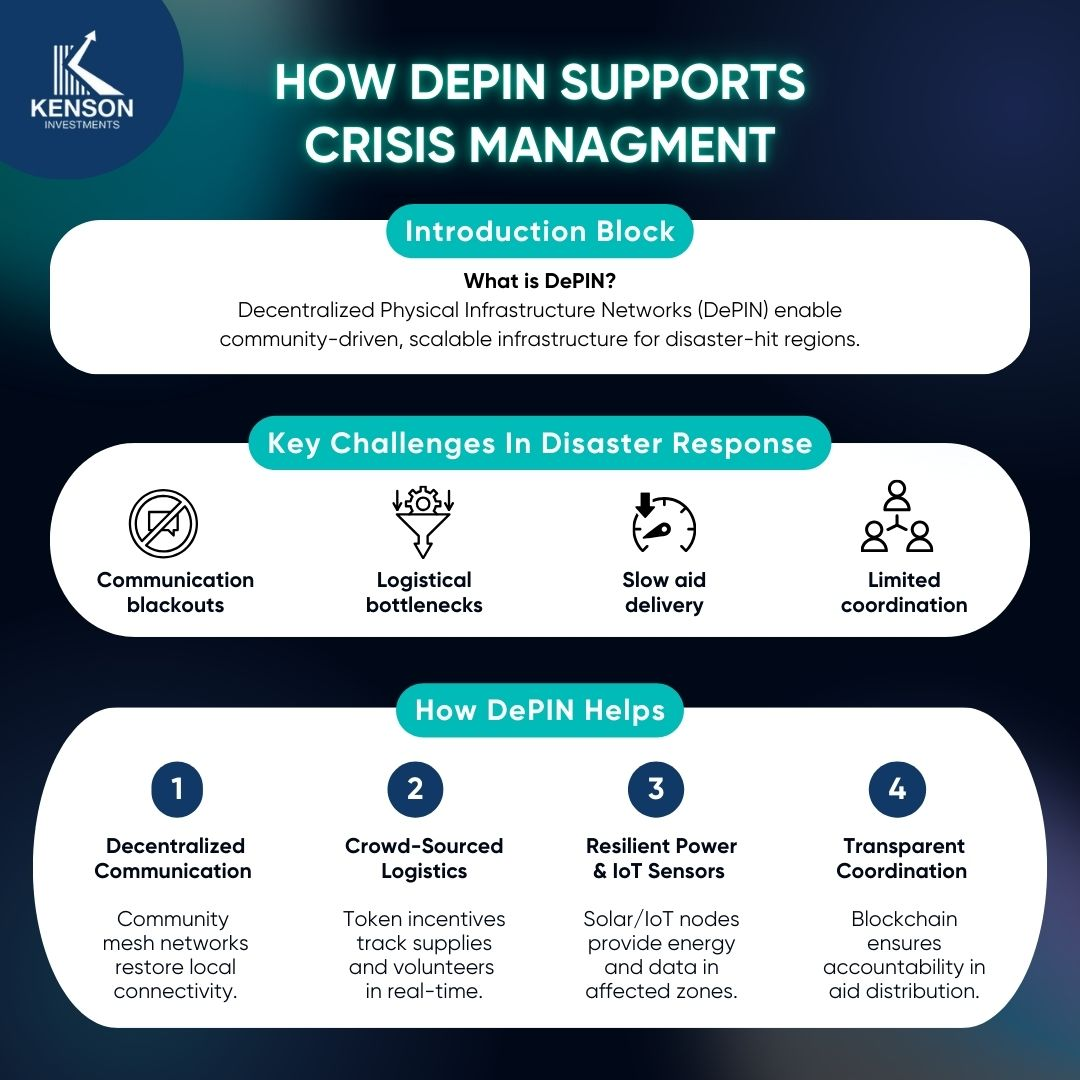
DePIN in Action: Communications in Disaster Zones
When a hurricane, earthquake, or flood strikes, communication is often the first casualty. Mobile networks and internet connectivity are disrupted, leaving residents and responders cut off. DePIN-backed projects like Helium Network have already demonstrated how community-powered telecom infrastructure can create resilient alternatives.
In disaster scenarios, individuals with decentralized nodes or hotspots can keep local communications alive, even when traditional towers are down. Unlike traditional networks that rely on a few centralized assets, decentralized networks thrive on scale and distribution.
This allows first responders and civilians to:
- Send emergency alerts.
- Share real-time updates on hazards.
- Coordinate rescue efforts in remote or inaccessible areas.
For insurance companies and aid agencies, the ability to access real-time, verifiable data on affected populations and damage can significantly speed up claims processing and resource distribution.
Logistics and Supply Chains: DePIN’s Role in Aid Delivery
Beyond communications, logistics is another critical bottleneck in disaster management. Roads are blocked, supply routes are disrupted, and resource allocation becomes chaotic.
Decentralized logistics platforms, powered by DePIN, can help create dynamic, community-led networks to move goods where they are needed most.
By tokenizing participation, individuals with vehicles, drones, or storage space can contribute to relief efforts in exchange for rewards. Smart contracts can verify deliveries and ensure aid packages reach their intended recipients without corruption or mismanagement.
For example:
- Local drivers in disaster zones could use decentralized apps to transport food and medical supplies.
- Drone operators could map inaccessible regions, sharing data across the network.
- Storage hubs contributed by the community could serve as temporary distribution points.
Such crowd-sourced logistics infrastructure allows aid agencies to bypass broken systems and respond with greater agility.
DePIN and Insurance: Bridging Data Gaps
Insurance agencies often struggle with delayed assessments and incomplete data following disasters. Traditional methods rely heavily on physical inspections and centralized reporting, both of which can be slow and unreliable. DePIN can introduce a new layer of crowd-sourced verification and real-time data capture.
- IoT sensorson decentralized energy grids can monitor flood levels or power outages.
- Decentralized mapping toolscan track damage across affected areas.
- Blockchain recordsprovide verifiable data trails for faster claims processing.
This reduces fraud, accelerates payouts, and builds trust between insurers and policyholders. In addition, insurers can use the data generated by DePIN networks to refine risk models and offer more accurate coverage in disaster-prone regions.

Challenges Facing DePIN in Disaster Response
Despite its promise, integrating DePIN into disaster management is not without hurdles.
- Regulatory Compliance:Many DePIN projects operate outside traditional telecom or logistics frameworks, creating legal uncertainties. Disaster zones often involve cross-border coordination, complicating matters further.
- Liquidity and Incentives:To function at scale, DePIN relies on token economies. In times of crisis, ensuring liquidity and incentivizing participation without exploitation remains a challenge.
- Interoperability:DePIN systems must work seamlessly with centralized infrastructure and official emergency protocols to be effective.
- Scalability:While pilot projects have shown promise, achieving global scalability requires significant investment, awareness, and cooperation between public and private stakeholders.
Opportunities for Aid Agencies and Insurers
Despite these challenges, the opportunities are compelling:
- For Aid Agencies:DePIN offers a scalable way to harness community participation, ensuring aid reaches more people faster.
- For Insurers:DePIN enables real-time claims data, faster response times, and lower administrative costs.
- For Governments:DePIN reduces dependence on fragile centralized systems and encourages self-sufficient local resilience.
By partnering with DePIN initiatives, stakeholders can enhance disaster preparedness while reducing costs and inefficiencies.
Turn Disruption into Opportunity
DePIN is more than a buzzword. It represents a paradigm shift in how we build, manage, and sustain critical infrastructure during times of crisis. For investors, aid agencies, and insurers, the adoption of decentralized physical networks is not just about efficiency — it’s about saving lives, reducing costs, and creating trust in fragile moments.
At Kenson Investments, we specialize in identifying transformative opportunities in the digital asset space, including emerging sectors like DePIN for disaster response. As decentralized networks expand into communications, logistics, and insurance, the potential for long-term growth and societal impact is immense.
If you are ready to explore how digital asset consulting services can position your portfolio to benefit from the next wave of decentralized infrastructure, now is the time to act.
Contact Kenson Investments today to learn how our digital asset management consultants can guide you through the evolving landscape of digital assets and blockchain-powered infrastructure investments.
Disclaimer: The information provided on this page is for educational and informational purposes only and should not be construed as financial advice. Crypto currency assets involve inherent risks, and past performance is not indicative of future results. Always conduct thorough research and consult with a qualified financial advisor before making investment decisions.
“The crypto currency and digital asset space is an emerging asset class that has not yet been regulated by the SEC and US Federal Government. None of the information provided by Kenson LLC should be considered as financial investment advice. Please consult your Registered Financial Advisor for guidance. Kenson LLC does not offer any products regulated by the SEC including, equities, registered securities, ETFs, stocks, bonds, or equivalents”