









Liquidity providers are often viewed as stabilizing participants within digital asset markets. By continuously placing buy and sell orders, market makers help tighten spreads, improve execution efficiency, and support orderly trading activity across exchanges and liquidity venues.
Under stable market conditions, this role contributes significantly to market functionality. However, institutions increasingly recognize that liquidity providers themselves can become sources of instability during periods of stress.
When volatility rises sharply, liquidity providers may reduce exposure, widen spreads, withdraw capital, or reprice risk faster than the broader market can adjust. In highly interconnected digital markets, these shifts can transform liquidity providers from stabilizing infrastructure participants into amplifiers of market stress.
This dynamic has made liquidity provider stability an increasingly important part of institutional market structure analysis.
Liquidity Providers Shape More Than Trading Efficiency
Market makers do more than facilitate transactions. Their behavior influences how markets absorb volatility, maintain depth, and process large flows of capital.
In digital asset markets, liquidity providers often support:
- Order book depth
- Bid-ask spread compression
- Continuous pricing activity
- Cross-venue liquidity distribution
- Arbitrage alignment between markets
- High-frequency execution environments
Because these functions are deeply integrated into market structure, changes in liquidity provider behavior can influence overall market stability very quickly.
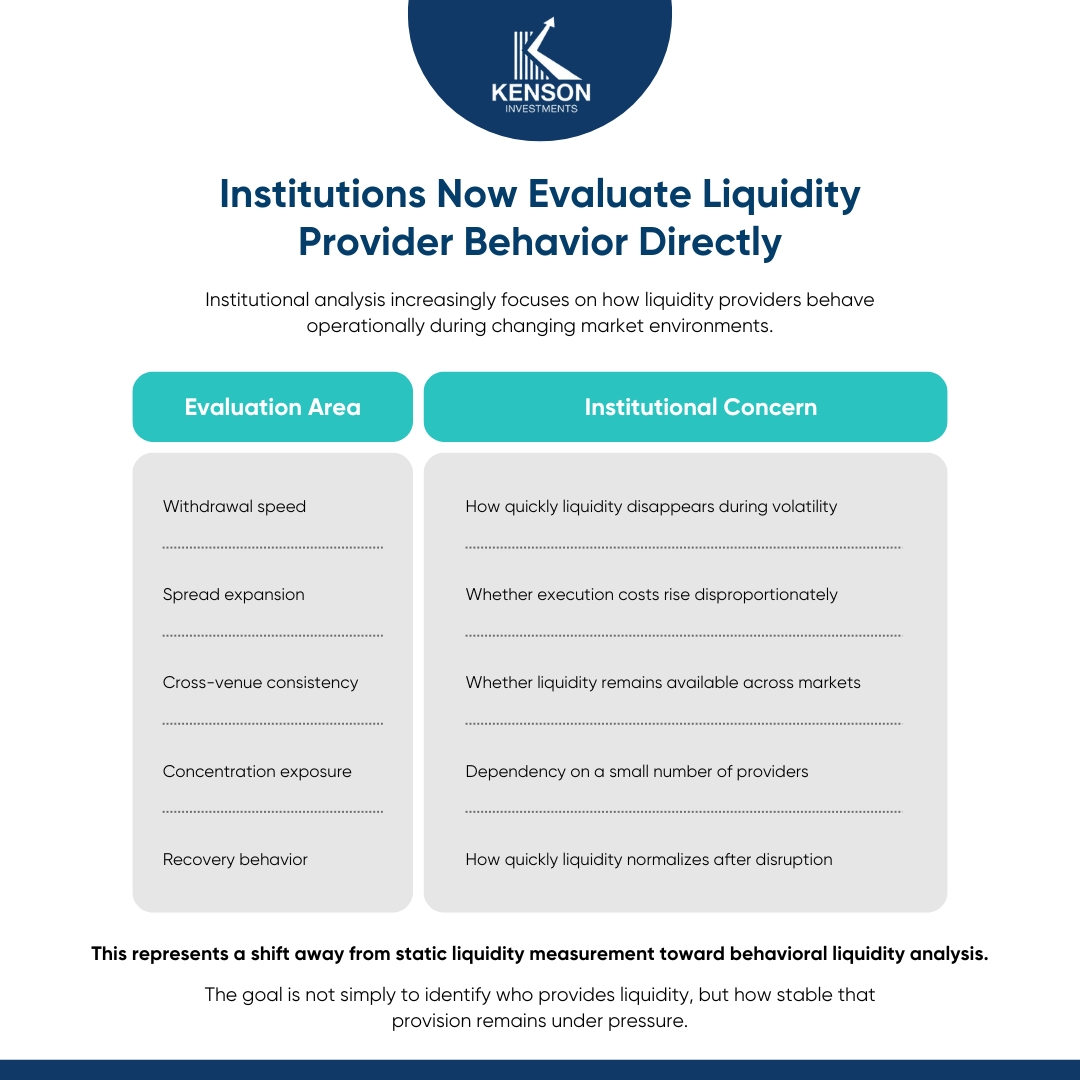
The issue is not simply whether liquidity exists. Institutions increasingly ask whether liquidity remains reliable when conditions become stressed.
Stable Liquidity and Stress Liquidity Are Different Conditions
One of the most important institutional distinctions is the difference between visible liquidity and durable liquidity.
Under calm conditions, order books may appear deep and execution may seem efficient. During volatility spikes, those same liquidity layers can disappear rapidly.
This occurs because many liquidity providers dynamically adjust risk exposure based on:
- Volatility conditions
- Inventory pressure
- Cross-market correlation risk
- Funding conditions
- Counterparty exposure
- Execution uncertainty
As a result, liquidity that appears stable during normal periods may become significantly less dependable during stress events.
Institutions increasingly evaluate whether liquidity providers behave consistently across different market environments rather than only during favorable conditions.
| An Interesting Observation: Liquidity Is Most Valuable When Conditions Deteriorate Markets rarely question liquidity quality during calm periods. The true test of liquidity provider stability appears when volatility forces participants to reassess risk rapidly. |
Market Makers Can Amplify Volatility
Liquidity providers are designed to manage risk continuously. When market conditions become unstable, many market makers reduce exposure defensively to protect capital and inventory positions.
This can involve:
- Widening spreads aggressively
- Reducing order book depth
- Pulling liquidity from certain assets
- Limiting participation across venues
- Repricing inventory faster than market demand adjusts
Individually, these actions are rational risk responses.
Collectively, however, they can accelerate volatility by reducing available liquidity exactly when markets need stability most.
This creates an important structural reality:
The same participants supporting market efficiency during stable periods may contribute to market instability during stress conditions.
Institutions therefore analyze not only liquidity presence, but liquidity behavior under pressure.
Concentration Among Liquidity Providers Creates Hidden Fragility
Another growing concern involves concentration risk within market-making activity.
In many digital asset markets, liquidity provision is heavily concentrated among a relatively small number of firms. While this can improve efficiency during stable periods, it also increases sensitivity to disruptions affecting those providers.
Concentration risk becomes more important when:
- Multiple venues rely on overlapping liquidity sources
- Similar risk models trigger synchronized withdrawal behavior
- A small group of firms dominates executable market depth
- Cross-market exposures create correlated defensive positioning
Under these conditions, the withdrawal of even a few major liquidity providers can materially affect market functionality.
This is particularly relevant in digital markets where liquidity fragmentation already creates uneven execution conditions across venues.
Liquidity Withdrawal Can Trigger Secondary Market Stress
Liquidity disruptions rarely remain isolated. When market makers withdraw aggressively, secondary effects often emerge across interconnected systems:
- Slippage increasesduring large trades
- Arbitrage efficiency weakens
- Price gaps widen across venues
- Automated trading systems react more aggressively
- Funding rates become unstable
- Volatility accelerates further
These secondary effects can create feedback loops where declining liquidity increases volatility, and increasing volatility causes further liquidity withdrawal.
Institutions therefore monitor liquidity provider stability because it directly affects broader market resilience.
Technology and Automation Intensify Liquidity Sensitivity
Modern digital asset liquidity provision is highly automated. Market-making systems continuously adjust quotes, spreads, and inventory exposure based on real-time market conditions.
This automation improves responsiveness, but it can also increase synchronization risk.
During periods of stress:
- Similar algorithms may react simultaneously
- Volatility thresholds may trigger coordinated withdrawal behavior
- Risk systems may reduce exposure across multiple venues at once
- Execution depth may deteriorate faster than human participants can respond
As execution environments become faster, liquidity disruptions can propagate more quickly through interconnected trading systems.
This makes infrastructure coordination increasingly important in institutional market structure analysis.
Why Institutions Are Prioritizing Liquidity Resilience Over Volume Metrics
Historically, many participants treated high trading volume as evidence of strong liquidity conditions. Institutional frameworks are evolving beyond that assumption.
Institutions now place greater emphasis on:
- Liquidity durability during stress
- Execution quality consistency
- Diversity of liquidity providers
- Infrastructure redundancy
- Venue resilience under volatility
This reflects growing recognition that reported liquidity and executable liquidity are not always identical.
Market depth that disappears during volatility may provide less operational value than smaller but more stable liquidity frameworks.

Cross-Market Dependencies Increase Systemic Sensitivity
Liquidity providers often operate across multiple exchanges, asset classes, and trading systems simultaneously. This interconnectedness can improve efficiency during stable periods but increase systemic sensitivity during disruptions.
A stress event affecting one environment may influence:
- Inventory management decisions elsewhere
- Cross-venue liquidity allocation
- Stablecoin settlement flows
- Collateral positioning strategies
- Automated hedging systems
Institutions therefore increasingly evaluate whether liquidity providers are overly exposed to interconnected operational dependencies.
The objective is to understand how localized stress may spread across broader market infrastructure layers.
Market Stability Depends on More Than Liquidity Presence
Liquidity providers remain essential to digital asset market function. However, institutional analysis increasingly recognizes that liquidity behavior under stress may matter more than liquidity availability during stable periods. This reality shapes everything from specialized NFT portfolio management to large-scale RWA tokenization investment strategies. As markets become faster, more interconnected, and increasingly automated, the stability of liquidity providers themselves becomes a critical factor in assessing operational resilience. Broader transformations, such as institutional supply chain digitization, continue to highlight the necessity of deep backend stability. Evaluate Liquidity Through a Resilience Framework Kenson Investments analyzes liquidity provider stability through institutional frameworks focused on execution durability, concentration risk, and digital asset market maker risk. Connect with our digital asset strategy consulting firm or speak with a derivative consultant to explore how liquidity resilience influences disciplined participation across evolving digital markets.
Disclaimer: The information provided on this page is for educational and informational purposes only and should not be construed as financial advice. Crypto currency assets involve inherent risks, and past performance is not indicative of future results. Always conduct thorough research and consult with a qualified financial advisor before making investment decisions.
“The crypto currency and digital asset space is an emerging asset class that has not yet been regulated by the SEC and the US Federal Government. None of the information provided by Kenson LLC should be considered as financial investment advice. Please consult your Registered Financial Advisor for guidance. Kenson LLC does not offer any products regulated by the SEC, including equities, registered securities, ETFs, stocks, bonds, or equivalents.”