









Governance has become one of the most closely watched structural elements in digital asset markets. While price action, liquidity conditions, and adoption metrics often dominate public attention, institutional participants increasingly evaluate how blockchain ecosystems make decisions, resolve disputes, and manage operational change.
This shift reflects a broader understanding that market confidence is not driven by technology alone. It is also shaped by the reliability of the systems governing that technology. Governance stability influences whether institutions believe a network can maintain continuity, coordinate stakeholders effectively, and preserve operational discipline during periods of uncertainty.
As digital markets mature, governance quality is becoming a filter for participation rather than a secondary consideration.
Governance Stability Extends Beyond Decentralization Narratives
Blockchain governance is frequently discussed in terms of decentralization, voting rights, or token-holder participation. Institutional evaluation tends to be more practical. The primary concern is whether governance structures produce predictable and disciplined outcomes.
This includes assessing:
- How decisions are introduced and reviewed
- Whether governance procedures remain transparent
- How protocol upgrades are coordinated
- Whether stakeholders follow consistent operational processes
- How efficiently disputes are resolved without destabilizing the ecosystem
For institutions, governance stability represents a form of operational reliability. A blockchain network may demonstrate strong technical capability, but if governance processes appear fragmented or reactive, confidence in long-term participation can weaken.
The issue is not whether disagreement exists. Most complex systems experience disagreement. What matters is whether governance frameworks can manage those disagreements without undermining trust in the broader infrastructure.
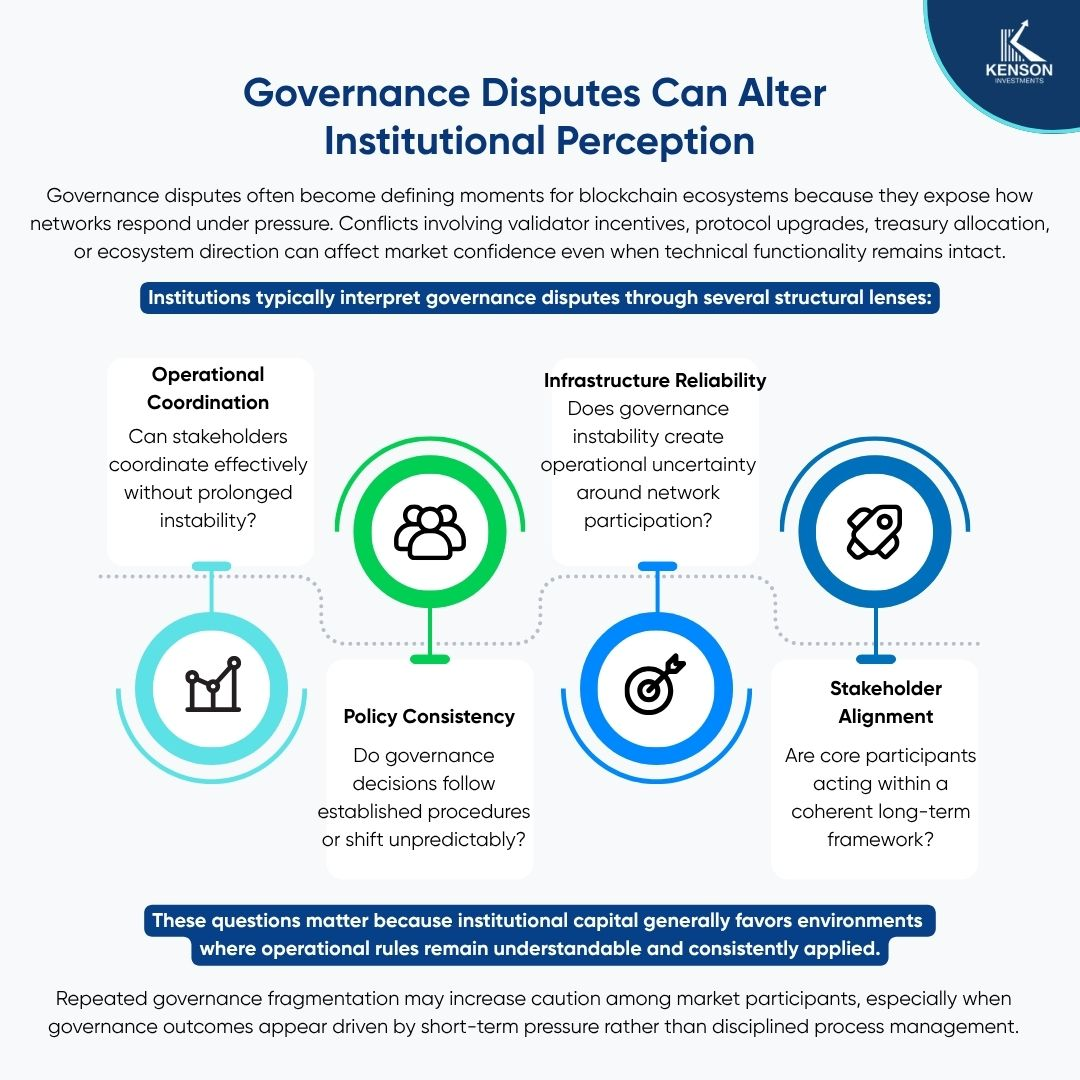
Protocol Changes Influence Confidence Beyond Technical Outcomes
Protocol upgrades are essential for blockchain networks to evolve. However, institutions evaluate not only the outcome of upgrades, but the governance discipline surrounding the implementation process.
Key areas of analysis include:
- Transparency around proposed changes
- Communication consistency before implementation
- Validator and developer coordination
- Operational preparedness during transitions
- Clarity regarding risk exposure and contingency planning
When upgrade procedures are structured and transparent, institutions often interpret this as evidence of infrastructure maturity. Conversely, rushed or poorly coordinated governance processes can create uncertainty even if the technical deployment succeeds.
This reflects a broader institutional mindset: confidence depends as much on procedural stability as it does on technical performance.
Transparency Functions as a Structural Confidence Signal
Decision-making transparency has become increasingly important in institutional blockchain evaluation. Institutions generally prefer governance environments where proposals, voting behavior, implementation timelines, and stakeholder discussions remain visible and documented.
Transparency strengthens confidence because it helps reduce operational ambiguity. Clear governance visibility allows institutions to better assess:
- Long-term strategic direction
- Governance accountability
- Stakeholder incentives
- Risk associated with protocol modifications
- Potential operational disruption during governance transitions
Without transparency, institutions may struggle to evaluate whether governance decisions align with broader network stability. Limited visibility can increase uncertainty around participation, particularly when significant exposure or infrastructure integration is involved.
In this sense, governance transparency operates as a market confidence mechanism rather than simply a community ideal.
Governance Discipline Shapes Participation Decisions
Institutional participation in digital markets has become increasingly selective. Governance stability now functions as part of the screening process for determining where capital can be allocated responsibly.
Rather than evaluating blockchain ecosystems solely through growth metrics or market popularity, institutions increasingly examine:
- Historical governance consistency
- Responsiveness during stress events
- Upgrade coordination reliability
- Validator participation discipline
- Clarity of governance frameworks over time
This shift reflects the growing importance of operational trust within digital markets. Institutions need confidence that governance systems can maintain continuity when market conditions become more complex or volatile.
Governance discipline does not eliminate market risk, but it improves the ability to evaluate and manage that risk within structured investment frameworks.

Governance Stability and Market Structure Are Increasingly Connected
Governance decisions influence more than internal protocol management. They can affect liquidity behavior, infrastructure participation, ecosystem development, and broader market confidence.
Stable governance environments may encourage:
- Greater institutional participation
- More consistent liquidity provision
- Increased infrastructure integration
- Higher operational confidence among service providers
- Stronger ecosystem coordination
Unstable governance can produce the opposite effect by increasing hesitation around long-term integration and operational dependency.
This relationship matters because blockchain ecosystems increasingly function as interconnected financial infrastructure layers rather than isolated technical projects. Governance quality therefore affects how external participants interpret systemic reliability across the broader market structure.
Governance Reliability Is Becoming Part of Infrastructure Due Diligence
Institutional due diligence processes are evolving beyond purely technical or market-based analysis. Governance quality is increasingly integrated into infrastructure evaluation frameworks.
Areas commonly reviewed include:
- Proposal governance mechanisms
- Validator coordination procedures
- Transparency standards
- Historical governance dispute management
- Decision-making accountability structures
These evaluations help institutions determine whether blockchain infrastructure demonstrates sufficient operational discipline for sustained participation.
Governance instability may not immediately affect price behavior, but it can influence confidence in the long-term reliability of the ecosystem itself.
The Kenson Perspective
At Kenson Investments, blockchain governance stability is evaluated as a critical institutional confidence factor within digital market infrastructure. Governance affects how markets interpret operational consistency, coordination reliability, and long-term ecosystem discipline. Specialized DeFi Finance consulting services and Digital asset consulting for compliance provide the structural framework needed to assess these systems. Our digital asset management consultants’ analytical framework focuses on: ●How governance structures respond during periods of uncertainty ●Whether protocol changes are managed transparently ●How governance discipline supports infrastructure reliability ●Whether stakeholder coordination aligns with sustainable market participation This perspective reflects the understanding that governance quality influences more than community engagement. It directly impacts institutional trust, operational clarity, and confidence in broader market structure integrity. Firms looking to enhance ROI with digital asset consulting must evaluate these underlying frameworks carefully, often relying on Security tokens investment consultants to map out regulatory and technical alignment. Connect with the digital asset strategy consulting firm to explore how governance discipline shapes participation across digital asset markets.
Disclaimer: The information provided on this page is for educational and informational purposes only and should not be construed as financial advice. Crypto currency assets involve inherent risks, and past performance is not indicative of future results. Always conduct thorough research and consult with a qualified financial advisor before making investment decisions.
“The crypto currency and digital asset space is an emerging asset class that has not yet been regulated by the SEC and the US Federal Government. None of the information provided by Kenson LLC should be considered as financial investment advice. Please consult your Registered Financial Advisor for guidance. Kenson LLC does not offer any products regulated by the SEC, including equities, registered securities, ETFs, stocks, bonds, or equivalents.”