









Digital asset markets were originally built around the idea of decentralization. Ironically, large portions of institutional trading activity are now concentrated through a relatively small number of execution venues.
That concentration creates a structural contradiction.
When too much trading flow, liquidity access, collateral movement, and operational coordination depend on one platform, the venue itself becomes a market vulnerability. An outage is no longer just a technical issue. A liquidity disruption is no longer isolated. The venue effectively becomes a pressure point capable of influencing broader market stability.
For institutions, this changes how execution infrastructure is evaluated. The discussion is no longer centered only on fees, spreads, or trading volume. It increasingly focuses on resilience, continuity, and whether operational dependence on a single venue creates unacceptable exposure.
One Venue Can Quietly Become an Entire Operational Stack
In digital markets, institutions often use exchanges for far more than execution.
A single venue may simultaneously provide:
- Trading access
- Custody connectivity
- Stablecoin conversion
- Margin infrastructure
- Collateral transfers
- Settlement coordination
- Liquidity sourcing
- API-based automation
Over time, this creates operational gravity. Systems become optimized around one environment because efficiency improves when infrastructure is consolidated.
But concentration has a cost.
The more functions tied to one venue, the more difficult it becomes to respond quickly when something fails.
This is why institutional firms increasingly separate the idea of market access from market dependency.
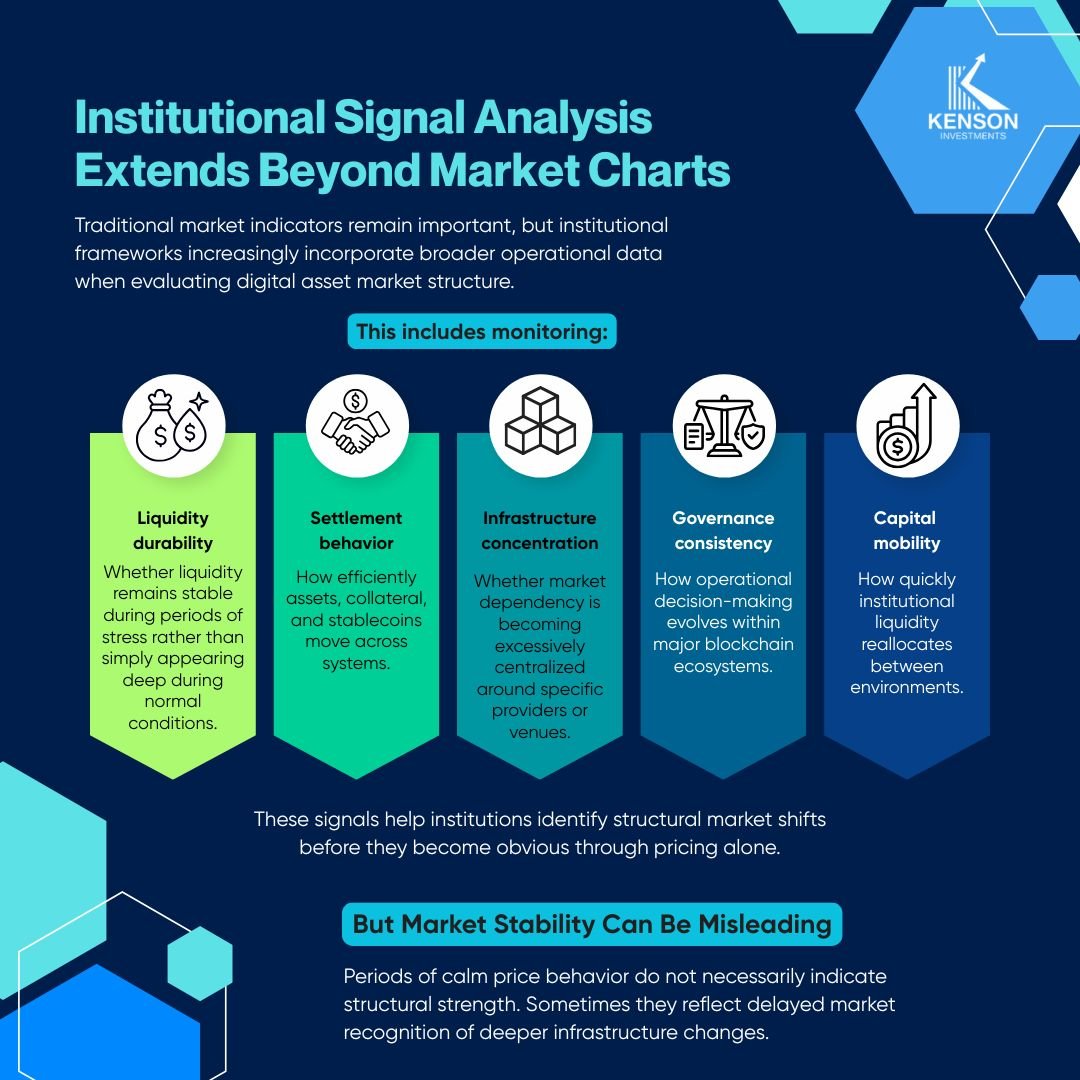
Liquidity Concentration Creates False Comfort
Large exchanges often project stability because they dominate trading volume.
But institutions increasingly understand that visible liquidity and usable liquidity are not always identical.
A venue may appear highly liquid under normal conditions while becoming significantly thinner during periods of stress.
This creates what some infrastructure analysts describe as conditional liquidity reliability:
Liquidity exists — until the market environment changes.
That distinction is important.
Institutional execution strategies depend not only on liquidity presence, but on liquidity durability.
Questions now being asked more frequently include:
- Does liquidity remain executable during volatility?
- How quickly does depth disappear under stress?
- Are spreads stable across different conditions?
- Can routing systems adapt if liquidity fragments suddenly?
The answers influence whether institutions treat a venue as structurally dependable or operationally fragile.
The Industry Is Moving Toward Execution Redundancy
One noticeable shift across institutional digital asset trading is the rise of execution redundancy.
Instead of relying on one dominant pathway, firms increasingly build multiple layers of access.
This may involve:
Multi-venue routing
Orders can be redirected dynamically depending on liquidity quality and venue performance.
Independent custody arrangements
Institutions reduce operational entanglement between custody and execution systems.
Distributed liquidity access
Capital is positioned across environments instead of concentrated entirely within one platform.
Contingency execution frameworks
Backup pathways are prepared before disruptions occur.
The objective is flexibility.
Not because institutions expect every venue to fail, but because operational resilience depends on optionality.
Speed Has Increased Dependency Risk
Modern execution systems operate faster than earlier market infrastructure models.
That speed improves efficiency, but it also compresses reaction windows.
If a venue experiences instability, institutions now have less time to:
- Reroute execution
- Reposition collateral
- Pause automated systems
- Reassess liquidity conditions
- Adjust exposure manually
This creates a new infrastructure reality:
The faster the market becomes, the more costly execution interruptions can become.
High-frequency environments amplify dependency sensitivity because disruptions propagate more quickly across connected systems.
Fragmented Markets Require Adaptive Infrastructure
Digital asset liquidity is no longer concentrated in a single market structure.
Institutions now interact across:
- Centralized exchanges
- OTC networks
- Prime brokerage systems
- Cross-chain liquidity environments
- Decentralized trading infrastructure
- Aggregated execution layers
This fragmentation changes execution strategy. The challenge is no longer simply accessing liquidity. It is coordinating liquidity access efficiently across multiple operational environments while maintaining execution consistency.
As a result, institutions are investing more heavily in infrastructure capable of:
- Monitoring venue reliability in real time
- Comparing liquidity conditions dynamically
- Measuring execution degradation
- Detecting operational instability early
- Adjusting routing behavior automatically
Execution diversification is increasingly becoming a technology problem as much as a trading decision.

Infrastructure Trust Is Becoming More Important Than Brand Recognition
Earlier phases of digital markets often rewarded visibility and scale. Institutional frameworks are shifting toward operational trust.
A venue may be large and widely recognized, but institutions still evaluate:
- Historical outage frequency
- Recovery coordination during disruptions
- Transparency during system failures
- Liquidity durability under stress
- Governance responsiveness
- Infrastructure scaling reliability
This reflects a more mature market approach.
Execution venues are increasingly treated like critical infrastructure providers rather than simply trading platforms.
Market Access Should Not Depend on a Single Point of Failure
As digital asset markets become more interconnected, over-reliance on a single execution venue creates increasingly visible structural risk. Institutions are responding by diversifying execution pathways, separating operational functions, and strengthening infrastructure flexibility. Elements like NFT portfolio management and RWA tokenization investment require these multi-venue approaches to ensure deep market access. The objective is not maximum venue exposure. It is maintaining continuity when conditions become less predictable. Wide-scale operational shifts, such as institutional supply chain digitization, emphasize the necessity of robust backend systems. Explore institutional execution resilience With Kenson Investments. Our digital asset management consultants analyze execution infrastructure through the lens of operational reliability, liquidity durability, and exchange dependency risk in digital assets. Reach out now to discuss how diversified execution frameworks and working with a dedicated derivative consultant support stronger institutional market participation.
Disclaimer: The information provided on this page is for educational and informational purposes only and should not be construed as financial advice. Crypto currency assets involve inherent risks, and past performance is not indicative of future results. Always conduct thorough research and consult with a qualified financial advisor before making investment decisions.
“The crypto currency and digital asset space is an emerging asset class that has not yet been regulated by the SEC and the US Federal Government. None of the information provided by Kenson LLC should be considered as financial investment advice. Please consult your Registered Financial Advisor for guidance. Kenson LLC does not offer any products regulated by the SEC, including equities, registered securities, ETFs, stocks, bonds, or equivalents.”