








Why Capital Deployment Depends on Data Confidence
Capital allocation in digital asset markets is no longer a question of access alone. Access is widely available. Liquidity, custody, exchange connectivity, on-chain analytics, staking dashboards, and tokenized market infrastructure now exist across multiple jurisdictions and platforms. The harder question is whether the data behind those systems is reliable enough to support disciplined capital deployment.
For institutions, digital asset data reliability is not a technical preference. It is a risk control. A trading signal, valuation model, liquidity screen, counterparty review, or treasury decision is only as strong as the data feeding it. When inputs are incomplete, delayed, manipulated, or poorly normalized, the resulting decision framework can misprice risk.
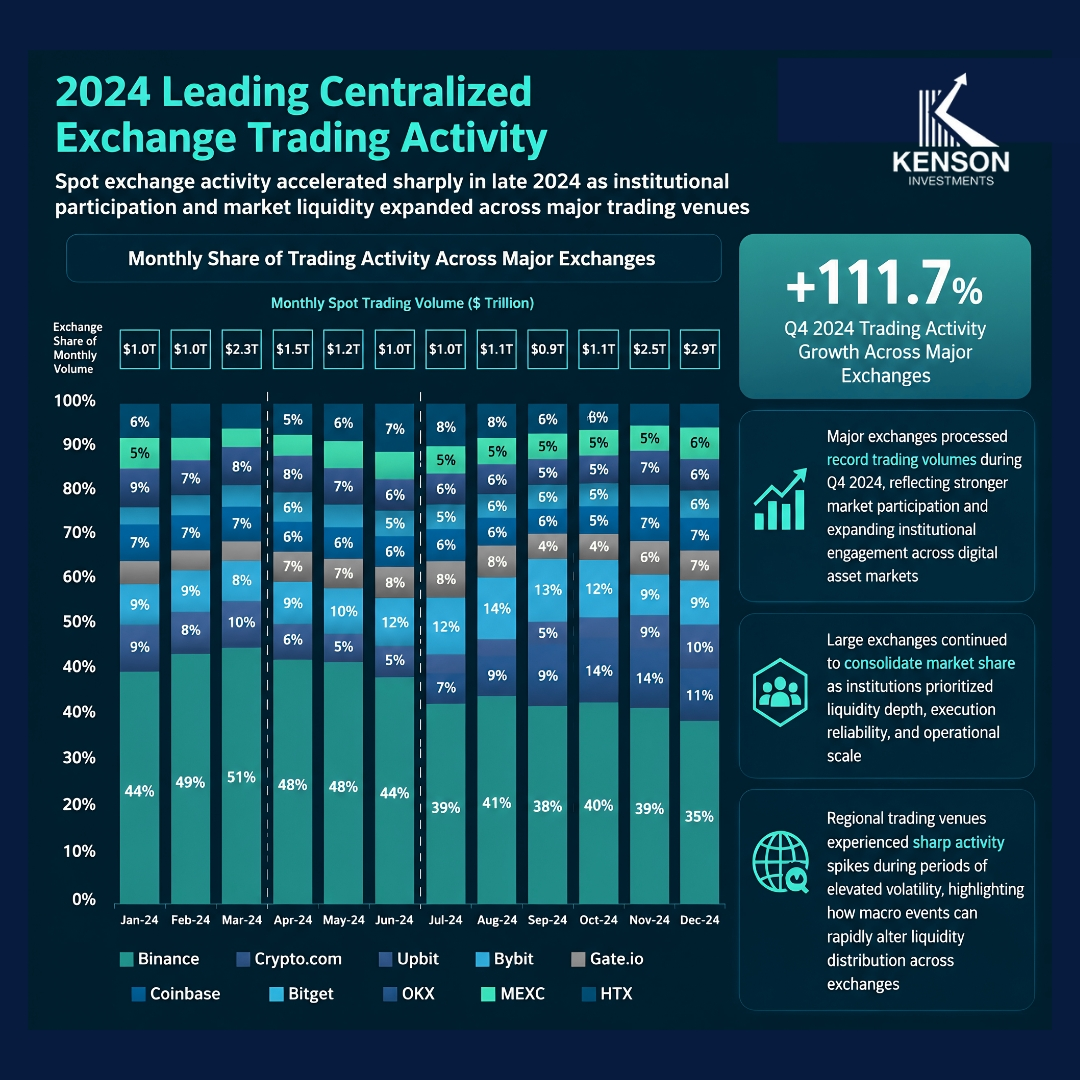
This matters because digital asset markets operate across centralized exchanges, decentralized venues, OTC desks, wallet networks, bridges, custodians, and protocol-level activity. CoinGecko reported that the top 10 centralized exchanges recorded $17.4 trillion in spot trading volume in 2024, compared with $7.2 trillion in 2023. The same report showed that top decentralized exchanges recorded $1.76 trillion in 2024 trading volume, up from $679.9 billion in 2023. Scale has increased, but so has the burden of verification.
For Kenson Investments, data confidence sits at the center of institutional decision frameworks. Without it, capital discipline becomes reactive rather than evidence-based.
Data Quality Is Now a Capital Protection Issue
Digital asset markets generate enormous quantities of visible information, but visibility does not equal reliability. On-chain data can show wallet flows, token transfers, and protocol activity, yet interpretation still requires classification. Exchange data can show volume and order book depth, but institutions must understand whether liquidity is organic, concentrated, fragmented, or vulnerable to rapid withdrawal.
Kaiko’s liquidity concentration research found that the top eight platforms accounted for more than 90% of global market depth and nearly 90% of volume across selected major crypto assets, while altcoin liquidity was increasingly concentrated offshore. That kind of concentration matters because a portfolio model based on headline volume may overstate true execution resilience.
This is why risk management in crypto investments increasingly begins with data governance. Before capital is deployed, institutions need to know what the data measures, where it comes from, how frequently it updates, what has been excluded, and how it behaves during market stress.
Why Institutions Validate Multiple Data Sources
No single data source should drive capital deployment in a fragmented market. Institutional teams often compare exchange feeds, on-chain activity, custody reports, liquidity metrics, and third-party analytics before acting on market signals.
A price move supported by rising liquidity, broad venue participation, deeper order books, and stable funding rates carries a different risk profile than a move driven by thin offshore liquidity or temporary leverage. Similarly, a token showing strong on-chain activity may require deeper inspection to determine whether that activity reflects real user demand, internal wallet cycling, incentive farming, or automated trading behavior.
This is where blockchain and digital asset consulting becomes operationally important. Institutions need frameworks that separate usable signals from noisy metrics.
Strong validation processes usually test five data dimensions: source credibility, methodology transparency, venue coverage, latency, and consistency across independent feeds. If one source shows a sharp increase in market depth while others do not, the discrepancy becomes a risk signal, not an immediate allocation trigger.
That discipline is central to best practices in digital asset consulting because capital decisions in this market can be distorted by poor data hygiene.
Exchange Data Requires More Than Volume Screens
Exchange volume is one of the most widely cited market indicators, but it can be misleading when viewed alone. A venue may show large reported volume while offering limited real depth near the mid-price. Another may support large spot activity but weak institutional custody integration. A third may have deep liquidity in major assets but limited reliability across smaller tokens.
CoinDesk Data’s April 2025 Exchange Benchmark noted that top-tier exchanges represented more than 60% of global spot trading volume while comprising only 19% of assessed venues. It also reported that more than 50% of benchmarked exchanges were licensed under broader market or virtual asset regimes, and that 83% of A-rated and 67% of AA-rated exchanges supported third-party custody solutions.
Those figures show why institutions increasingly treat exchange selection as a data confidence issue. The quality of an execution venue affects pricing, settlement, reporting, custody coordination, and operational resilience.
For allocators evaluating digital asset consulting firms, the question should not be whether a firm can access liquidity. The question is how it evaluates the reliability of that liquidity before capital is exposed.
On-Chain Data Still Needs Interpretation
Blockchain records are transparent, but not self-explanatory. A large transfer may represent investor accumulation, exchange rebalancing, custodial migration, internal treasury movement, bridge settlement, or liquidation activity. Without wallet labeling, behavioral analysis, and context, raw blockchain data can produce false conclusions.
This is particularly relevant in stablecoin markets, DeFi lending, tokenized asset flows, and cross-chain settlement. Institutions using digital asset portfolio management systems need to distinguish between activity that signals durable market demand and activity that reflects temporary incentive structures.
The same applies to DeFi. Data confidence depends heavily on oracle design, pricing sources, and manipulation resistance. A 2024 Bank of Canada staff discussion paper noted that aggregation-based price oracles and liquidity-based oracles carry different trade-offs across accuracy, timeliness, and security. It also warned that liquidity-based oracles can be vulnerable to manipulation through mechanisms such as flash loans.
For institutions involved in navigating DeFi finance assets with consultants, oracle quality is not a technical footnote. It is a direct input into collateral valuation, liquidation risk, and protocol exposure limits.
Bad Data Can Become Operational Risk
Data failures can lead to more than weak performance. They can produce operational loss. Poor pricing inputs can trigger incorrect rebalancing. Incomplete wallet monitoring can miss counterparty concentration. Misclassified exchange flows can obscure liquidation pressure. Faulty liquidity assumptions can lead to failed execution during volatility.
Security data also matters. Chainalysis reported that $2.2 billion was stolen from crypto platforms in 2024, a 21.07% year-over-year increase, while individual hacking incidents rose from 282 in 2023 to 303 in 2024. Those losses reinforce why institutions must validate data around custody, wallet activity, bridge exposure, private key controls, and transaction monitoring before treating infrastructure as reliable.
This is where security in digital asset management connects directly with market intelligence. A platform may appear liquid, active, and technically advanced, but weak security data or poor operational transparency can make it unsuitable for meaningful capital exposure.
Regulatory Data Standards Are Tightening
Regulatory developments are also pushing institutions toward better data discipline. ESMA explains that MiCA creates uniform EU market rules for crypto-assets, including provisions covering transparency, disclosure, authorization, and supervision of transactions.
IOSCO’s 2025 implementation review also emphasized crypto-asset market integrity, investor protection, regulatory consistency, and the growing complexity of centralized activities conducted by crypto-asset service providers.
For institutions, this means data validation is no longer only an internal risk preference. It is increasingly tied to documentation, auditability, counterparty review, and governance oversight.
The Kenson Perspective
Kenson Investments views data confidence as a prerequisite for disciplined digital asset participation. In our framework, no market signal is useful until it has been tested for reliability, relevance, and operational context.
As a digital asset strategy consulting firm, Kenson emphasizes education around source validation, liquidity interpretation, risk controls, and infrastructure transparency. Market data should not be treated as a dashboard decoration. It should function as a capital governance tool.
This approach matters for institutions focused on long-term investment in digital assets, where consistency is more important than reacting to every short-term market movement. Data confidence helps separate durable signals from temporary noise, especially across fast-moving markets where liquidity, leverage, and sentiment can shift within hours.

Firms seeking comprehensive digital asset consulting services should prioritize data methodology as much as market access. A disciplined process asks: Who produced the data? What does it exclude? How is it verified? How does it compare with independent sources? What decision does it actually support?
Build Confidence before Capital Moves
Capital deployment in digital asset markets depends on verified information, disciplined interpretation, and governance around every market signal. Integrating Digital asset consulting for startups alongside specialized DeFi Finance consulting services can help build a robust foundation for navigating these variables. Kenson Investments helps institutions approach this environment through education-led research, operational awareness, and data-focused market frameworks. To discuss how digital asset management consulting services can support clearer decision-making, start a conversation with the Kenson Investments team. Working directly with a Cryptocurrency investment consultant or consulting with Security tokens investment consultants can further ensure that your capital frameworks remain aligned with emerging market structures.
.
Disclaimer: The information provided on this page is for educational and informational purposes only and should not be construed as financial advice. Crypto currency assets involve inherent risks, and past performance is not indicative of future results. Always conduct thorough research and consult with a qualified financial advisor before making investment decisions.
“The crypto currency and digital asset space is an emerging asset class that has not yet been regulated by the SEC and US Federal Government. None of the information provided by Kenson LLC should be considered as financial investment advice. Please consult your Registered Financial Advisor for guidance. Kenson LLC does not offer any products regulated by the SEC including, equities, registered securities, ETFs, stocks, bonds, or equivalents”