










Meta:
Why Tokenized Money Needs Clear Settlement Hierarchies
Tokenized money is often discussed as if every digital cash instrument can do the same job. A central bank digital currency, a tokenized commercial bank deposit, a regulated stablecoin, and a tokenized money market fund share some surface similarities. They may all move on digital rails, interact with smart contracts, and settle faster than legacy payment workflows.
Underneath that surface, they are not the same.
The difference matters because settlement is not just movement. It is the point at which obligations are discharged, records are updated, and counterparties know what they actually hold. For institutions building around tokenized money settlement, the question is not only whether value can move across a blockchain or ledger. The deeper question is what kind of money is settling the transaction, who stands behind it, how it can be redeemed, and where it sits in the broader hierarchy of financial trust.
That hierarchy becomes even more important as tokenization expands from isolated pilots into production workflows involving securities, real-world assets, collateral, treasury operations, and cross-border liquidity. Without clear distinctions between central bank money, commercial bank money, stablecoins, and tokenized cash equivalents, digital markets can become faster without becoming safer or easier to reconcile.
The Settlement Hierarchy Starts with the Issuer
In traditional finance, money already has a hierarchy. Central bank money sits at the top because it is a direct liability of the central bank. Commercial bank deposits are private bank liabilities, widely used and trusted, but still different from central bank reserves or physical currency. Money market fund shares, payment balances, and other cash-like instruments may be useful for liquidity management, but they are not the same as bank money.
Tokenization does not erase these distinctions. It makes them more visible.
The Bank for International Settlements’ work on a unified ledger describes the potential for tokenized central bank reserves, commercial bank money, and financial assets to operate within shared programmable environments. That framing is useful because it recognizes that different types of money can coexist on modern infrastructure while still retaining different legal and economic meanings.
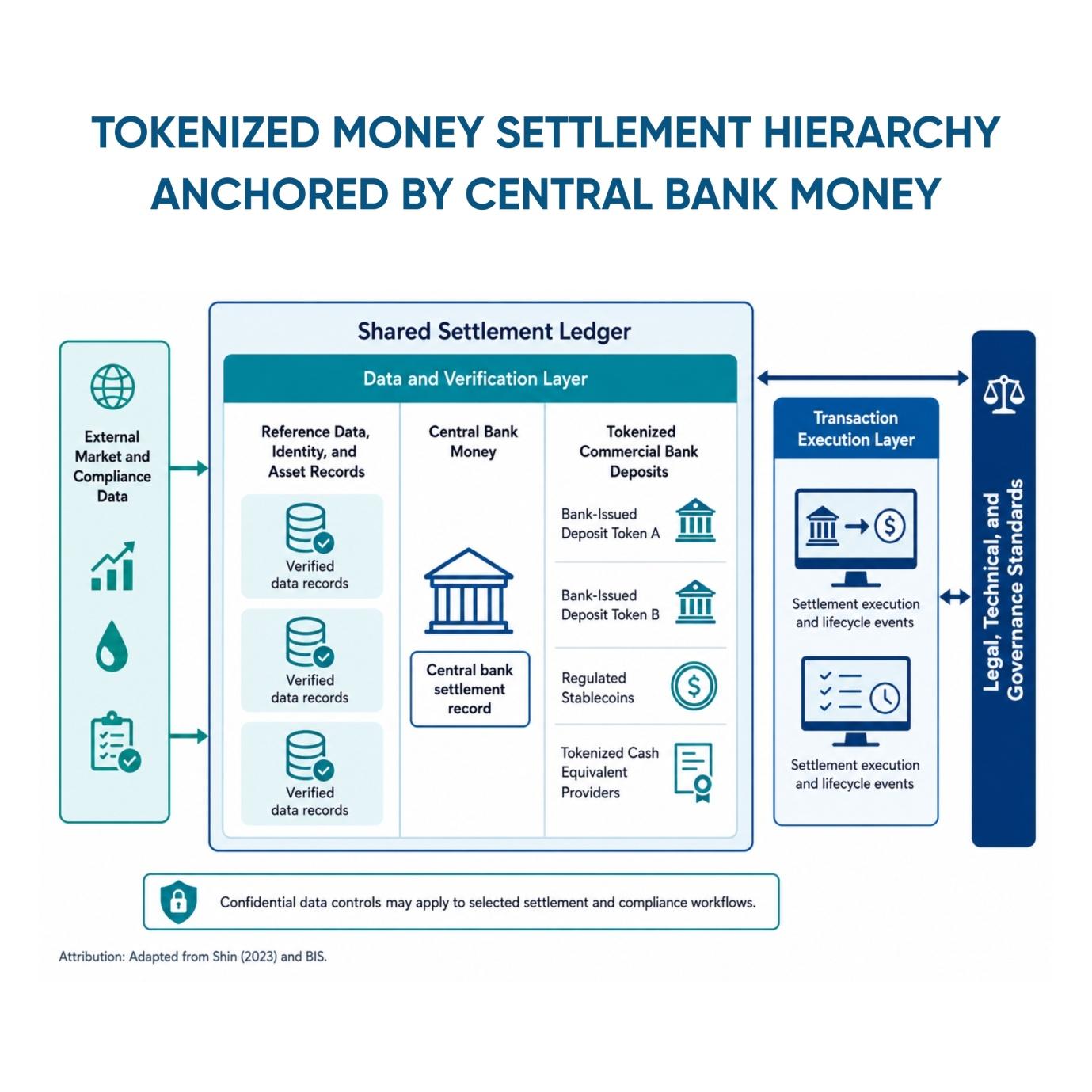
For institutional workflows, this hierarchy affects every downstream process. A token representing central bank money may be treated differently from a tokenized deposit issued by a commercial bank. A stablecoin backed by reserve assets may settle differently from a tokenized cash equivalent linked to short-duration instruments. A fund token that behaves like cash operationally may still introduce redemption, valuation, or liquidity risk that does not exist in central bank money.
Clear labeling is not enough. Market participants need legal clarity, issuer clarity, redemption clarity, and operational clarity.
Central Bank Money as the Trust Anchor
Central bank money has a special role in settlement because it is generally viewed as the safest settlement asset within a domestic monetary system. Wholesale central bank reserves already support final settlement across many existing payment and securities systems. In tokenized markets, the same principle carries forward.
A digital representation of central bank money, or a platform that enables tokenized assets to settle against central bank money, can reduce the uncertainty that appears when private liabilities are used as the final settlement asset. This is why central banks and market infrastructure providers are studying how tokenized securities, payment systems, and central bank settlement can interoperate.
The Bank of England’s discussion of innovation in money and payments highlights the need to consider RTGS modernization, tokenized deposits, stablecoins, digital securities, and central bank digital currency work together rather than as disconnected projects. That perspective matters for regulated digital cash infrastructure because institutions need to know whether settlement happens in public money, private bank money, or another digital claim.
For example, a tokenized bond transaction may appear atomic if payment and asset transfer happen together on a shared ledger. But if the payment leg is a private stablecoin, the transaction still depends on the issuer’s reserves, redemption mechanics, governance, and operational resilience. If the payment leg settles in central bank money, the risk profile changes.
The rails may look similar. The settlement asset is not.
Commercial Bank Money and Tokenized Deposits
Commercial bank money remains central to business activity because deposits are already integrated into credit creation, cash management, treasury operations, and payment services. Tokenized deposits build on that familiar structure by representing bank deposit claims on programmable infrastructure.
This could support delivery-versus-payment workflows, programmable escrow, automated reconciliation, and intraday liquidity movement. It also creates new questions. Can tokenized deposits issued by different banks be exchanged at par? How are transfers finalized? What happens if the receiving institution does not participate in the same ledger environment? How are compliance checks applied before movement?
Projects such as the Hong Kong Monetary Authority’s Project Ensemble are testing real-value transactions involving tokenized deposits and digital assets in controlled settings. These pilots reflect a broader institutional need: digital cash instruments must work across legal, banking, compliance, and technology layers.
For institutional blockchain infrastructure, tokenized deposits may be practical because they connect digital settlement with existing banking relationships. But they still sit below central bank money in the settlement hierarchy. Their reliability depends on the issuing bank, the deposit framework, the operating network, and the rules governing redemption and transfer.
That does not make them weak. It makes classification essential.
Stablecoins and the Importance of Reserve Transparency
Stablecoins are already widely used in digital asset markets because they move quickly, support 24/7 settlement, and provide a familiar unit of account. In institutional settings, however, the word “stablecoin” is too broad to be treated as a single category.
Some stablecoins are backed by cash and short-term government instruments. Others may rely on different reserve structures, offshore issuers, algorithmic mechanisms, or complex redemption arrangements. For institutions, the settlement question is not “Is this token stable?” It is “What exactly supports this token, and under what conditions can it be redeemed?”
The Bank of England’s 2025 update on the digital pound and multi-money systems describes a future where public money, commercial bank deposits, stablecoins, and tokenized assets may need to exchange smoothly without loss of value. That kind of interoperability is useful only if the instruments being exchanged are clearly understood.
Stablecoin reserves, attestations, custody arrangements, insolvency protections, and redemption timelines all shape settlement quality. A transaction may be technically final on-chain while the underlying economic exposure still depends on the issuer’s balance sheet and reserve management. This is one reason stablecoin liquidity infrastructure needs strong reconciliation controls, not just fast transfers.
Tokenized Cash Equivalents Are Not Always Money
Tokenized money market funds, treasury-backed tokens, and other cash-like instruments can be useful in digital asset workflows. They may support collateral movement, treasury management, and short-term liquidity positioning. Still, they should not be confused with money itself.
A tokenized fund share may represent a claim on a portfolio. Its value may be stable under normal conditions, but it can involve settlement cutoffs, redemption gates, fund administration processes, valuation timing, and asset liquidity considerations. That creates a different risk profile from commercial bank deposits or central bank money.
This distinction matters in smart contract workflows. If a protocol treats all cash-like instruments as interchangeable, it may misprice liquidity risk or fail to account for redemption delays. If a collateral engine accepts tokenized fund shares as if they were central bank money, stress conditions could expose hidden timing gaps.
In this sense, digital asset risk management depends on classification before automation. Smart contracts can execute rules quickly, but the rules must reflect the legal and economic character of the instrument.
Settlement Hierarchy Supports Reconciliation
Reconciliation is one of the least glamorous parts of financial infrastructure, but it is where settlement hierarchy becomes operationally visible.
An institution needs to know which ledger is authoritative, which entity issued the settlement asset, which time zone or business calendar applies, and which records control in the event of a discrepancy. Tokenized systems can reduce manual breaks, but they can also create new reconciliation issues when multiple forms of money move across multiple platforms.
For example, an asset transfer may settle on a tokenized securities platform while the payment leg moves through a bank deposit token network. Another transaction may involve a stablecoin on a public blockchain, with off-chain reserve records maintained by a custodian. A third may use a tokenized cash equivalent with fund accounting performed separately from the blockchain transfer record.
These cases require clear hierarchy. Which record proves settlement? Which claim is being held after settlement? Which party carries issuer exposure? Which control process confirms that the token and the underlying claim remain aligned?
The Monetary Authority of Singapore’s Project Guardian has explored tokenized financial products and multi-currency workflows, showing why institutional tokenization must address both asset movement and settlement design. For Kenson readers studying tokenized market settlement infrastructure, the lesson is straightforward: programmable finance needs reliable operating rules before it can scale across institutions.
Liquidity Movement Depends on Money Type
Liquidity moves differently depending on the settlement asset. Central bank money may provide the strongest finality but may be limited to eligible institutions and operating windows unless infrastructure expands. Tokenized deposits may be more accessible for bank clients, but they depend on bank-level interoperability. Stablecoins may offer speed and broad network reach, but they introduce reserve, redemption, and regulatory considerations. Tokenized cash equivalents may support portfolio-level treasury use, but they are not always suitable for immediate payment finality.
This is where hierarchy becomes a liquidity map. Institutions need to know which assets can be used for immediate settlement, which can serve as collateral, which require conversion, and which may become less liquid under stress.
A digital market with many cash tokens but no settlement hierarchy can fragment liquidity. A market with clear categories can route payment flows more intelligently. High-finality payments can use the strongest available settlement asset. Collateral workflows can apply haircuts or eligibility rules. Treasury teams can separate operational cash from reserve-like instruments. Compliance teams can monitor issuer and jurisdictional exposure.
The technology matters, but the operating model matters more.
Why Kenson Investments Tracks Settlement Design
Tokenized money will not be defined by a single format. It will likely develop as a layered system where central bank money, bank-issued tokens, regulated stablecoins, and tokenized cash equivalents serve different functions. The challenge is making those layers legible.
For institutions, clear settlement hierarchy supports trust, accounting, liquidity management, and operational controls. It also helps teams avoid treating speed as a substitute for settlement quality. A token can move in seconds, but the legal claim behind that token determines what has actually changed hands.
At Kenson Investments, we view this as a core part of digital asset market education. Readers exploring blockchain and digital asset consulting or digital asset risk management resources need more than surface-level discussions of tokenized cash. They need a framework for understanding how digital money instruments differ, how they interact, and where operational risks can enter the settlement chain.
Build Clearer Understanding Before Digital Money Scales
The future of tokenized finance depends on more than faster ledgers. It depends on whether institutions can identify the settlement asset, understand the issuer, confirm finality, reconcile records, and manage liquidity across different forms of digital money.
Kenson Investments helps informed market participants follow these infrastructure shifts with a careful, education-first lens. To explore more research on tokenization, stablecoins, and institutional digital asset systems, visit our digital asset market education resources and continue building a clearer view of how regulated digital markets are taking shape.
Disclaimer: The information provided on this page is for educational and informational purposes only and should not be construed as financial advice. Crypto currency assets involve inherent risks, and past performance is not indicative of future results. Always conduct thorough research and consult with a qualified financial advisor before making investment decisions.
“The crypto currency and digital asset space is an emerging asset class that has not yet been regulated by the SEC and US Federal Government. None of the information provided by Kenson LLC should be considered as financial investment advice. Please consult your Registered Financial Advisor for guidance. Kenson LLC does not offer any products regulated by the SEC including, equities, registered securities, ETFs, stocks, bonds, or equivalents”



