








Institutional lending desks are quietly embracing tokenized corporate credit, moving receivables, supplier finance, and revolving credit facilities onto permissioned, on-chain systems. Tokenization allows institutions to enforce governance rules automatically, reduce operational friction, and generate real-time, auditable data. Unlike traditional systems that rely on fragmented ledgers or paper-based workflows, tokenized credit transforms lending desks into highly structured, policy-driven environments.
What You Need to Know About Tokenized Corporate Credit
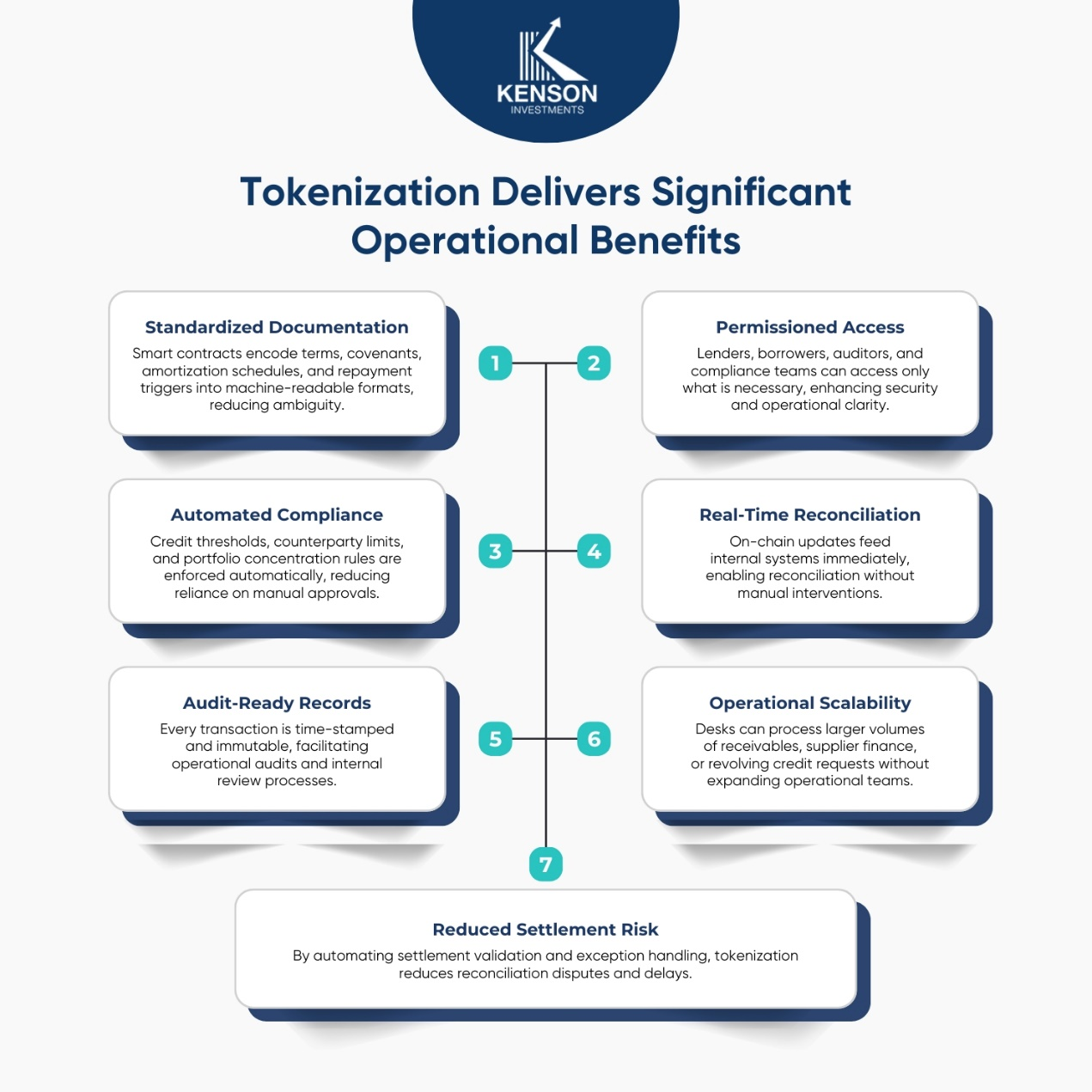
Tokenized corporate credit represents corporate lending instruments digitally, turning obligations, terms, and approvals into programmable tokens on permissioned blockchains. These tokens allow desks to monitor, manage, and enforce operational rules across multiple participants seamlessly. Key operational benefits include:
- Integration with treasury, accounting, and compliance platforms, ensuring that all systems share a single source of truth.
- Real-time visibility into obligations, approvals, and settlement progress, reducing lag between contract execution and reporting.
- Automated enforcement of internal limits, AML/KYC checks, and counterparty policies, which minimizes manual intervention and human error.
- Standardized representation of multi-party agreements, which simplifies auditing and regulatory oversight.
Tokenization ensures that desks retain operational control while increasing transparency and process consistency, without altering the underlying risk of the credit.
How Tokenized Receivables Work
Tokenized receivables simplify corporate credit operations while maintaining operational rigor:
- Invoice Tokenization:Each invoice is converted into a digital token capturing the total amount, payment terms, counterparty identity, and approval workflow.
- Access Control & Verification:Authorized participants—such as lenders, clients, and auditors—can view, validate, or dispute invoices within a permissioned environment.
- Automated Status Updates:Partial payments, disputes, or settlements are automatically updated on-chain, providing immediate visibility to all stakeholders.
- Reconciliation & Reporting:Accounting and treasury systems receive standardized feeds, ensuring internal ledgers match on-chain activity.
- Operational Transparency:The immutable nature of blockchain logs ensures that auditors and compliance teams can trace every update without additional manual reporting.
This workflow increases efficiency, reduces errors, and ensures transparency throughout the lifecycle of corporate receivables.
Supplier Finance on a Tokenized Ledger
Supplier finance programs benefit from tokenization through enhanced automation, standardization, and oversight. Operational improvements include:
- Instant Visibility:Lenders and corporate buyers can monitor obligations, approvals, and settlement status in real time, minimizing delays.
- Standardized Contracts:Uniform tokenized agreements reduce variation and the need for manual document validation.
- Automated Settlement Triggers:Payments execute automatically once invoices are approved, accelerating cash flow management for suppliers.
- Integrated Reporting:Tokenized records feed treasury, compliance, and accounting dashboards simultaneously, improving operational coordination.
- Reduced Operational Risk:Automation minimizes human error and prevents misrouting, duplicate processing, or missed settlements.
- Enhanced Auditability:All tokenized supplier obligations are timestamped and auditable, simplifying internal and external reviews.
This approach allows desks to scale supplier finance efficiently while maintaining robust operational and compliance controls.
Revolving Credit Agreements Digitally Represented
Revolving credit facilities are inherently complex, with multiple drawdowns, repayments, and covenants. Tokenization provides a centralized operational model for these agreements:
- Tokenized Drawdowns:Each drawdown request becomes a digital token, including embedded approval logic and counterparty verification.
- Automated Monitoring:On-chain systems track covenants, portfolio thresholds, and credit utilization limits, generating alerts for exceptions.
- Integrated Reporting:Treasury and accounting systems receive real-time updates, ensuring that all teams operate from the same data source.
- Permissioned Execution:Only authorized desks and compliance teams can approve or execute drawdowns, maintaining governance standards.
- Operational Transparency:All actions are traceable, reducing disputes and enabling auditors to verify compliance efficiently.
This approach standardizes processes, enhances oversight, and reduces operational bottlenecks in revolving credit management.
Architecture of Tokenized Credit
| Layer | Function | Key Features |
| Access Layer | Identity & permissions | Role-based access, approval thresholds, integration with internal ID and compliance systems |
| Execution Layer | Transaction processing | Smart contract orchestration, routing logic, automated policy enforcement, on-chain validation |
| Settlement Layer | Harmonized reconciliation | Real-time settlement state, multi-party verification, reporting integration, audit-ready logs |
By separating responsibilities across layers, institutions can maintain operational control while automating routine tasks, reducing reconciliation errors, and harmonizing data across multiple systems.
Security & Risk Controls in Tokenized Corporate Credit
Tokenized corporate credit embeds multiple operational and security safeguards to protect institutional workflows and reduce procedural risk. Key controls include:
1. Multi-Party Authorization
- Critical credit actions, such as drawdowns or invoice settlements, require approval from multiple authorized participants.
- Reduces risk of unauthorized transactions and enforces internal governance standards.
2. Immutable Audit Trails
- Every tokenized transaction is recorded on-chain with timestamps.
- Provides a permanent, auditable record for compliance reviews and internal monitoring.
3. Deterministic Account Mapping
- Each counterparty’s obligations are linked to verified digital identities.
- Prevents misrouting, duplication, and unauthorized access.
4. Permissioned Network Access
- Only approved participants can view, approve, or execute tokenized credit instruments.
- Ensures sensitive credit data remains secure within the institutional ecosystem.
5. Automated Reconciliation & Alerts
- Internal systems are automatically reconciled with on-chain activity, reducing manual error.
- Real-time alerts notify teams of policy breaches, covenant violations, or operational anomalies.
6. Integrated Monitoring for Operational Risk
- Continuous monitoring of tokenized credit operations ensures deviations from policy or process are detected early.
- Helps institutions maintain consistent enforcement of credit limits, covenants, and compliance rules.
By combining these layers of control, tokenized corporate credit maintains operational integrity while providing institutions with transparency, efficiency, and audit-ready oversight.
Integration With Institutional Systems
Tokenized corporate credit is most effective when seamlessly integrated with existing infrastructure:
- Treasury Systems:Automatic feed of tokenized drawdowns, repayments, and obligations.
- Accounting Platforms:Ledger entries update automatically, eliminating manual journal adjustments.
- Compliance Dashboards:Real-time alerts track exceptions and policy breaches.
- Internal Audit Systems:Immutable logs simplify reconciliations and regulatory reviews.
- Reporting Automation:Standardized data structures enable cross-team visibility and reduce errors.
- Portfolio Monitoring:Risk teams can track utilization, exposure, and credit concentrations without manual aggregation.
Integration ensures tokenization enhances efficiency while maintaining a single source of operational truth.
Learn More About Tokenized Corporate Credit with Kenson Investments
Kenson Investments provides educational materials that explain tokenized corporate credit, including on-chain receivables, supplier finance, and revolving credit mechanisms. Our digital asset management consultants share insights to help institutions understand how tokenized credit facilities integrate into institutional lending desks, improve transparency, and standardize workflows.
For more detailed educational resources and blockchain asset consulting solutions, connect with Kenson Investments today.
Disclaimer: The information provided on this page is for educational and informational purposes only and should not be construed as financial advice. Crypto currency assets involve inherent risks, and past performance is not indicative of future results. Always conduct thorough research and consult with a qualified financial advisor before making investment decisions.
“The crypto currency and digital asset space is an emerging asset class that has not yet been regulated by the SEC and the US Federal Government. None of the information provided by Kenson LLC should be considered as financial investment advice. Please consult your Registered Financial Advisor for guidance. Kenson LLC does not offer any products regulated by the SEC, including equities, registered securities, ETFs, stocks, bonds, or equivalents.”