








Global secured finance is undergoing a structural redesign as trading firms, prime brokers, and asset managers shift toward tokenized collateral infrastructure. The shift has less to do with digital novelty and more with the operational friction embedded in today’s repo, securities lending, and margin financing processes. Collateral moves slowly. Haircuts vary by counterparty. Substitutions require manual coordination. Eligibility rules depend on static documentation, not live data.
Tokenized collateral platforms introduce a unified, programmable structure in which assets, eligibility decisions, margin requirements, and attestations exist on a shared execution layer. Instead of handling custody silos, messaging delays, and manual reconciliations, market participants interact with tokenized representations of collateral that can be verified, re-hypothecated, locked, or released in real time—without compromising legal enforceability.
Why Tokenized Collateral Infrastructure Matters for Institutional Credit
The value of tokenization in secured finance emerges from its ability to redesign how collateral actually behaves. Institutions care about three operational pillars:
- Mobility:How quickly collateral can move, settle, or be substituted.
- Transparency:How haircut, eligibility, and exposure models are applied and verified.
- Attestation:How ownership, encumbrance status, and margin calls are reflected with certainty.
Traditional processes require intermediaries to confirm availability, transfer title, update encumbrance records, and reconcile movements across multiple systems. Tokenized collateral infrastructure compresses these functions into a shared settlement layer in which ownership, lien status, and valuation inputs are updated programmatically.
For trading firms running high-frequency financing cycles, the operational uplift is measurable. Instead of waiting for custodian updates or tri-party confirmations, tokenized collateral platforms provide real-time state transitions validated by institutional policy engines.
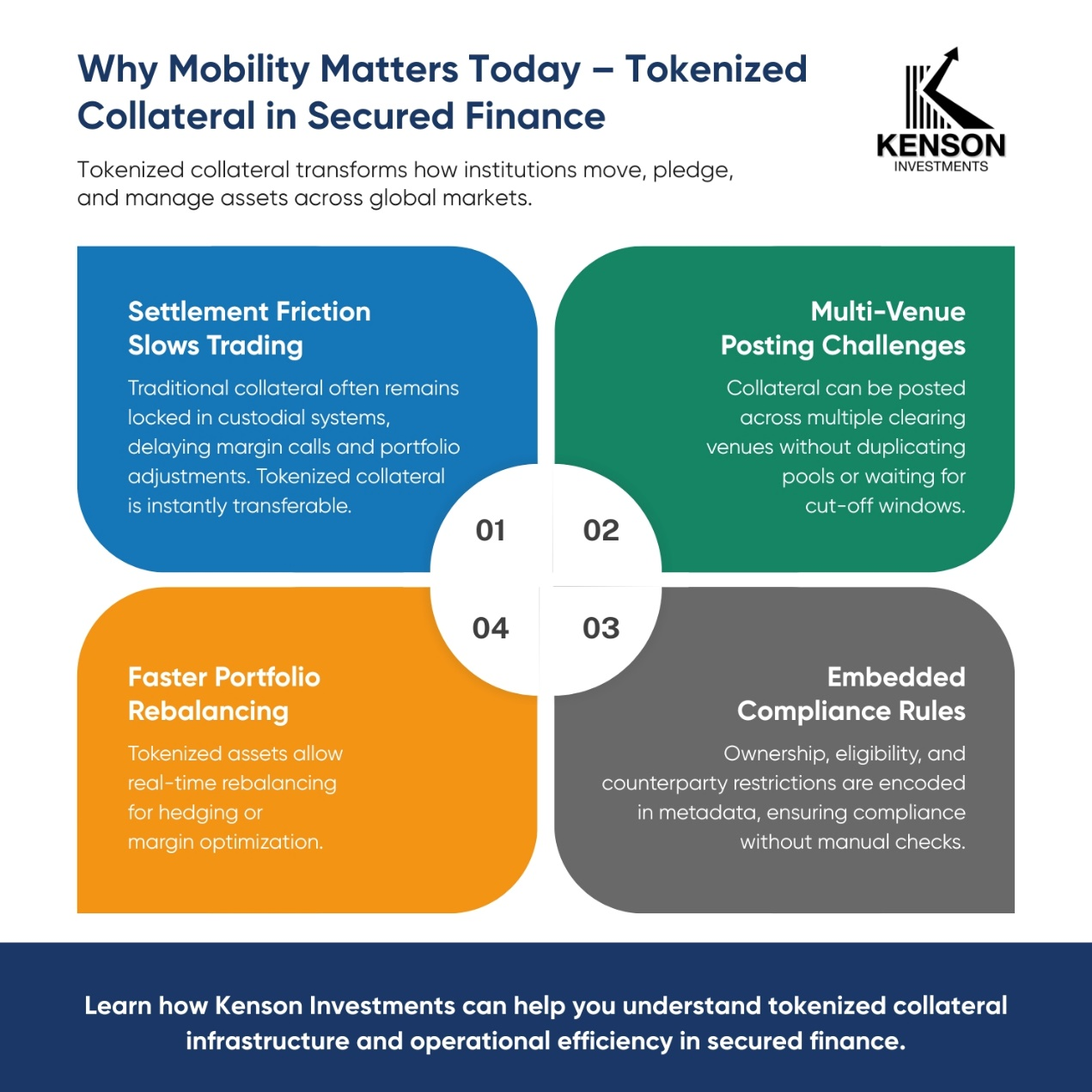
How Collateral Mobility Improves Under Tokenization
Tokenization introduces frictionless collateral lifecycle management, eliminating discrete handoffs between custodians, credit teams, settlement desks, and risk controllers. Mobility improves through three mechanisms:
1. Programmable Locks and Releases
Collateral can be programmatically immobilized when pledged and automatically released when exposure drops below predefined thresholds. Instead of email-based releases or settlement agent approvals, the pledge and unwind actions become deterministic.
2. Instant Substitution Capabilities
An institution can swap collateral types—such as treasuries for investment-grade corporate bonds—without instructing multiple intermediaries. The substitution executes based on policy rules embedded at the credit facility level, ensuring eligibility and haircut checks occur before the swap.
3. Real-Time Rehypothecation Tracking
Tokenization enables live visualization of encumbrance levels, preventing double-pledging and providing immediate insight into available vs. pledged assets. Trading desks benefit from clear collateral inventory data without waiting for overnight reconciliations.
Mobility does not introduce settlement risk because the pledged tokens remain on regulated, permissioned rails, preventing unapproved transfers or unauthorized reuse.
Haircut Transparency Reduces Ambiguity Across Facilities
Haircuts traditionally vary by fund, counterparty, asset class, and even individual trading relationships. The application of haircuts often depends on manual spreadsheets or credit team evaluations. Tokenized collateral infrastructure standardizes the process by encoding haircut models directly into the collateral token or the facility contract.
Haircut Transparency Includes:
- Pre-trade visibilityinto approved haircut schedules
- Dynamic updateswhen price or volatility conditions trigger model adjustments
- Deterministic enforcementof haircuts at the settlement layer
- Automated portfolio-level margin checksbased on live collateral valuations
A fund can see the haircut applied to each collateral token before execution, eliminating ambiguity and reducing disputes. Risk teams can verify that haircut changes propagate across all outstanding obligations instantly rather than relying on delayed ops updates.
Real-Time Attestations Reshape Counterparty Assurance
Attestations—confirmations of ownership, encumbrance, valuation, and eligibility—drive trust in secured credit. On legacy rails, attestations depend on custodians, tri-party agents, or fund administrators issuing reports at daily or weekly intervals. Tokenized collateral infrastructure embeds attestations into the asset lifecycle itself.
What Real-Time Attestations Capture
- Ownership status(unencumbered, pledged, rehypothecated, or free)
- Valuation inputs(price feeds, volatility metrics, reference indices)
- Eligibility parameters(approved asset types, jurisdictions, risk criteria)
- Lien positions(seniority, time of pledge, counterparty allocations)
These attestations are cryptographically signed and accessible to approved participants. A lender no longer waits for custodian confirmation; the platform produces trust-minimized verifications backed by institutional signing authorities.
For asset managers, the advantage is immediate visibility into whether margin obligations are met or breached, allowing intraday adjustments instead of end-of-day remediation.

Operational Architecture of Tokenized Collateral Systems
The architecture supporting tokenized collateral infrastructure integrates four execution layers:
1. Asset Tokenization Layer
Traditional securities, cash equivalents, and alternative credit assets are represented as programmable tokens that include:
- Eligibility metadata
- Haircut schedules
- Issuer data
- Pricing sources
- Encumbrance flags
This layer ensures the token mirrors the legal and economic characteristics of the underlying asset.
2. Policy and Permissioning Layer
Institutions use permissioned identity frameworks to enforce:
- Counterparty access limitations
- Rehypothecation rules
- Custody-based restrictions
- Role-based transfer rights
This layer ensures tokens cannot be transferred or pledged outside approved workflows.
3. Margin and Exposure Engine
This engine performs:
- Automated exposure calculations
- Collateral sufficiency tests
- Haircut recalculations
- Margin breach alerts
- Real-time netting between positions
It enables continuous monitoring instead of periodic reporting.
4. Settlement Orchestration Layer
This final layer coordinates:
- Pledge initiation
- Substitution logic
- Release workflows
- Settlement finality
- Inter-platform messaging
The orchestrator ensures that collateral movements adhere to established facility rules without requiring manual intervention.
Where Tokenized Collateral Infrastructure Delivers the Most Value
- Repo desksgain faster rollovers and near-instant substitution.
- Prime brokersreduce operational bottlenecks around margin calls.
- Asset managersaccess transparent haircut rules and real-time exposure data.
- Credit fundseliminate disputes related to encumbrance records.
- Trading firmsbenefit from intraday collateral optimization cycles.
- Custodiansmaintain legal title and control while enabling programmable movements.
- Risk teamsreceive high-frequency valuation attestations instead of daily reports.
Each participant sees measurable reductions in operational drag, settlement disputes, manual interventions, and fragmented data pipelines.
Why Institutional Adoption Accelerates When Systems Integrate
Adoption depends heavily on compatibility with the existing institutional stack. Tokenized collateral platforms integrate with:
- Order management systems
- Portfolio management and risk suites
- Custodian APIs
- Pricing and valuation providers
- Compliance and reporting tools
- Legal contract management systems
This integration ensures that tokenization enhances the current workflow instead of replacing it. Trading desks receive updated collateral states inside their existing systems, while back-office teams maintain oversight through unified audit rails.
Build Collateral Infrastructure That Supports Institutional Scale
Tokenized collateral infrastructure is reshaping secured finance with programmable mobility, transparent haircut frameworks, and audit-ready attestations. Kenson Investments helps institutions evaluate these models, design adoption frameworks, and build operational readiness for a fully interconnected secured credit environment.
Speak with Kenson Investments to align your collateral operations with the next generation of institutional market infrastructure.
Disclaimer: The information provided on this page is for educational and informational purposes only and should not be construed as financial advice. Crypto currency assets involve inherent risks, and past performance is not indicative of future results. Always conduct thorough research and consult with a qualified financial advisor before making investment decisions.
“The crypto currency and digital asset space is an emerging asset class that has not yet been regulated by the SEC and the US Federal Government. None of the information provided by Kenson LLC should be considered as financial investment advice. Please consult your Registered Financial Advisor for guidance. Kenson LLC does not offer any products regulated by the SEC, including equities, registered securities, ETFs, stocks, bonds, or equivalents.”