







Liquidity in digital markets no longer lives in a single venue. By 2025, institutions operate across tokenized funds, onchain credit pools, centralized prime services, and collateral engines that span multiple networks. The challenge is not access. It is coordination. Moving liquidity efficiently while maintaining accurate exposure records has become one of the defining operational problems of institutional digital finance.

Early digital asset markets treated liquidity as siloed. Capital sat idle in wallets, exchanges, or lending pools, often overcollateralized and underutilized. Today, that model is breaking down. Institutions now expect liquidity to move dynamically across platforms, responding to margin requirements, redemptions, and opportunity costs in near real time. This shift has elevated the importance of cross-platform liquidity workflows as core infrastructure rather than a tactical enhancement.
Why Fragmented Liquidity Forces New Workflows
Institutional portfolios now include a mix of tokenized funds, private credit exposures, and onchain yield strategies. Each venue has its own settlement rules, collateral requirements, and reporting standards. Without coordination, risk becomes opaque.
Consider a tokenized credit fund used as collateral in a lending pool while simultaneously contributing to portfolio exposure elsewhere. A price move or redemption request in one venue can trigger margin calls in another. If systems are not synchronized, firms risk delayed responses or excess liquidation.
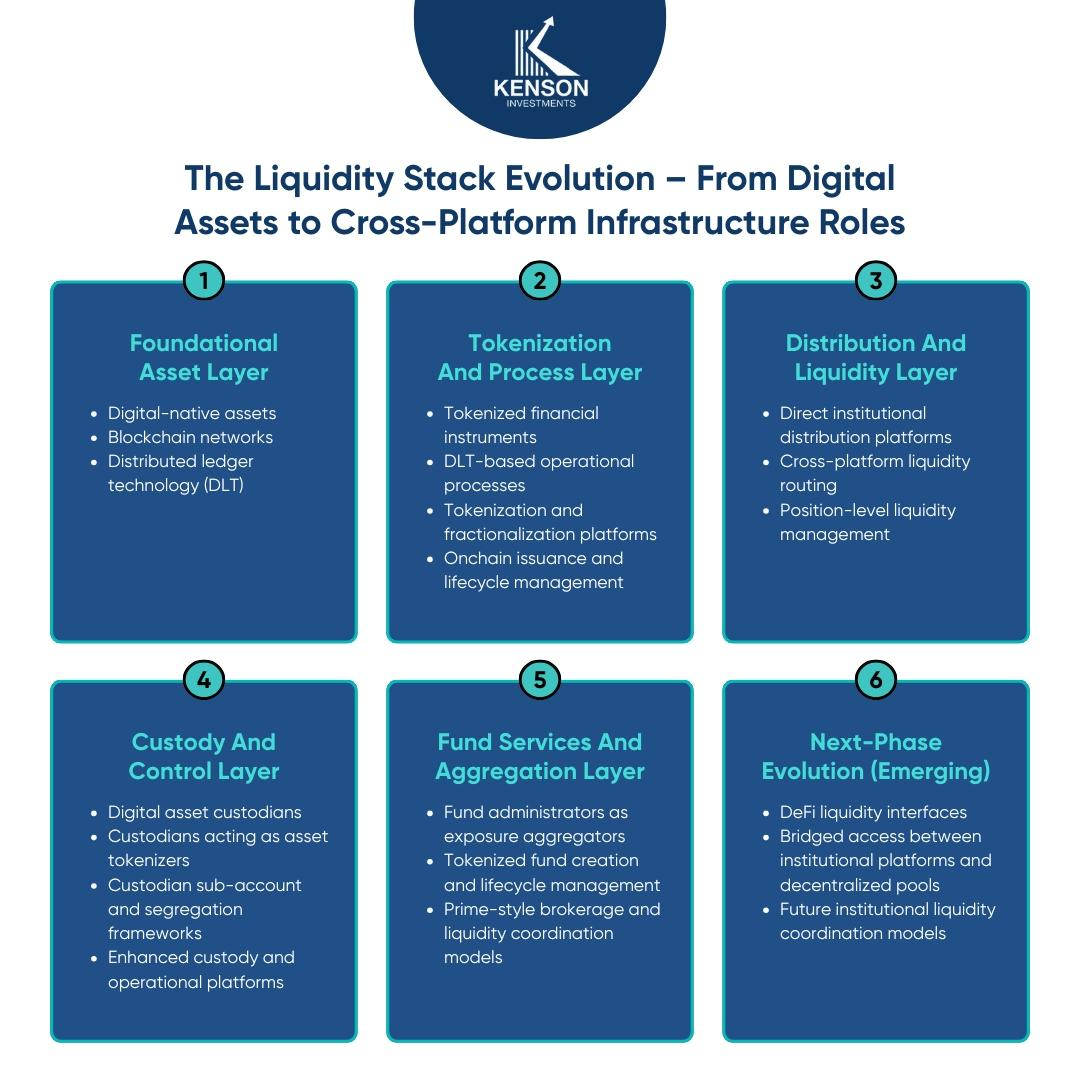
This is why digital asset portfolio management increasingly focuses on liquidity orchestration rather than static allocation. Institutions seek workflows that allow them to see, move, and reassign capital across platforms without breaking compliance or custody controls.
Routing Liquidity Across Tokenized Funds and Credit Pools
Routing liquidity across platforms starts with eligibility and valuation. Tokenized funds often have transfer restrictions and periodic liquidity windows. Credit pools may accept only certain assets as collateral, often with haircuts that change dynamically.
Modern liquidity workflows abstract these constraints into policy layers. Instead of manually assessing where capital can move, institutions rely on rule engines that encode eligibility, concentration limits, and risk tolerances. These engines decide whether assets can be pledged, redeemed, or swapped to satisfy funding needs.
Firms offering blockchain and digital asset consulting frequently emphasize this policy-driven approach. It reduces operational burden while allowing institutions to respond faster to market stress. In practice, routing decisions now resemble treasury management more than traditional trading.
Position Breaking and Capital Efficiency
One of the most significant changes enabled by tokenization is position breaking. Large positions can be subdivided into smaller units without manual reconciliation. This allows institutions to meet margin calls or fund redemptions without unwinding entire exposures.
For example, a portion of a tokenized fund position may be temporarily pledged to meet collateral requirements while the remainder stays invested. This flexibility improves capital efficiency but increases complexity. Systems must track fractional ownership, lien status, and reuse restrictions across platforms.
Position breaking also introduces sequencing risk. If multiple platforms attempt to claim the same liquidity simultaneously, conflicts arise. Robust workflows require atomic operations or clear priority rules to prevent double counting. These challenges sit at the heart of risk management in crypto investments for institutional participants.
Margin Calls and Real-Time Response
Margin calls are where cross-platform liquidity workflows are tested. In volatile markets, collateral values can shift rapidly. Institutions must respond by posting additional collateral, reducing positions, or reallocating liquidity from other venues.
In traditional finance, this process can take hours or days. In digital markets, expectations are measured in minutes. Automated monitoring systems now watch margin ratios across platforms and trigger predefined responses when thresholds are breached.
These responses may include drawing from stablecoin reserves, redeeming tokenized fund units, or reallocating assets between credit pools. The goal is not constant optimization but resilience. Institutions want predictable behavior under stress, a principle central to best practices in digital asset consulting.
Unified Exposure Records Across Platforms
Liquidity routing is only as good as the data behind it. Institutions require a unified view of exposure that spans onchain and offchain venues. This includes not only asset balances but also encumbrances, pending settlements, and conditional obligations.
Unified exposure records rely on standardized data models that reconcile different representations of the same asset. A tokenized bond held in custody, pledged in a lending pool, and referenced in portfolio reporting must be recognized as a single economic position with multiple states.
Maintaining this view is a core function of digital asset management services and increasingly a deciding factor when institutions evaluate digital asset consulting firms. Without accurate exposure records, liquidity workflows introduce more risk than they remove.
The Role of Collateral Engines
Collateral engines sit at the center of cross-platform workflows. They calculate eligibility, apply haircuts, and enforce concentration limits. More importantly, they act as the bridge between trading activity and risk controls.
In 2025, leading institutions treat collateral engines as shared infrastructure rather than platform-specific tools. They connect to multiple venues, normalize data, and provide a single source of truth for collateral status. This architecture supports security in digital asset management while enabling faster response times.
Collateral engines also play a role in governance. Audit trails, permissioning, and approval workflows ensure that automated actions remain transparent and controllable.
Interoperability Standards and Liquidity Portability
As cross-platform workflows mature, interoperability moves from aspiration to requirement. Institutions cannot afford bespoke integrations for every venue. They need shared standards that allow tokenized funds, credit positions, and collateral claims to be recognized consistently across systems.
In practice, interoperability focuses on three layers. Identity and permissions ensure only approved entities can initiate transfers or pledges. Asset representation standardizes how instruments are identified and valued, even when they live on different networks. Event messaging synchronizes state changes so margin calls, redemptions, and settlements propagate without delay.
This is where digital asset consulting for compliance becomes operational rather than theoretical. Institutions rely on standardized schemas and permission frameworks that travel with assets, reducing re-onboarding friction when liquidity moves between platforms. The result is portability without loss of control.
Stress Testing Liquidity in a Multi-Venue World
Liquidity workflows must hold up under stress, not just during steady markets. Institutions now simulate adverse scenarios where multiple venues experience volatility simultaneously. These tests examine whether collateral engines can source liquidity fast enough and whether position breaking introduces unintended exposure.
Stress testing often reveals bottlenecks. A tokenized fund may offer periodic liquidity but fail to meet an intraday margin call. A credit pool may accept an asset in calm markets but reject it when volatility spikes. Identifying these constraints in advance is critical for transparent investment solutions that aim to preserve capital under pressure.
Firms increasingly integrate stress testing into investment analysis and portfolio management. Rather than optimizing yield, they prioritize survivability. This mindset shift reflects lessons learned during periods of rapid deleveraging, where fragmented liquidity amplified losses.
Governance Models for Automated Liquidity Actions
Automation introduces speed, but governance provides safety. Institutions define who can authorize liquidity movements, under what conditions, and with what oversight. These rules are embedded into workflow engines as approval thresholds, escalation paths, and kill switches.
For example, small collateral top-ups may execute automatically, while larger reallocations require human sign-off. This balance preserves responsiveness without ceding control. Audit logs capture every action, supporting internal reviews and regulatory expectations.
Effective governance aligns closely with best practices in digital asset consulting. Institutions that rush automation without governance often encounter operational risk. Those that design governance first tend to scale more smoothly as volumes grow.
Data Quality and the Single Source of Truth
Cross-platform workflows depend on data accuracy. Discrepancies between onchain states, custodian records, and internal books can cascade into liquidity errors. Institutions therefore invest heavily in reconciliation and validation layers.
A single source of truth does not mean a single database. It means consistent reconciliation logic that resolves differences and flags anomalies. Unified exposure records update in near real time, reflecting pledged collateral, pending settlements, and conditional obligations.
Providers of digital asset management consulting services often focus on this layer because it underpins everything else. Without reliable data, routing logic and collateral engines cannot perform as intended.
Strategic Implications for Institutions
As assets under management in tokenized products expand, cross-platform liquidity workflows become a strategic differentiator. Institutions that master these workflows unlock capital efficiency, respond faster to market stress, and offer clients more resilient products.
This capability also reshapes competitive dynamics. Platforms that integrate cleanly into institutional workflows attract more flow. Those that impose friction are sidelined. Over time, liquidity concentrates around infrastructure that prioritizes interoperability and governance.
For private banks, RIAs, and asset managers, the implication is clear. Liquidity management is no longer a back-office concern. It is a core competency that influences product design, client trust, and long-term performance. This is why many institutions partner with strategic digital asset consulting partners to assess architecture choices before scaling exposure.
The Road Ahead for Cross-Platform Liquidity
The next phase will bring deeper integration between tokenized funds, credit pools, and traditional financing tools, with growing interest in RWA tokenization investment and tokenfi rwa. Stablecoins already play a central role in meeting margin needs, alongside evolving considerations such as Solana DeFi risk management. Tokenized collateral is following, supported by broader market exploration into areas like ai cloud mining. Over time, boundaries between onchain and offchain liquidity will blur further, influencing participation from nft investors across digital markets.
Institutions that invest early in robust workflows position themselves to navigate this transition with confidence, often seeking to enhance ROI with digital asset consulting. Those that delay risk being reactive during periods of stress, when flexibility matters most, particularly without access to consultancy for DeFi finance investments. The market is moving toward coordinated liquidity, and the learning curve is steep.
Building Resilient Liquidity Infrastructure
Kenson Investments focuses on research and education around institutional digital market infrastructure, including themes tied to institutional supply chain digitization. By examining how cross-platform liquidity workflows link tokenized funds, credit pools, and collateral engines, market participants can approach digital adoption with clarity, discipline, and resilience.
Disclaimer: The information provided on this page is for educational and informational purposes only and should not be construed as financial advice. Crypto currency assets involve inherent risks, and past performance is not indicative of future results. Always conduct thorough research and consult with a qualified financial advisor before making investment decisions.
“The crypto currency and digital asset space is an emerging asset class that has not yet been regulated by the SEC and US Federal Government. None of the information provided by Kenson LLC should be considered as financial investment advice. Please consult your Registered Financial Advisor for guidance. Kenson LLC does not offer any products regulated by the SEC including, equities, registered securities, ETFs, stocks, bonds, or equivalents”