









Blockchain and decentralized systems have long been celebrated for openness. Every transaction, governance decision, and protocol interaction is permanently recorded on-chain, accessible to anyone at any time. On-chain transparency provides unparalleled insight into market behavior, participant activity, and systemic health.
Yet transparency is more than a technical feature. It transforms participant behavior, making responsibility unavoidable. In transparent systems, plausible deniability is reduced, and all actions carry visible consequences. Participants are forced to internalize responsibility, act deliberately, and consider long-term implications of every trade, vote, or contract interaction.
How Transparency Shapes Accountability
Transparency transforms the decision-making landscape by making actions visible and traceable. In opaque systems, responsibility can be diffuse: intermediaries shield participants from consequences, and decision-making is often removed from immediate scrutiny. On-chain transparency removes these buffers.
- Visibility:Every transaction or interaction can be publicly observed. This includes trading activity, staking interactions, lending, and governance votes. Visibility ensures that no action occurs in isolation.
- Traceability:Transparent systems link outcomes to specific actors. Historical activity can be connected to decisions, creating accountability.
- Auditability:Transparent systems can be continuously reviewed, enabling participants and observers to evaluate behavior and results over time.
The combination of visibility, traceability, and auditability ensures that participants cannot avoid responsibility. Their actions are permanently recorded and observable, reinforcing the need for deliberate decision-making.
On-Chain Accountability in Action
Transparency fosters accountability across multiple dimensions.
Financial Accountability
On-chain transactions are permanent and publicly accessible. Misjudgments, speculative trades, or over-leveraged positions are visible in real time. This visibility compels participants to act responsibly:
- Decision Deliberation:Public visibility of trades makes errors observable. Impulsive or poorly considered decisions can have visible consequences, influencing reputational and financial outcomes.
- Reputational Considerations:Participants are aware that wallets, transaction histories, and protocol interactions reflect on their credibility.
- Immediate Consequences:Mistakes—like liquidations, failed arbitrage, or incorrect staking—are instantly visible, providing real-time feedback loops for the ecosystem.
Even without central enforcement, transparency functions as a discipline mechanism, compelling careful decision-making.
Governance Accountability
Decentralized governance systems rely on token-weighted votes or multi-signature decision mechanisms. Transparency ensures that every vote is auditable, and outcomes are observable:
- Attribution:Decisions are linked to identifiable participants, eliminating anonymity as a shield.
- Outcome Visibility:Changes to parameters, rewards, or protocol rules are recorded permanently, visible to all.
- Behavioral Feedback:The effects of votes are immediate and public, reinforcing thoughtful engagement in future governance decisions.
By connecting decisions to outcomes, on-chain transparency transforms governance from an abstract process into a real-time accountability mechanism.
Operational Responsibility
Transparency extends to the operational layer of blockchain systems. Validators, developers, and service providers operate under visible scrutiny:
- Validators:Their performance, uptime, and adherence to protocol rules are observable, ensuring responsible operation.
- Developers:Smart contract updates, protocol upgrades, and deployment actions are permanently recorded and reviewable.
- Service Providers:Auditable interactions with the blockchain ecosystem make operational responsibility visible and enforceable.
This transparency reduces moral hazard and promotes operational diligence without relying on centralized enforcement.

Risk Awareness
Transparent systems illuminate risk exposure. Participants cannot ignore leverage, liquidity, or counterparty dependencies:
- Liquidity Risks:Pool sizes, concentrated holdings, and capital flows are visible.
- Leverage Exposure:Borrowing and lending positions are auditable, showing systemic risk in real time.
- Counterparty Risk:Visible activity reveals dependencies on specific participants or protocols.
By making risks observable, transparency forces participants to internalize responsibility, as they are accountable for understanding and managing these risks.
Social and Behavioral Impacts
Transparency affects human behavior in profound ways. Behavioral economics demonstrates that visibility drives accountability even without formal penalties:
- Social Scrutiny:Public observation encourages careful decision-making.
- Reputational Incentives:Actions have consequences on credibility and trust, reinforcing responsibility.
- Cognitive Considerations:The volume of visible information requires more deliberate evaluation of decisions.
In transparent systems, accountability becomes ingrained in participant psychology. Decisions are considered more carefully because participants understand their actions are publicly interpretable.
Market Discipline
Transparent systems foster market discipline through observable feedback loops:
- Visible Risk:Over-leveraged positions, liquidity imbalances, or aggressive yield strategies are public, influencing participant behavior.
- Learning by Observation:Failures, liquidations, and protocol missteps serve as instructive examples for the broader community.
- Behavioral Alignment:Publicly visible success or failure encourages sustainable, responsible participation rather than reckless speculation.
Transparency functions as a self-enforcing accountability mechanism, guiding participant behavior without central oversight.
Multi-Layer Responsibility
Responsibility extends across multiple protocol layers:
- Smart Contract Interactions:Function calls, parameters, and results are permanently recorded.
- Network Operations:Validator performance, consensus participation, and network health are observable.
- Token Flows:Lending, staking, and liquidity provision are auditable, linking yield and risk to participant actions.
Every layer adds complexity and responsibility, forcing participants to evaluate decisions holistically.
Reducing Plausible Deniability
Plausible deniability, the ability to deny involvement or responsibility in a transaction, is diminished in transparent systems. In traditional finance, intermediaries can obscure transaction flows or provide ambiguous reporting, making it difficult to attribute mistakes to specific actors. Blockchain transparency removes that buffer.
Every transaction is tied to a public address, and smart contracts enforce precise logic that executes automatically. When participants interact with a protocol, their actions are recorded, making it difficult to claim ignorance or shift blame. Even complex, multi-party transactions are traceable, with clear input-output relationships.
This accountability extends to operational mistakes, governance votes, and contract development. Developers cannot claim responsibility lies elsewhere if an error arises from a smart contract they deployed. Validators, node operators, and liquidity providers are similarly accountable for misconfigurations or malicious actions.
Multi-Layer Responsibility
Responsibility extends across multiple protocol layers:
- Smart Contract Interactions:Function calls, parameters, and results are permanently recorded.
- Network Operations:Validator performance, consensus participation, and network health are observable.
- Token Flows:Lending, staking, and liquidity provision are auditable, linking yield and risk to participant actions.
Every layer adds complexity and responsibility, forcing participants to evaluate decisions holistically.
Regulatory and Compliance Implications
Transparency interacts with regulatory expectations:
- On-chain visibility supports compliance reporting, audit readiness, and anti-fraud efforts.
- Participants must be aware of how public activity aligns with legal obligations.
- Transparent systems facilitate oversight but also shift responsibility to participants to ensure lawful, ethical engagement.
Even decentralized systems must balance visibility, responsibility, and regulatory alignment, adding another dimension to accountability.
The Cultural Shift Toward Accountability
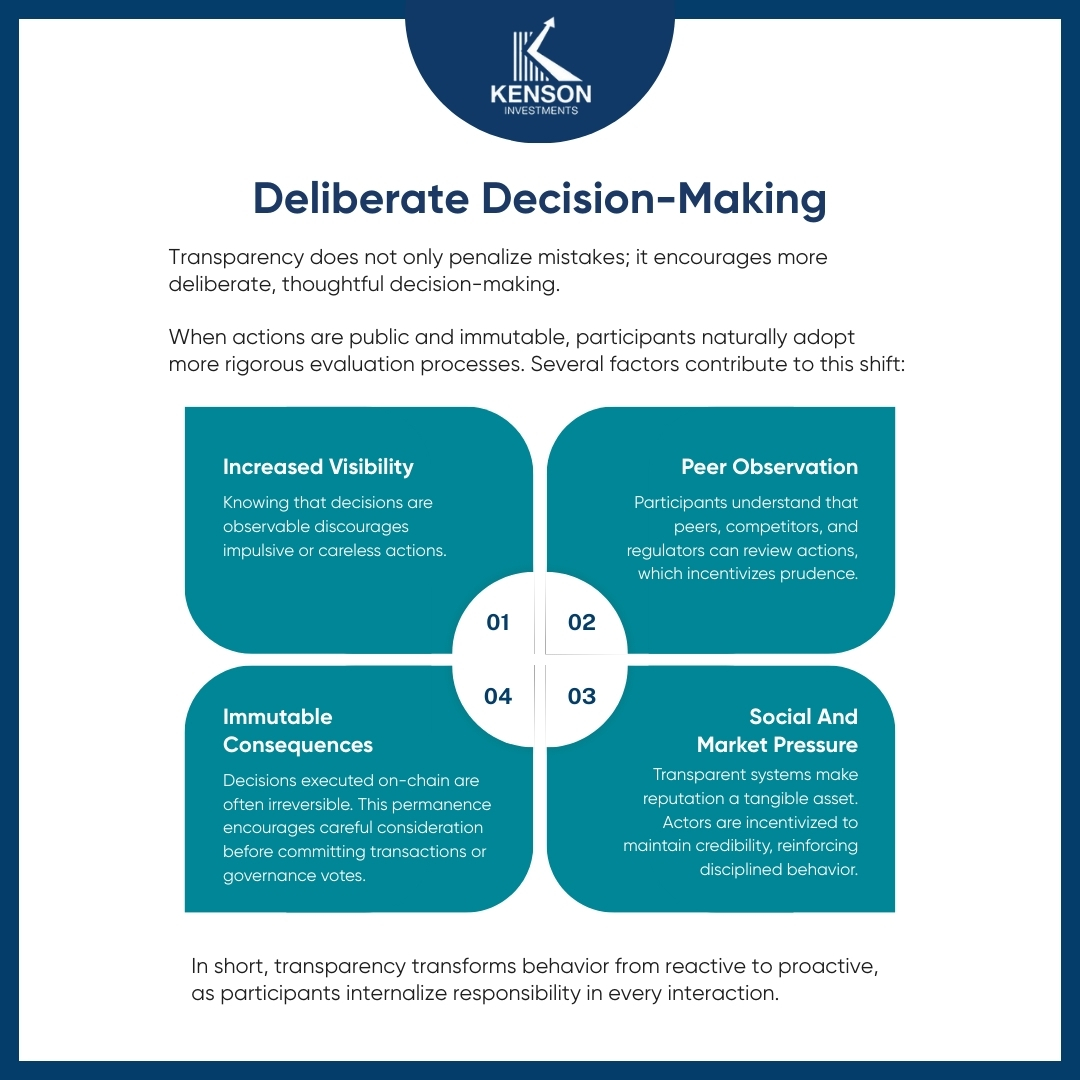
Transparent systems also foster a cultural shift. Participants internalize accountability because it is visible and measurable. Behavior that might have been acceptable in opaque systems — like passing the blame or ignoring minor errors — becomes untenable. This culture of accountability has long-term benefits:
- Improved Operational Hygiene:Participants adopt disciplined workflows.
- Enhanced Trust:Stakeholders trust transparent networks more, knowing responsibility is traceable.
- Better Decision-Making:Transparency encourages rigorous evaluation and deliberate action, reducing the likelihood of systemic failures.
Challenges of Transparency
While transparency promotes responsibility, it introduces challenges:
- Information Overload:The sheer volume of visible activity can overwhelm participants.
- Misinterpretation Risks:Public metrics may be misread, leading to poor decisions or herd behavior.
- Privacy Tensions:Transparency exposes financial positions, creating trade-offs between accountability and confidentiality.
Effective participation requires education, analysis, and disciplined evaluation, ensuring visibility translates into actionable insights.
Feedback Loops and Time Compression
Transparency amplifies responsibility further through feedback loops. In on-chain systems, actions are observable almost instantaneously, and consequences manifest quickly:
- Immediate Response Expectation:Because every transaction is visible, other participants react quickly, creating a faster-paced environment that pressures timely, responsible decisions.
- High-Frequency Information Updates:Continuous inflows of blockchain data compress perception cycles, forcing participants to process information rapidly and adjust their behavior.
- Error Amplification:Mistakes are immediately verifiable and permanent, reinforcing attentiveness and careful execution.
These feedback mechanisms compress time perception, making decisions feel more consequential and reducing tolerance for inattention. Participants must adapt to a system where actions are magnified in both visibility and impact.
On-Chain Transparency as a Tool for Responsibility
At Kenson Investments, we help investors navigate transparent blockchain systems by translating on-chain data into actionable insights for responsible decision-making. Transparency provides visibility, but only informed participants can leverage it effectively, often supported by digital asset consulting for compliance.
Register now to:
- Analyze on-chain activity, transaction flows, and governance patterns with guidance from consultancy for DeFi finance investments
● Identify risks and dependencies within transparent systems and explore structured cryptocurrency investment solutions
● Develop disciplined strategies to integrate responsibility into decision-making using digital asset portfolio management
● Translate transparency into actionable, risk-aware investment approaches while evaluating altcoin investment options
Our digital asset consultants offer access research, insights, and tools for risk-aware participation in transparent blockchain systems. Get started now.
Disclaimer: The information provided on this page is for educational and informational purposes only and should not be construed as financial advice. Crypto currency assets involve inherent risks, and past performance is not indicative of future results. Always conduct thorough research and consult with a qualified financial advisor before making investment decisions.
“The crypto currency and digital asset space is an emerging asset class that has not yet been regulated by the SEC and the US Federal Government. None of the information provided by Kenson LLC should be considered as financial investment advice. Please consult your Registered Financial Advisor for guidance. Kenson LLC does not offer any products regulated by the SEC, including equities, registered securities, ETFs, stocks, bonds, or equivalents.”