








Volatility is inherent to digital asset markets. Many investors focus on trying to anticipate price swings or chase fleeting opportunities. Yet history repeatedly shows that capital protection rarely comes from timing the market—it comes from operational discipline. For institutions and high-net-worth investors managing digital assets, preparation, controls, and structured processes are far more reliable tools for managing downside risk than chasing short-term gains.
Operational Discipline: The Core of Capital Protection
Operational discipline encompasses the systems, policies, and procedures an institution applies to manage digital asset exposure safely and consistently. At its core, it is about risk awareness and mitigation, not predicting market moves. High-stakes digital markets amplify the consequences of mistakes; errors in execution, security lapses, or mismanaged exposure can quickly erode capital.
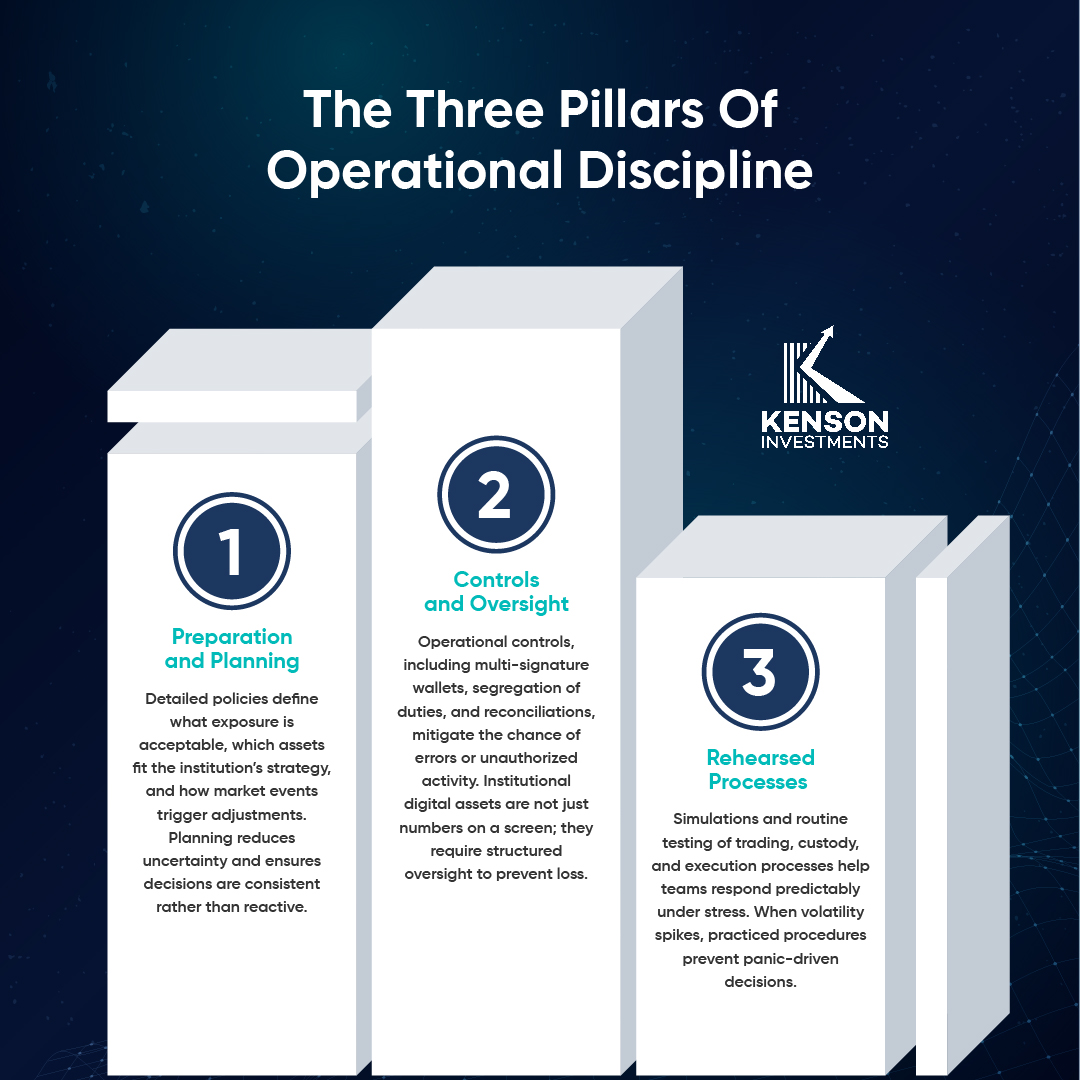
Operational discipline is forward-looking, designed to anticipate operational and market risks, not to chase returns. By embedding these structures, institutions ensure that capital preservation remains the primary outcome, regardless of short-term market movements.
Why Market Timing Falls Short
Digital asset markets are among the most volatile in any asset class. Price swings of 10–20% in a single day are not uncommon, and periods of extreme illiquidity can magnify losses. Attempting to time these markets is inherently speculative, relying on perfect foresight of unpredictable factors. Even experienced traders struggle to consistently anticipate market direction.
In contrast, operational discipline focuses on what can be controlled:
- Security of private keys and wallets
- Timely execution of exposure adjustments based on pre-set parameters
- Compliance with risk limits established by governance frameworks
By prioritizing execution quality and procedural consistency, institutions reduce exposure to operational failures, which are often more damaging than price volatility itself.
Institutional Digital Assets Require Institutional Processes
Handling digital assets at scale introduces complexities that retail investors rarely encounter. Institutional managers must consider:
- Custody arrangements:Using multi-layered storage strategies to protect against hacking and loss
- Settlement and reconciliation:Ensuring that all trades and transfers are recorded and verified
- Liquidity management:Monitoring the ease of entering and exiting positions without undue market impact
Each of these areas represents operational risk, which, if unmanaged, can outweigh market risk. A well-timed trade executed with poor operational controls can destroy more value than a poorly timed trade executed flawlessly within a disciplined framework.
Operational Risk Management in Practice
Effective operational risk management involves anticipating failure points and designing safeguards. Examples include:
- Segregated access control:Only authorized personnel can initiate transactions, reducing the risk of internal error or malicious activity
- Automated monitoring:Continuous oversight of wallet balances and market positions to detect anomalies early
- Scenario rehearsals:Stress testing the operational framework under extreme market conditions to validate procedures
Operational risk management is not reactive; it builds confidence in the processes so that decisions under pressure remain consistent with strategic objectives.

Discipline Over Reaction: Avoiding Emotional Decisions
Market timing often appeals because it promises outsized gains—but it also encourages emotion-driven behavior. FOMO (fear of missing out) or panic selling can override strategy, resulting in capital erosion. Operational discipline mitigates these behavioral risks by embedding decision-making into predefined, repeatable procedures.
For example, a disciplined process might specify that exposure adjustments occur only when certain thresholds are met, reducing the likelihood of impulsive trades in response to headlines or short-term volatility.
Risk Management as a Performance Lever
While operational discipline does not guarantee profits, it enhances the predictability of outcomes. By controlling operational risk, institutions can:
- Avoid catastrophic losses from security breaches or execution errors
- Maintain consistent exposure to digital asset opportunities without overleveraging
- Support long-term capital growth bymanaging risk systematically
The focus shifts from “winning every market move” to “preserving and optimizing capital across market cycles.” For high-net-worth investors and institutional allocators, this approach prioritizes capital resilience over speculation, aligning with fiduciary responsibility.
Integrating Operational Discipline into Strategy
Embedding discipline requires coordination across multiple functions:
- Governance and Policies:Define operational limits, risk tolerance, and escalation procedures
- Technology and Security:Implement robust custody and transaction systems
- Monitoring and Reporting:Maintain real-time visibility of positions, liquidity, and operational performance
- Continuous Improvement:Review procedures after incidents and adapt to evolving market conditions
Institutions that successfully integrate these elements create a culture of accountability and preparedness, where operational risk is measured, understood, and mitigated consistently.
The Kenson Approach to Operational Discipline
Market timing may appear attractive in the fast-moving digital asset space, but it is inherently speculative and unpredictable. In contrast, operational discipline—through preparation, controls, and rehearsed processes—directly mitigates the largest risks to institutional capital.
At Kenson Investments, operational discipline is integrated into the core management of institutional digital assets. Our focus is not chasing market trends but minimizing exposure to operational failures through:
- Standardized processes and protocols
- Active monitoring and exposure adjustments by digital asset specialists
- Risk-aware decision frameworks designed to preserve capital during periods of high volatility
By foregrounding operational risk management, Kenson ensures that strategic objectives remain intact even under unpredictable market conditions.
In digital asset management, process matters more than prediction, and operational discipline is the foundation upon which long-term, consistent, and risk-aware investment outcomes are built. Whether working with NFT investors, exploring AI cloud mining, or engaging a derivative consultant, the ability to enhance ROI with digital asset consulting depends on robust investment analysis and portfolio management practices that prioritize operational resilience over speculation.
Disclaimer: The information provided on this page is for educational and informational purposes only and should not be construed as financial advice. Crypto currency assets involve inherent risks, and past performance is not indicative of future results. Always conduct thorough research and consult with a qualified financial advisor before making investment decisions.
“The crypto currency and digital asset space is an emerging asset class that has not yet been regulated by the SEC and the US Federal Government. None of the information provided by Kenson LLC should be considered as financial investment advice. Please consult your Registered Financial Advisor for guidance. Kenson LLC does not offer any products regulated by the SEC, including equities, registered securities, ETFs, stocks, bonds, or equivalents.”