







Stress testing frameworks were built for markets that paused. Trading sessions opened and closed. Liquidity windows were predictable. Margin calls followed defined cycles. Even during periods of extreme volatility, time itself acted as a stabilizer. In always-on digital asset markets, that assumption no longer holds. Trading, liquidation, and collateral repricing operate continuously, often through automated systems that respond faster than human oversight. For investor capital, this structural shift renders many legacy stress models incomplete. They underestimate the speed, persistence, and feedback loops that now define market stress, creating blind spots precisely when capital protection matters most.

From Kenson Investments’ perspective, the failure is not one of effort but of design. Traditional stress testing treats volatility as episodic. Digital markets experience stress as a state. Once triggered, liquidation engines, cross-venue arbitrage, and margin recalibration can reinforce pressure without a natural reset. This dynamic directly affects market resilience and exposes portfolios to compounded drawdowns that legacy models were never meant to capture.
Why Batch-Era Assumptions Understate Downside Risk
Conventional stress tests rely on batch-era assumptions: discrete shocks, static correlations, and time-bound recovery. These models often simulate price moves over fixed horizons and assume liquidity returns once stress subsides. In digital asset markets, stress propagates through interconnected systems that do not wait for recalibration. Automated liquidation mechanisms, particularly in leveraged and collateralized structures, can force asset sales continuously, even as prices fall. This creates reflexive pressure that extends stress beyond the initial shock.
For allocators focused on risk management in crypto investments, the implication is clear. Stress scenarios based solely on price volatility fail to account for execution friction, collateral velocity, and infrastructure constraints. Kenson’s approach treats these factors as integral to stress testing digital assets, recognizing that capital impairment often stems from the interaction between price moves and system mechanics rather than price moves alone.
Infrastructure and Automation As Stress Multipliers
Always-on markets are inseparable from their infrastructure. Oracles, custody APIs, margin engines, and settlement layers operate continuously, translating market signals into mechanical actions. During stress, these systems can amplify pressure if thresholds are breached simultaneously across venues. A single oracle lag or API bottleneck can cascade into delayed margin updates or forced liquidations, extending stress even in the absence of new information.
This infrastructure coupling challenges traditional stress frameworks that assume orderly execution. For a digital asset management company, stress testing must therefore incorporate operational dependencies alongside market variables. Kenson’s educational resources integrate infrastructure behavior into its stress analysis, evaluating how system performance degrades under load and how that degradation affects access to capital. This approach reflects best practices in digital asset consulting, where operational resilience is treated as a capital variable.
Correlation Dynamics in Always-On Environments
Legacy stress tests often rely on historical correlations to estimate portfolio behavior under stress. In always-on markets, correlations are neither stable nor symmetric. Assets that appear uncorrelated during normal conditions can converge rapidly during stress due to shared liquidity pools, common collateral frameworks, or synchronized liquidation triggers. This convergence is exacerbated by the global, uninterrupted nature of digital markets, where stress in one region immediately transmits to others.
For investors evaluating digital asset portfolio management, this reality undermines assumptions of diversification. Kenson addresses this by stress testing portfolios under correlation regimes that reflect structural linkages rather than historical averages. The goal is not to predict exact outcomes but to bound capital exposure under adverse conditions, aligning with a disciplined view of security in digital asset management.
Governance Limitations of Legacy Stress Practices
Traditional stress testing often sits within periodic governance cycles. Models are reviewed quarterly or annually, and scenarios are updated infrequently. In always-on markets, this cadence is insufficient. Stress conditions evolve continuously, and new failure modes emerge as market structure changes. Static models quickly become outdated, leaving capital exposed to unmodeled risks.
Kenson approaches stress testing as an ongoing process rather than a compliance exercise. Our framework emphasizes adaptive scenario design and continuous monitoring, reflecting a broader commitment to consulting on digital asset management that prioritizes governance over optimization. This posture is particularly relevant for institutional allocators seeking transparent investment solutions grounded in process discipline.
How Kenson Approaches Stress in Always-On Markets
Adapting stress testing to always-on markets requires a shift in mindset. Instead of asking how portfolios perform under isolated shocks, modern stress thinking examines how systems behave under sustained pressure. This includes analyzing liquidation cascades, funding rate feedback, and infrastructure degradation over extended periods. The objective is not to forecast market outcomes but to identify thresholds beyond which capital access or control is compromised.
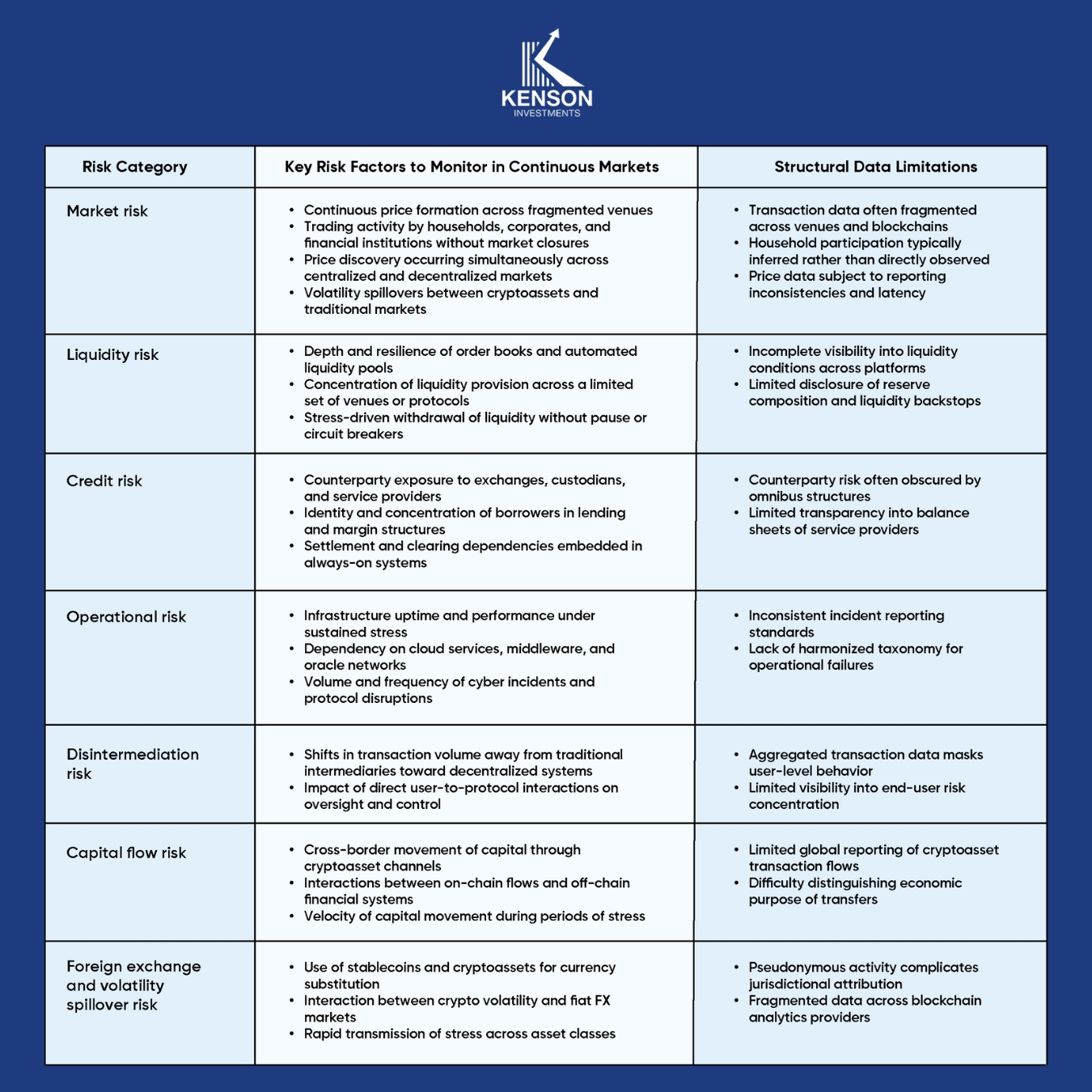
Kenson’s educational methodology integrates these considerations into allocation decisions and liquidity planning. By aligning stress assumptions with market structure, we aim to reduce the likelihood that stress scenarios underestimate downside exposure. This approach supports long-term capital stewardship and aligns with our role as a digital asset strategy consulting firm focused on governance and resilience rather than short-term performance.
Implications for Allocators And Decision-Makers
For high-net-worth investors and institutional allocators, the inadequacy of old stress tests has practical implications. Due diligence must extend beyond reported stress metrics to include an assessment of how those metrics are constructed. Questions about liquidation mechanics, infrastructure dependencies, and scenario persistence are now central to evaluating manager discipline. In this context, evaluating digital asset consulting firms requires attention to how stress frameworks reflect the realities of continuous markets.
Kenson’s stance is that stress testing should constrain risk-taking, not justify it. By treating stress as an ongoing condition rather than an exception, we seek to align portfolio behavior with the structural realities of digital markets. This perspective supports long-term investment in digital assets by prioritizing capital preservation over theoretical resilience.
A Disciplined Approach to Stress In Continuous Markets
Always-on markets demand stress frameworks that recognize persistence, automation, and infrastructure coupling as primary risk drivers. Legacy models, designed for batch-era trading, underestimate these forces and leave capital exposed during prolonged stress. Kenson Investments approaches stress testing as a dynamic governance tool, integrating market mechanics and operational realities into capital oversight. For allocators seeking consistency and discipline, this approach reflects a commitment to managing risk where it actually resides in modern digital markets. As a trusted digital asset strategy consulting firm, our blockchain asset consulting and blockchain and digital asset consulting services are led by dedicated blockchain asset investments consultant professionals with deep expertise in Solana DeFi risk management. Be more informed and acquire educational resources by connecting with Kenson Investments’ digital asset specialists.
Disclaimer: The information provided on this page is for educational and informational purposes only and should not be construed as financial advice. Crypto currency assets involve inherent risks, and past performance is not indicative of future results. Always conduct thorough research and consult with a qualified financial advisor before making investment decisions.
“The crypto currency and digital asset space is an emerging asset class that has not yet been regulated by the SEC and US Federal Government. None of the information provided by Kenson LLC should be considered as financial investment advice. Please consult your Registered Financial Advisor for guidance. Kenson LLC does not offer any products regulated by the SEC including, equities, registered securities, ETFs, stocks, bonds, or equivalents”