


Counterparty review has always been a control problem. Institutions need to know who they are dealing with, whether the counterparty is eligible, which restrictions apply, and whether the relationship can be monitored over time. Digital assets complicate that process because wallet addresses are not the same as verified legal entities.
On-chain identity changes the workflow. Instead of relying only on off-chain onboarding files and manual checks, tokenized markets can use verifiable credentials, wallet-level permissions, and revocation logic to support review before a transaction occurs. This does not remove the need for compliance teams. It gives them a more technical control layer.
For regulated tokenized markets, on-chain identity compliance is becoming part of the same operating discussion as custody architecture, smart contract governance, settlement finality, and digital asset counterparty review.
Wallets Need Context, Not Just Addresses
A blockchain address can show transaction history, but it does not automatically show legal status, jurisdiction, accreditation, sanctions status, mandate, or beneficial ownership. That distinction matters when tokenized assets are restricted to approved participants.
A wallet may represent a regulated institution, a custodian-controlled account, a treasury function, a trading desk, or a smart contract. Without identity context, a receiving address is only a technical endpoint. Counterparty review requires more.
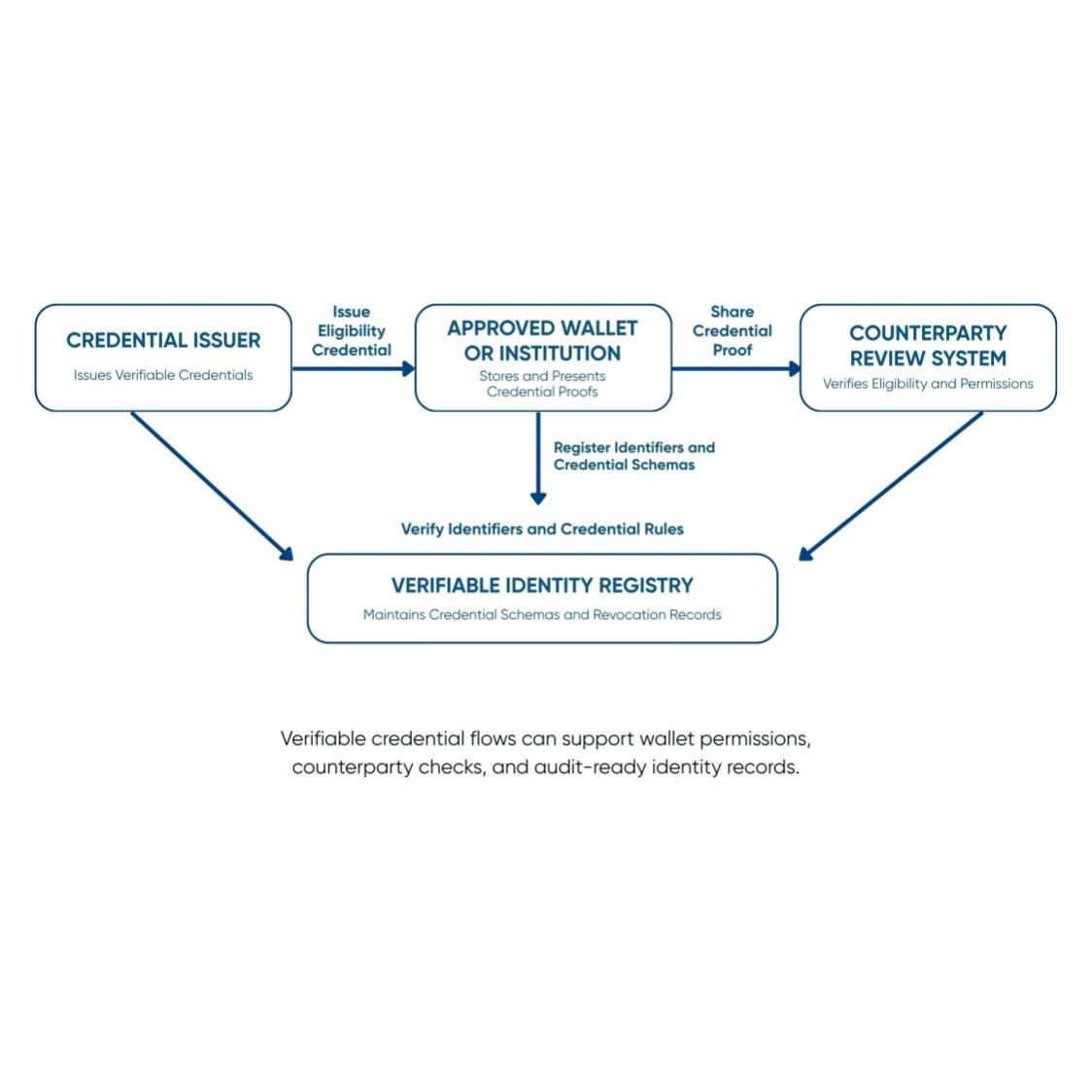
This is where verifiable credentials become useful. The W3C Verifiable Credentials Data Model 2.0 describes a way to express credentials that can be cryptographically verified while supporting privacy-respecting digital identity. In tokenized markets, that model can help separate the proof of eligibility from unnecessary exposure of sensitive information.
For example, a counterparty may prove that it passed onboarding, belongs to an eligible jurisdiction, or meets a market access requirement without disclosing every underlying document to every network participant. The credential confirms status. The full file can remain with the issuer, custodian, or compliance provider.
Permissioned Transfers Make Eligibility Operational
In traditional counterparty review, a firm may approve a counterparty in a system of record, then rely on people and processes to prevent unauthorized activity. In tokenized markets, eligibility can become part of the transfer logic.
A token contract may restrict transfers to allowlisted wallets. A fund token may only move between wallets with valid investor credentials. A tokenized real-world asset may require jurisdictional eligibility before settlement. A stablecoin or deposit token used in regulated workflows may require sanctions screening and approved participant status.
That makes permissioning more than a compliance note. It becomes an operational control.
This does not mean every identity detail should be placed on-chain. In most institutional settings, the better model is selective disclosure. The wallet can prove it holds a valid credential, while sensitive identity data remains off-chain. That approach supports privacy while still allowing smart contracts, transfer agents, custodians, or permissioning systems to enforce access rules.
Readers reviewing blockchain and digital asset consulting topics should see this as a key example of how compliance workflows and technical infrastructure are merging.
Privacy Is a Design Requirement
Identity systems can create new risk if they expose too much. A fully public identity trail could reveal trading relationships, portfolio activity, jurisdictional exposure, or customer information. That is not acceptable for many institutional use cases.
The design challenge is to prove eligibility without broadcasting unnecessary personal or commercial data. NIST’s Digital Identity Guidelines focus on identity proofing, authentication, federation, security, privacy, and user experience. Those principles are relevant because tokenized markets need identity systems that are reliable without becoming excessive surveillance systems.
Privacy-preserving identity may involve credential issuers, decentralized identifiers, selective disclosure, zero-knowledge proofs, or partitioned data environments. The goal is not anonymity at all costs. The goal is controlled disclosure.
For a regulated tokenized securities workflow, a wallet might need to prove that it belongs to an approved participant and is not on a restricted list. The issuer does not necessarily need to reveal all onboarding documents to the broader network. The market needs enough information to enforce rules, but not so much that confidentiality is weakened.
This is one reason digital asset internal controls should include data minimization standards. Identity architecture is not only about access. It is also about what information is retained, shared, logged, and exposed.
Revocation Is as Important as Approval
Counterparty review is not static. A participant that is eligible today may become restricted tomorrow. A credential may expire. A jurisdictional rule may change. A wallet may be compromised. A legal entity may fail ongoing review. A sanctions update may require immediate action.
That is why revocation matters.
On-chain identity systems need a way to remove, suspend, or update permissions. This can involve credential revocation registries, allowlist updates, transfer-agent controls, wallet freezes, expiration dates, or periodic revalidation. Without revocation logic, identity credentials become stale control artifacts.
The operational question is simple: if a counterparty fails review, how quickly can its wallet permissions be changed?
For tokenized markets, delayed revocation can create settlement, custody, and compliance risk. A credential that remains valid after a counterparty loses eligibility may allow transactions that should have been blocked. A wallet that remains approved after compromise may expose the market to unauthorized transfers.
Good digital asset risk management treats approval and revocation as two sides of the same process. Kenson’s digital asset risk management resources provide useful context for understanding how operational controls support market integrity.
Audit Trails Need to Connect Identity and Activity
On-chain identity can also improve auditability. A strong identity system can show which credential was used, who issued it, when it was valid, which wallet used it, what permissions applied, and whether the transaction met policy at the time of execution.
That is valuable because tokenized markets often involve many layers: custodians, issuers, compliance vendors, smart contracts, wallets, identity providers, and settlement systems. If something goes wrong, institutions need a coherent record.
The Bank for International Settlements’ work on the next-generation monetary and financial system discusses unified ledger concepts and highlights the importance of data protection in cross-border tokenized systems. That matters here because identity and audit records must be useful without exposing more data than necessary.
An audit-ready identity framework should answer practical questions. Was the counterparty eligible at the time of transfer? Which credential supported that eligibility? Was the credential expired, revoked, or restricted? Did the wallet act within its permission scope? Were exceptions reviewed?
This shifts counterparty review from a document archive to a living control environment.
On-Chain Identity Supports Regulated Market Design
Tokenized markets need more than asset issuance. They need identity, permissions, settlement rules, custody controls, and monitoring systems that work together. MAS Project Guardian has focused on frameworks for asset tokenization and open, interoperable networks, reflecting the broader institutional need for standards that reduce fragmentation.
For institutions studying real-world asset tokenization or institutional blockchain infrastructure, on-chain identity is one of the clearest examples of how regulated market structure is evolving. It helps convert counterparty review from a pre-trade checklist into a rules-based control layer.
The strongest designs will not place every identity fact on a public ledger. They will use verified credentials, selective disclosure, wallet permissions, revocation controls, and audit records to support compliant participation.
Build Counterparty Review for Tokenized Markets
On-chain identity does not replace institutional judgment. It improves the control surface. A wallet can carry proof of eligibility, a smart contract can enforce transfer rules, and audit systems can preserve evidence of who was approved and when.
Kenson Investments follows these developments through an education-first lens. As tokenized markets mature, counterparty review will depend on data quality, privacy design, revocation controls, and verifiable permissions.
To keep building a clearer understanding of identity, compliance, and tokenized market infrastructure, explore Kenson’s digital asset market education resources and related blockchain and tokenization insights.