


Compressed settlement windows change the questions portfolio managers must answer before capital moves. When settlement becomes near-instant, funding and collateral that once settled over hours or days must now be available at the moment of execution.
That shift creates new real-time settlement risk and forces institutions to rethink liquidity buffers, counterparty selection, and intraday exposure. For high-net-worth allocators and allocators evaluating manager discipline, these are not technical curiosities — they are practical constraints that determine whether capital is protected or needlessly exposed.
What Real-Time Settlement Risk Means For Capital
Real-time settlement risk is the danger that a trade or transfer will settle in a compressed timeframe while the funding, collateral, or counterparty readiness required to support it are not in place. In traditional markets, multi-day settlement cycles gave institutions time to move funding, reconcile positions, and correct mistakes. In programmable, near-instant settlement environments, that operational margin evaporates.
The immediate implications for capital include:
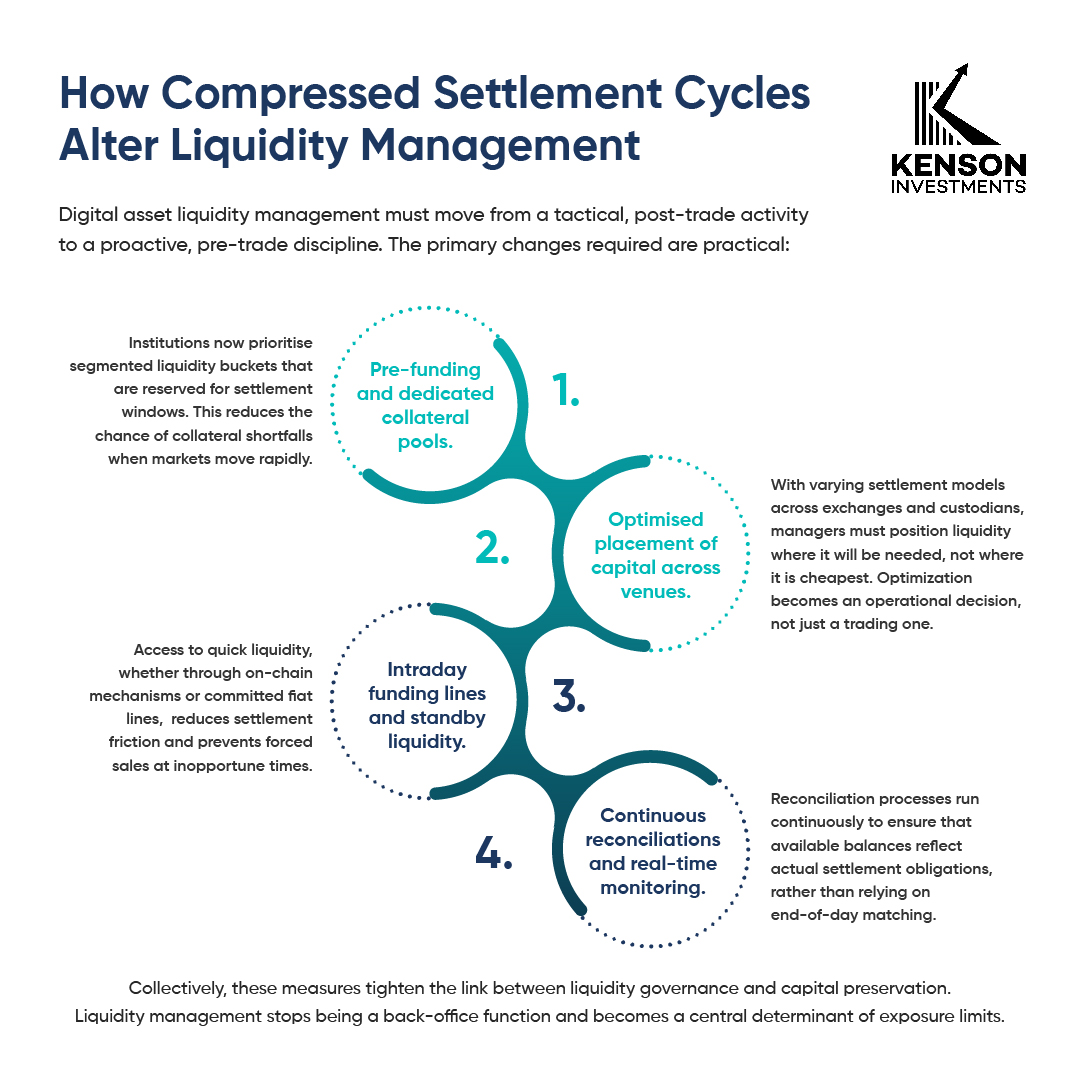
- Compressed funding cycles:Cash or stablecoin liquidity must be pre-positioned or immediately accessible. Delays in funding availability translate directly into failed settlements or forced asset liquidation.
- Collateral strain:Collateral that once rotated across accounts can no longer be relied upon without explicit pre-allocation, increasing the need for dedicated collateral pools.
- Intraday exposure:Positions opened in the morning could require additional collateral within minutes, amplifying intraday financing needs and creating leverage risk if not properly managed.
These dynamics change the capital equation: managers must accept that exposure is as much a function of operational readiness as it is of market conviction.
Operational Risks Amplified By Faster Settlement
Faster settlement surfaces operational vulnerabilities that were previously hidden by settlement latency. Examples of those vulnerabilities include:
- Address and routing errors:An error in a wallet address or routing instruction, when settlement is immediate, can result in irreversible outflows before remediation is possible.
- Platform outages and fails:If an execution venue or custodian experiences downtime, compressed cycles can magnify realized losses because there is less time to reroute liquidity.
- Counterparty readiness:Counterparties that once had time to confirm funding may now fail to deliver, creating settlement mismatches.
- Margin and collateral waterfall impacts:Automated margining processes that trigger quickly can cascade across linked positions, forcing rapid portfolio adjustments.
Effective operational design reduces these risks by ensuring that the preconditions for settlement are validated before any trade is allowed to execute.
Technical And Governance Responses That Protect Capital
Mitigating real-time settlement risk requires practical solutions that combine technology, process, and governance. Key responses include:
- Embedded pre-trade validation:Systems should verify wallet addresses, counterparty status, and available collateral immediately prior to execution. This prevents capital from being exposed by avoidable execution errors.
- Multi-signature and staged authorizations:For large transfers, staged authorization paths limit single points of failure and ensure meaningful oversight before settlement finality.
- Liquidity orchestration layers:Middleware that routes settlement flows to the most appropriate venue or liquidity pool in real time reduces settlement friction and lowers funding costs associated with prepositioning.
- Tiered collateral architecture:Segregated pools for intraday settlement vs. longer-term holdings reduce the operational contagion of collateral calls.
- Operational playbooks and rehearsed fails:Teams rehearse settlement-fail scenarios so that reroutes and emergency funding are executed without hesitation when latency disappears.
These measures are not theoretical. They are practical, operational choices that reduce real exposure and prioritise capital protection over speculative agility.

Compliance And Transparency In Fast Settlement Environments
Faster settlement does not remove the need for compliance; it increases it. Digital asset compliance must ensure that automated pre-trade checks reflect governance policies, anti-money-laundering controls, and custody requirements. Automation should codify the firm’s rules so that compliance is enforced at machine speed.
Best practices for compliance include:
- Policy-as-code:Encoding limits, counterparty lists, and approval matrices into execution workflows so that policy is enforced automatically.
- Audit-ready trails:Capturing real-time logs of pre-trade validations and authorisations to demonstrate adherence to governance.
- Segregation of duties:Ensuring that execution, custody, and approval roles are separated and that exceptions require multi-party sign-off.
When compliance is embedded upstream, capital moves only when those obligations are satisfied—reducing regulatory and operational liability.
Why This Matters To Capital, How Kenson Acts Differently, And What Risk Is Managed
Compressed settlement increases the probability that operational gaps will turn into realized losses. Liquidity mismatches and failed settlements directly threaten capital, particularly during periods of market stress when funding is scarce.
Kenson Investments treats settlement design and liquidity placement as primary capital-protection tools. Rather than relying on elastic post-trade remedies, Kenson embeds pre-trade validation, tiered collateral pools, and liquidity orchestration into execution workflows. Digital asset specialists and operational teams coordinate to keep capital positioned where it can settle, not merely where it might earn a return. As a trusted digital asset strategy consulting firm, Kenson integrates blockchain and digital asset consulting and Solana DeFi risk management into its operational framework to address the full spectrum of settlement and liquidity risk.
The primary risks addressed are settlement failure, intraday funding shortfalls, routing errors, and operational cascades from automated margining. Managing these risks preserves capital and maintains the firm’s ability to execute strategy under stress.
Join the Kenson Investments tribe to review your digital asset liquidity management and settlement strategies. Our blockchain asset investments consultant team and blockchain asset consulting specialists provide operational oversight, pre-trade validation, and collateral monitoring, ensuring your capital is positioned safely and efficiently in fast-moving markets.
Disclaimer: The information provided on this page is for educational and informational purposes only and should not be construed as financial advice. Crypto currency assets involve inherent risks, and past performance is not indicative of future results. Always conduct thorough research and consult with a qualified financial advisor before making investment decisions.
“The crypto currency and digital asset space is an emerging asset class that has not yet been regulated by the SEC and the US Federal Government. None of the information provided by Kenson LLC should be considered as financial investment advice. Please consult your Registered Financial Advisor for guidance. Kenson LLC does not offer any products regulated by the SEC, including equities, registered securities, ETFs, stocks, bonds, or equivalents.”