








Legacy fund structures were not designed for onchain recordkeeping, real-time settlement, or programmable ownership. Yet growing interest in tokenized share classes has pushed established managers to evaluate how traditional registries, transfer processes, and reporting systems can evolve without disrupting existing operations.
For many organizations, the question is not whether tokenization will influence fund infrastructure, but how to migrate responsibly. Transitioning to tokenized share classes requires coordinated planning across operations, legal frameworks, and technology stacks. Firms engaged in digital asset consulting increasingly focus on migration pathways that emphasize continuity, transparency, and risk awareness rather than rapid conversion.
This article outlines the practical steps legacy funds follow when transitioning toward tokenized share classes. It covers registry conversion, participant onboarding, wallet seeding, data synchronization, and parallel book operations during transitional phases. The goal is to provide educational clarity around how these migrations are approached in practice.
Understanding Tokenized Share Classes in Legacy Funds
Tokenized share classes represent fund ownership interests recorded on a blockchain rather than solely within traditional transfer agent systems. Each token corresponds to a unit of fund participation, with ownership tracked through cryptographic records.
Legacy funds often explore tokenization to improve settlement efficiency, data reconciliation, and transparency. However, tokenization does not eliminate operational responsibilities. It introduces new processes that must align with existing governance frameworks.
Organizations evaluating these structures often engage with blockchain and digital asset consulting resources to understand how onchain records coexist with offchain obligations. Education remains central. Tokenized shares are not shortcuts to performance outcomes, and they do not change underlying market risks.
Step One: Assessing Legacy Share Registries
The first migration step is assessing the current share registry. Legacy registries typically rely on centralized databases maintained by administrators or transfer agents. These systems define ownership, transaction history, and eligibility constraints.
During assessment, teams identify:
- Data fields required for token representation
- Historical transaction integrity
- Transfer restrictions and compliance logic
- Reporting dependencies tied to existing systems
This evaluation phase often appears in digital asset strategy consulting discussions, as it defines whether full tokenization or a phased approach is appropriate. In most cases, registries are not replaced immediately. Instead, data mappings are created to mirror registry records onchain while maintaining legacy controls.

Step Two: Designing the Tokenized Share Structure
Once registry data is assessed, funds define how share classes will be represented onchain. This includes decisions around token standards, transfer logic, and permissioning frameworks.
Design considerations typically include:
- Token divisibility and supply controls
- Transfer approval workflows
- Wallet eligibility criteria
- Alignment with offering documentation
Firms engaged in digital assets consulting stress that token design reflects operational realities rather than theoretical efficiency. Tokenized shares must align with existing fund terms, not override them.
At this stage, educational guidance from digital asset management consulting services helps teams understand how smart contract logic mirrors administrative rules without introducing unintended consequences.
Step Three: Participant Onboarding and Access Controls
Tokenized share classes require participants to interact with blockchain wallets. Onboarding focuses on ensuring that only approved participants can hold or transfer tokens.
Operational teams develop onboarding workflows that include:
- Identity verification through existing processes
- Wallet creation or validation
- Secure key custody education
- Access permission enforcement
This step is often underestimated. Funds transitioning to tokenized shares must support participants unfamiliar with blockchain tools. Clear communication and structured onboarding reduce friction and errors.
Within digital asset management company environments, onboarding is treated as an extension of existing administrative responsibilities rather than a technical afterthought.

Step Four: Seeding Wallets and Issuing Tokens
After onboarding, initial token issuance occurs. This process, often referred to as wallet seeding, assigns tokenized shares to participant wallets based on existing ownership records.
Accuracy is critical. Errors during issuance can create reconciliation challenges across systems. To mitigate this, many funds conduct controlled test issuances before full deployment.
Educational frameworks common in digital asset investment solutions emphasize that issuance events do not change economic exposure. They change the representation of ownership, not the underlying fund structure.
Wallet seeding is often accompanied by detailed reporting to ensure participants understand how their holdings are represented onchain.
Step Five: Synchronizing Onchain and Offchain Records
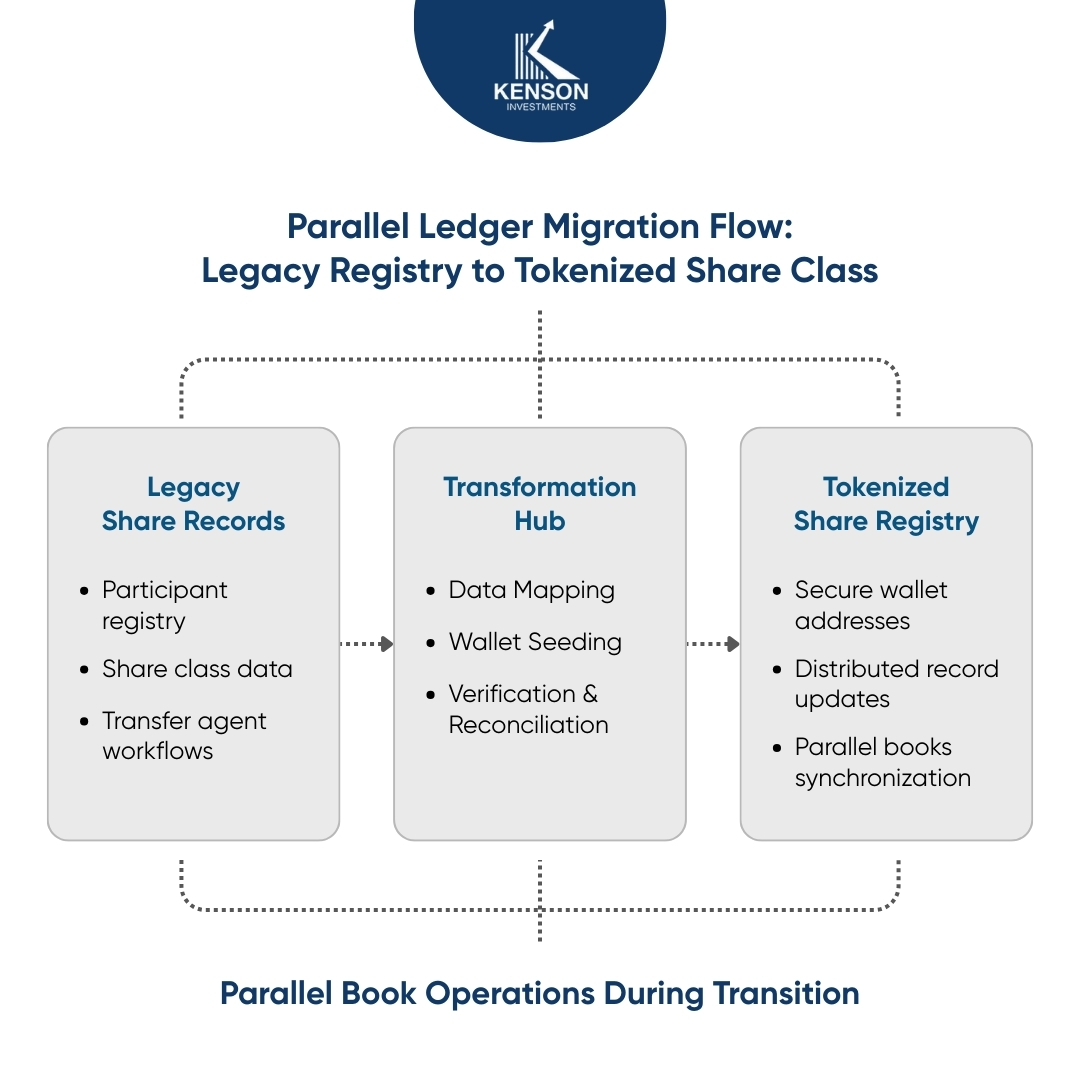
During transition periods, most legacy funds operate parallel systems. Onchain token records coexist with offchain registries to ensure continuity and auditability.
Synchronization processes typically include:
- Daily reconciliation between systems
- Automated alerts for discrepancies
- Redundant reporting outputs
- Defined escalation procedures
Parallel operations are a core focus within digital asset management consulting, as they allow organizations to validate onchain systems without abandoning established controls.
This approach supports gradual adoption and reduces operational risk during early tokenization phases.

Step Six: Managing Transitional Governance
Governance does not disappear when shares become tokenized. Decision rights, voting procedures, and reporting obligations must be clearly defined.
Legacy funds often retain offchain governance mechanisms while exploring onchain enhancements. These may include token-based voting or automated recordkeeping, implemented gradually.
Educational materials developed through cryptocurrency investment solutions initiatives stress that governance evolution should follow operational readiness, not market pressure.
Throughout this phase, transparency remains essential. Participants must understand what has changed and what remains the same.
Parallel Operations and Risk Awareness
Running parallel books is resource-intensive but common. It allows funds to validate onchain records, test controls, and refine processes without introducing unnecessary exposure.
Data from industry studies published in 2024 indicate that more than 65 percent of funds exploring tokenized share classes maintained parallel operations for at least twelve months before consolidating systems. This cautious approach reflects broader themes in risk management in crypto investments.
Tokenization introduces new operational considerations, including key management and smart contract dependencies. A measured transition helps teams address these factors systematically.
How Market Participants Evaluate Migration Readiness
Organizations evaluating tokenized share classes often seek educational insight from digital asset consulting services to assess readiness across people, processes, and technology.
Key readiness indicators include:
- Internal operational maturity
- Participant familiarity with digital wallets
- Reporting and reconciliation capabilities
- Governance clarity
Within broader market discussions involving fund management services, tokenization is viewed as an infrastructure evolution rather than a short-term initiative.

The Role of Education in Tokenized Fund Transitions
Education underpins every successful migration. Tokenized share classes introduce unfamiliar concepts that require clear explanation.
Organizations positioned as a crypto investment firm or investment company often publish educational resources to help participants understand blockchain mechanics, custody responsibilities, and operational boundaries.
Similarly, cryptocurrency hedge fund structures exploring tokenization emphasize structured learning to avoid misconceptions. Tokenization does not remove market volatility or operational risk.
Across hedge fund firms and management companies, tokenization is increasingly discussed as a tool for efficiency, not a promise of outcomes.
Migration Pathways Will Continue to Evolve
Tokenized share classes remain an emerging practice. Standards are developing, and best practices continue to evolve.
As more organizations experiment with these structures, shared knowledge improves. Case studies from hedge fund investment strategies and venture capital fund management contexts show that gradual, well-governed transitions reduce friction.
Firms involved in investment analysis and portfolio management recognize that infrastructure changes must be aligned with long-term operational goals.
Learn More with Kenson Investments
Understanding tokenized share class migration requires clarity, education, and careful planning. At Kenson Investments, our Digital Asset Specialists focus on helping market participants interpret infrastructure shifts, assess operational readiness, and understand how blockchain-based structures interact with existing fund frameworks, including considerations tied to RWA tokenization investment, tokenfi rwa, and institutional supply chain digitization.
Explore our educational resources on digital asset consultation to enhance ROI with digital asset consulting, review insights on digital asset investments relevant to nft investors and emerging models such as ai cloud mining, or contact us to learn how structured market awareness supports informed decision-making across areas like Solana DeFi risk management and consultancy for DeFi finance investments.
Disclaimer:
The information provided on this page is for educational and informational purposes only and should not be construed as financial advice. Crypto currency assets involve inherent risks, and past performance is not indicative of future results. Always conduct thorough research and consult with a qualified financial advisor before making investment decisions.
“The crypto currency and digital asset space is an emerging asset class that has not yet been regulated by the SEC and the US Federal Government. None of the information provided by Kenson LLC should be considered as financial investment advice. Please consult your Registered Financial Advisor for guidance. Kenson LLC does not offer any products regulated by the SEC, including equities, registered securities, ETFs, stocks, bonds, or equivalents.: