










In electronic markets, submitting an order cancellation does not guarantee that the order has stopped executing. A cancellation request may reach a trading system while the original order is already being matched, creating an order cancellation race in which different records appear to tell different stories.
One system may acknowledge the cancellation request, while another reports that some or all of the order was filled. This can seem contradictory, but both events may be valid. The key is understanding what each message confirms, when the underlying event occurred, and whether the available records provide a complete account.
For digital asset operations, this distinction matters. Treating a cancellation acknowledgement as proof that no trade occurred can lead to inaccurate balances, incomplete transaction histories, and incorrect exposure records. Reliable reconciliation depends on examining the full sequence of events rather than relying on a single status.
What Happens During an Order Cancellation Race?
An order cancellation race occurs when a cancellation request and an execution process overlap. Once an order enters a matching system, it may be eligible for execution until the system processes the cancellation and changes the order’s state.
Consider a simplified example. A participant submits an order to buy 100 units. Later, the participant requests cancellation. Before the cancellation is processed, 30 units are matched. The system may then cancel the remaining 70 units.
The resulting record can show both a fill for 30 units and a cancellation for the unfilled remainder. These events are not inherently inconsistent: the cancellation stopped further execution after the fill had occurred.
Other outcomes are possible. The order might be fully filled before cancellation takes effect, or the cancellation might be processed before any execution occurs. The actual result depends on the venue’s processing rules, event sequence, and order status.
Why an Acknowledgement Is Not Proof of Zero Execution
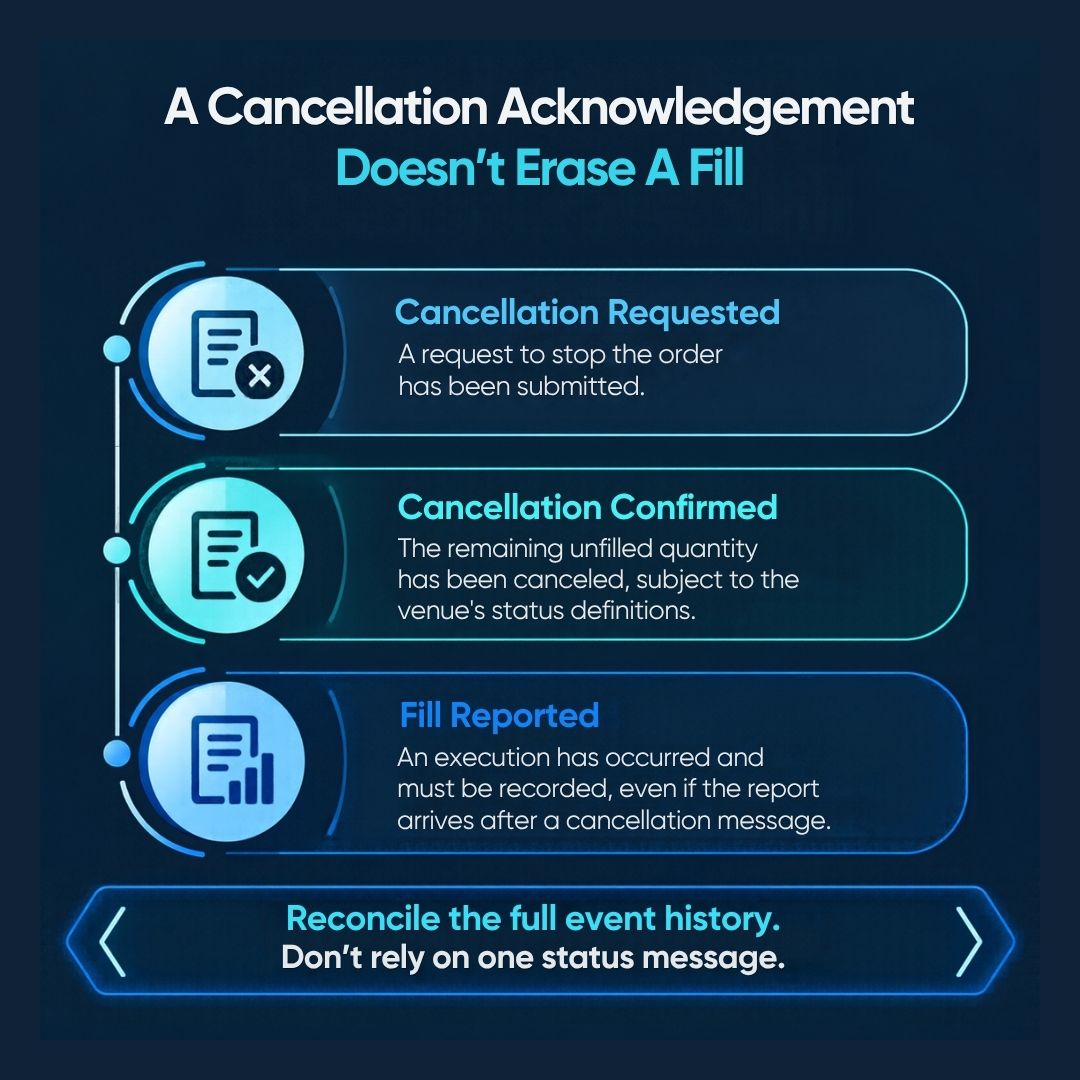
A cancellation acknowledgement confirms a particular stage of the cancellation process, according to the venue or platform that issued it. Its meaning depends on the message definition.
An acknowledgement may confirm receipt of a request rather than final cancellation. A confirmed cancellation may indicate that the remaining order quantity is no longer active, without reversing executions completed beforehand.
This distinction becomes especially important when systems use similar labels for different events. “Request received,” “cancel pending,” and “canceled” should not automatically be treated as interchangeable statuses.
A fill reported through another channel may arrive later because execution reports and cancellation messages can travel through separate streams, be processed asynchronously, or appear in different orders in an interface. Message arrival time alone does not establish the actual sequence of underlying events.
The practical lesson is straightforward: acknowledgement, cancellation confirmation, and execution reporting are separate pieces of evidence. None should be interpreted beyond what its documented meaning supports.
Mapping the Evidence Across Order States
A dependable review begins by identifying which records describe the request, which describe the order’s state, and which confirm executed quantity.
Relevant evidence may include:
- Order identifiers: The original order ID and any venue-specific identifiers used to associate messages with the same order.
- Cancellation request records: The request timestamp, reference number, and response received.
- Execution reports: Fill quantity, execution price, execution identifier, and the event timestamp supplied by the venue.
- Order-state updates: Accepted, partially filled, canceled, rejected, or completed states, where supported by the platform.
- Sequence information: Venue sequence numbers or event identifiers that help establish ordering when available.
- Account records: Subsequent balance movements, fees, and settlement entries that help confirm the recorded economic effect.
These records should be assessed together. A timestamp displayed by a dashboard may reflect message receipt rather than the event’s occurrence. Where the distinction matters, reviewers should preserve both timestamps and understand their definitions.
Reconciliation When Records Appear to Conflict
When a cancellation acknowledgement and a fill appear together, the first step is not to assume that one record is wrong. Establish whether both records refer to the same order and determine what each event represents.
Next, compare event timestamps and sequence information, accounting for differences between event time and receipt time. Review the venue’s documented order-state rules, including how partial fills and cancellation requests are handled.
Then reconcile the quantities. For an order partially filled before cancellation, the executed amount should be recorded separately from the remaining amount canceled. The total should align with the original order quantity, subject to any venue-specific adjustments or reporting conventions.
If the records still disagree, preserve the evidence and flag the discrepancy for investigation. Do not silently overwrite one status with another or infer that a missing message proves an event did not occur. Some venues provide authoritative order histories or execution queries that can help resolve incomplete event streams.
The Kenson Perspective: Clarity Over Assumptions
At Kenson Investments, operational clarity is an important part of responsible digital asset management. Market events should be understood through documented evidence, consistent records, and disciplined review rather than assumptions based on a single notification.
An order cancellation race illustrates why this approach matters. A status label may be useful, but its meaning is limited to the event it represents. Reliable oversight requires connecting order requests, state changes, execution reports, and account-level records into a coherent history.
This perspective supports a broader principle of capital stewardship: operational records should explain what happened, not merely display the latest status. When evidence is incomplete or inconsistent, documenting uncertainty is more responsible than presenting an unverified conclusion.

Building Better Order-State Records
Organizations can improve reconciliation by retaining original event messages, recording both event and receipt times, preserving unique identifiers, and documenting how each venue defines its statuses. Periodic reviews can identify missing reports, duplicate events, and quantity mismatches before they affect wider records.
These controls do not prevent every reporting delay or system discrepancy. They make issues easier to detect, investigate, and explain. They also help ensure that downstream accounting and exposure records reflect actual executions rather than assumptions about cancellation requests.
Continue Learning with Kenson Academy
Order-state evidence is one part of understanding digital market infrastructure. Kenson Academy and the Kenson Knowledge Center provide educational resources for readers seeking a stronger foundation in digital asset operations, market structure, and disciplined recordkeeping. Register today!
Disclaimer: The information provided on this page is for educational and informational purposes only and should not be construed as financial advice. Cryptocurrency assets involve inherent risks, and past performance is not indicative of future results. Always conduct thorough research and consult with a qualified financial advisor before making investment decisions.
“The cryptocurrency and digital asset space is an emerging asset class that has not yet been regulated by the SEC and the US Federal Government. None of the information provided by Kenson LLC should be considered as financial investment advice. Please consult your Registered Financial Advisor for guidance. Kenson LLC does not offer any products regulated by the SEC, including equities, registered securities, ETFs, stocks, bonds, or equivalents.”



