











Solana Pay is no longer just a curiosity for Web3-native merchants—it’s entering serious conversations at boardroom tables. From multinational retailers to B2B platforms exploring instant settlements, Solana’s low-latency and near-zero fee infrastructure is driving new institutional pilots for merchant payments and enterprise disbursements.
What sets these pilots apart isn’t simply the underlying blockchain—it’s how Solana Pay is being used in real-time wallet integrations, programmable disbursements, and merchant-side treasury controls that traditional payments infrastructure has failed to offer. The result? A cleaner, faster, and more transparent system for value transfer.
Why Institutions Are Eyeing Solana Merchant Payments
Solana Pay offers a peer-to-peer payment protocol that settles transactions directly on the Solana blockchain, known for high throughput (65,000+ TPS) and sub-cent fees. Unlike Layer 2 rollups or sidechains, Solana’s base layer is fast enough to eliminate intermediaries in payment processing, enabling direct transactions between users and merchants.
Key Features:
- Instant finality– Payments are confirmed in under 400ms
- Fees under $0.001 per transaction
- Built-in QR code and wallet integration support
- Open-source developer tools for merchants
- Support for USDC and other stablecoins
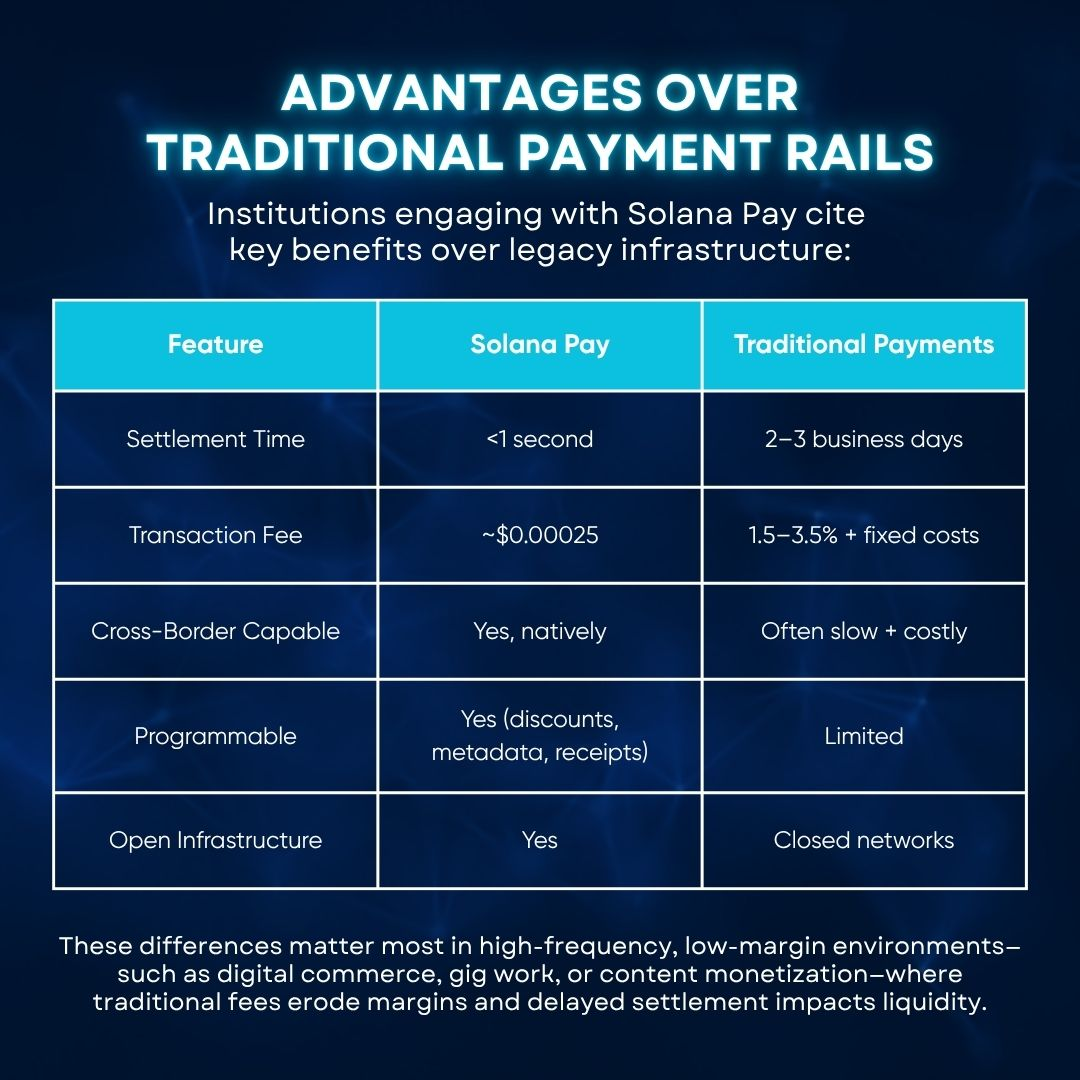
For institutions managing thousands of microtransactions or real-time disbursements, the cost and latency advantages are significant when compared to card processors or bank rails.
Where Solana Merchant Payments Are Being Deployed
Retail Pilots: Low-Friction Checkout
In retail, Solana Pay pilots have focused on in-store QR code payments, wallet-based authentication, and instant confirmation. Retailers testing the system report:
- <1-second settlementversus traditional 2–3 day card processing
- No interchange fees(vs. 1.5–3.5% typical card fees)
- Real-time wallet-based incentives, reducing reliance on third-party rewards apps
For example, a multinational fashion brand recently completed a limited pilot at flagship stores in New York and Tokyo, allowing customers to pay using their Phantom wallets. Transactions were not only instant but integrated into the store’s CRM system, tagging customer behavior and enabling direct-to-wallet coupon issuance for future visits.
Enterprise Disbursements: Payroll, Rewards, and Vendor Payouts
Institutional treasury teams are also experimenting with Solana Pay for automated disbursements. Instead of relying on batch ACH transfers or international wire systems with embedded costs and delays, companies are exploring Solana’s programmable transfers to:
- Send real-time micro-bonuses to employees based on KPIs
- Distribute payments to global vendors in USDC within seconds
- Maintain transparent, immutable logs of payment history
These use cases are particularly relevant in sectors like ride-sharing, logistics, and creator economies—anywhere payment timing directly affects user satisfaction or platform engagement.
Wallet Integration: Seamless Consumer and Merchant Experience
Solana Pay’s architecture enables native wallet integration, meaning users don’t need separate apps or plugins to make payments. Phantom, Solflare, and other wallets now support Solana Pay links and QR code scanning for merchant checkouts.
On the merchant side, POS systems can be built with:
- QR-code generation for each purchase
- Auto-confirmation and inventory tracking
- Receipt metadata pushed directly to user wallets
This simplifies both sides of the transaction and reduces dependencies on APIs and external payment gateways. Institutions piloting this flow are focusing on omnichannel commerce, ensuring the same payment infrastructure can support physical stores, websites, and mobile apps.
Risk Considerations and Technical Challenges
Despite the appeal, institutional adoption of Solana Pay isn’t without friction. The key challenges include:
- Volatility Exposure: Native SOL payments are subject to price fluctuations, although most pilots use USDC or other stablecoins.
- Compliance Readiness: Regulatory reporting, AML screening, and tax obligations need to be integrated into payment flows.
- Network Reliability: While Solana’s performance has improved significantly in 2024 and 2025, past downtime has made risk officers cautious.
Institutions address these concerns through controlled pilot environments, with capped volumes and pre-approved users. Some have built additional compliance middleware to run KYC and screen payments before final confirmation on-chain.
The Bigger Picture: Interoperability and Institutional Onramps
The vision for Solana Pay extends beyond Solana itself. With protocols like Wormhole enabling cross-chain compatibility, and real-world asset (RWA) initiatives growing, it’s likely Solana Pay will soon interface with other chains and tokenized assets, bringing new composability to institutional payment rails.
Additionally, centralized exchanges (CEXs) and OTC desks are exploring Solana Pay plugins that allow direct off-ramping of assets to USDC wallets—bridging the fiat and crypto divide even for non-technical teams.
Is Solana Pay Ready for Prime Time?
Solana Pay is proving its potential in live pilots across sectors. While not yet a plug-and-play solution for every institution, it’s clear that merchant payments and enterprise disbursements are entering a new era of programmability and efficiency.
For businesses seeking low-cost, real-time settlement infrastructure without sacrificing regulatory foresight, Solana Pay offers a forward-thinking alternative. As ecosystem partners mature and infrastructure improves, expect more institutional pilots—and even full deployments—in the year ahead.
Stay Ahead of Blockchain Payment Innovation
Institutions exploring crypto payment infrastructure must think beyond pilot projects and toward scalable deployment. Whether you’re evaluating retail wallet integrations, cross-border disbursements, or token-based loyalty programs, Solana Pay offers a fast, open, and programmable option that’s production-ready.
At Kenson Investments, we monitor the evolution of real-time blockchain payment systems and their impact on asset deployment, fund structuring, and financial infrastructure. If your firm is exploring scalable blockchain-based payment solutions or looking to stay ahead of digital asset infrastructure shifts, contact Kenson Investments to learn how we evaluate opportunities in programmable finance and on-chain commerce.
Disclaimer: The information provided on this page is for educational and informational purposes only and should not be construed as financial advice. Crypto currency assets involve inherent risks, and past performance is not indicative of future results. Always conduct thorough research and consult with a qualified financial advisor before making investment decisions.
“The crypto currency and digital asset space is an emerging asset class that has not yet been regulated by the SEC and the US Federal Government. None of the information provided by Kenson LLC should be considered as financial investment advice. Please consult your Registered Financial Advisor for guidance. Kenson LLC does not offer any products regulated by the SEC, including equities, registered securities, ETFs, stocks, bonds, or equivalents.”



