









Liquidity is often described as the ease with which an asset can be exchanged without significantly affecting its price. In digital asset markets, liquidity is highly visible. Order books, automated liquidity pools, and real-time pricing create the impression that exit is always available.
However, liquidity and exit capacity are not the same. On-chain markets reveal this distinction with unusual clarity, especially during periods of operational stress.
Understanding digital asset liquidity risk requires separating what appears available from what can actually be executed under real conditions, a distinction frequently analyzed through Digital assets consulting frameworks.
Visible Liquidity vs. Exit Capacity
Visible liquidity is what you see: token balances on a decentralized exchange (DEX), the best bid and ask on a centralized order book, or total locked value in a protocol. Exit capacity is what actually happens when you attempt to move value out of a position. Two key differences explain why the two can diverge:
- Fragmentation:Liquidity can be spread across many venues and order book levels. The sum of small pockets of liquidity may look large on aggregate but be shallow when accessed from a single execution path.
- Stress sensitivity:In stressed conditions, counterparties withdraw liquidity, fees spike, and automated market makers (AMMs) reprice instantly. That visible liquidity can vanish or become prohibitively expensive when it’s needed most.
Understanding crypto exit mechanics means asking not just “how much liquidity exists?” but “how will liquidity behave when I try to transact, and what are the execution frictions I’ll face?” — a question often explored in Consultancy for DeFi Finance investments engagements.
Order Book Depth: The Illusion of Size
Order book depth shows the cumulative limit orders at different price levels. A deep book suggests a buyer or seller will absorb a sizable trade with limited price movement. But order books can be deceptive:
- Hidden orders and iceberg ordersmay mask true depth.
- Latency and cancellationsmean displayed orders can disappear before they execute. In on-chain contexts, front-running bots and mempool observation can accelerate order cancellations and order flow changes.
- Concentration riskmatters: if a large fraction of depth sits with a few entities, those entities’ behavior determines exit capacity.
Under stress, the visible depth can evaporate quickly. That evaporation is not a failure of the market so much as a dynamic reallocation of risk: liquidity providers choose to reduce exposure when they see adverse signals.
Slippage and Market Impact: Cost of Exiting
Slippage is the difference between the expected execution price and the actual price received. Market impact is the price movement caused by executing an order.
Key drivers of slippage in digital asset markets include:
- Order size relative to available depthat each price level.
- Execution speedand transaction confirmation times in the network. Slow confirmation can increase the realized cost if prices move while a transaction is pending.
- Fee dynamics, including gas fees on blockchains, which can make small trades uneconomical during congestion.
In AMM-based markets, slippage follows mathematical curves driven by the liquidity curve of the pool. In order-book markets, slippage depends on sequentially taking out liquidity at successive price levels. Both frameworks show that larger trades cause disproportionately larger price moves, especially when liquidity is shallow or fragmented.
Liquidity Signaling vs. Liquidity Commitment
One of the most misunderstood aspects of digital asset markets is the difference between liquidity as a signal and liquidity as a commitment.
Displayed liquidity reflects intent, not obligation. Orders can be canceled, pools can rebalance, and routing paths can change in milliseconds. This distinction matters because exit mechanics depend on what liquidity providers are willing to commit at the moment of execution, not what they previously signaled.
In on-chain environments, signaling is especially fragile. Automated systems react to transaction visibility, price movements, and network congestion. When volatility increases, liquidity signals degrade quickly, leaving exit paths thinner than expected. This reinforces digital asset liquidity risk as a dynamic, behavior-driven exposure rather than a static metric.
Fee Markets and Exit Compression
Transaction fees play a larger role in exit mechanics than many dashboards suggest. On blockchains, fees are not fixed costs—they are competitive markets. When activity spikes, participants compete for transaction inclusion, driving fees higher and compressing effective exit windows.
This creates a layered form of friction:
- Higher fees reduce net proceeds from exits.
- Delayed confirmations increase exposure to price movement.
- Failed or dropped transactions require resubmission at higher cost.
During congestion, small exits may still be possible, but larger exits can become impractical without incurring significant slippage and fee overhead. Fee volatility therefore acts as an invisible constraint on exit capacity, even when nominal liquidity appears sufficient.

Correlation Effects and Liquidity Clustering
Liquidity risk is not isolated to a single token. Correlation between assets can cause cascading effects:
- Cross-asset correlation:When multiple assets move together, attempts to exit one position can trigger rebalancing or liquidations in correlated holdings, increasing selling pressure.
- Leverage and margin mechanics:Liquidations on lending platforms or margin exchanges can create concentrated sell pressure that overwhelms visible liquidity.
- Protocol linkages:Bridges, wrapped tokens, and composability mean stress on one protocol can transmit to others, reducing exit capacity across many assets simultaneously.
These correlation effects transform what looks like localized liquidity into system-level vulnerability — a key component of crypto systemic risk.
Liquidity Recycling and Reflexive Pressure
Liquidity in digital asset markets often recycles rapidly through leveraged positions, automated strategies, and protocol incentives. While recycling can enhance apparent depth during stable conditions, it introduces fragility during stress.
As prices move, automated systems rebalance or unwind positions simultaneously. This synchronized behavior concentrates exit demand into short timeframes. The result is reflexive pressure: selling begets more selling, not because fundamentals changed, but because liquidity pathways are structurally intertwined.
This reflexivity is amplified on-chain, where composability links protocols together. A disruption in one liquidity source can propagate across others, reducing exit options in multiple venues at once.
Liquidity During Asymmetric Stress
Not all stress affects markets evenly. Asymmetric stress—where selling pressure dominates buying interest—exposes the limits of exit mechanics. In these conditions, liquidity providers demand greater compensation for risk, widening spreads and steepening slippage curves.
On-chain markets respond algorithmically. AMMs adjust prices mechanically as reserves shift. Order books thin as participants withdraw bids. These responses are rational, but they mean that exit costs rise nonlinearly just as demand for exits increases.
Visible liquidity metrics often lag these changes, reinforcing the gap between perceived and actual exit capacity.
The Role of Time-to-Finality
Time-to-finality—the duration between transaction submission and irreversible confirmation—is a critical but underappreciated component of crypto exit mechanics. While blockchains operate continuously, confirmation is probabilistic until finality is reached.
During periods of high activity:
- Pending exits remain exposed to price changes.
- Competing transactions may reorder execution priority.
- Partial fills or failed swaps can increase realized slippage.
Exit capacity is therefore not only about price and depth but also about how long value remains exposed during execution. Faster settlement does not eliminate this exposure; it reshapes it.
Fragmentation and Venue Selection
Liquidity fragmentation across multiple venues — both centralized exchanges and decentralized platforms — means execution strategy matters. Aggregation tools and smart order routers attempt to source liquidity across venues, but they face real constraints:
- Routing latency:Splitting an order across venues requires coordination. Execution at one venue can change prices at another before orders there fill.
- Counterparty rules and withdrawal limits:Centralized venues may impose withdrawal holds or limits, which affect how quickly assets can be moved off-platform into on-chain holdings or fiat rails.
- KYC/AML and access frictions:Non-technical barriers can inhibit immediate exit options for certain participants.
Visible liquidity across venues gives an impression of capacity that can be misleading if execution cannot access that depth simultaneously.
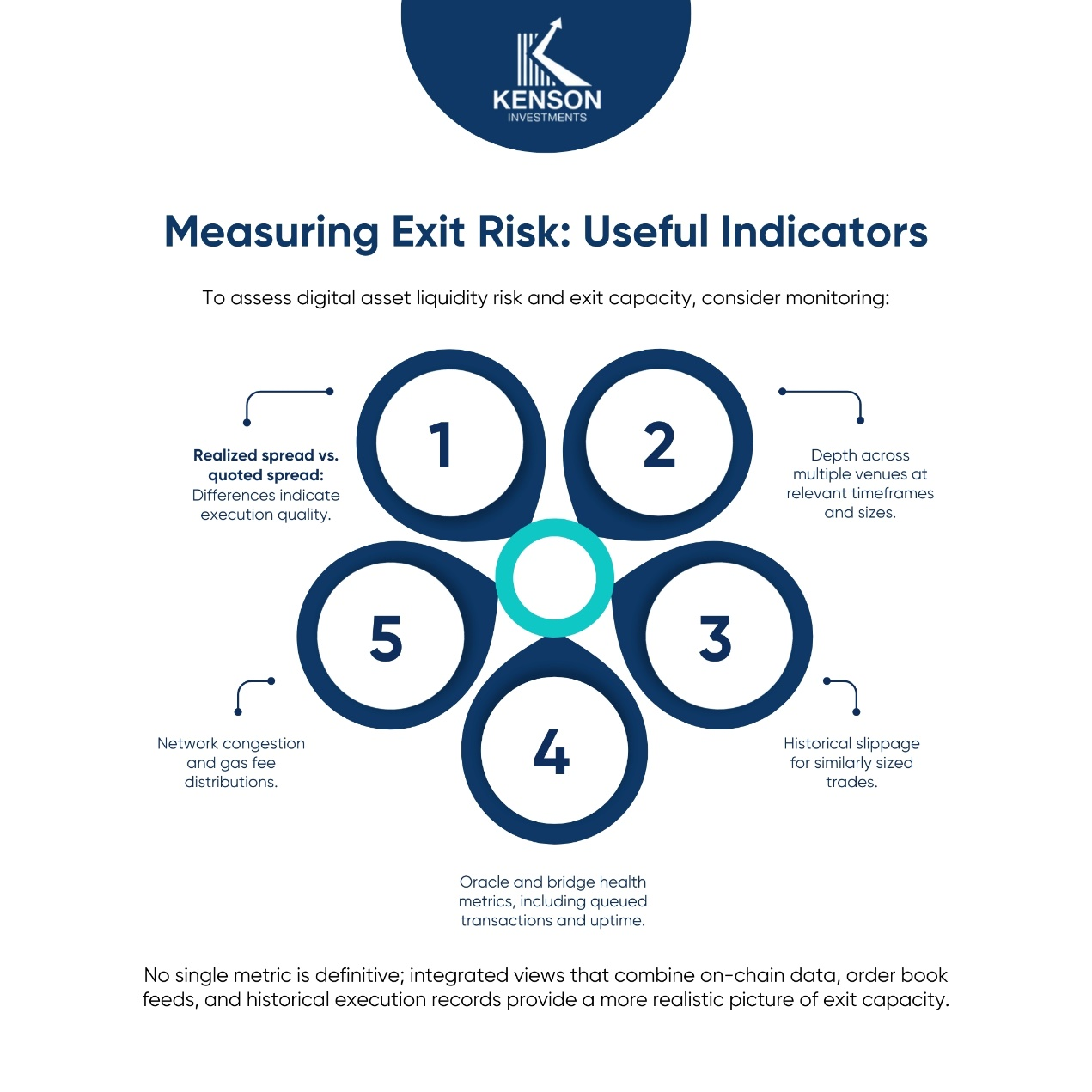
When Exit Becomes Difficult
During stress events, several mechanisms impair exit capability:
- Liquidity provider withdrawal:Market makers pull orders to manage risk.
- Fee spikes:Network congestion raises transaction costs, making exits more expensive or unattractive.
- Protocol halts:Bridges, oracles, or contract-level pauses can prevent certain exits entirely until governance or maintainers intervene.
These dynamics highlight the difference between a static snapshot of liquidity and the dynamic processes that determine exit feasibility under real conditions.
Execution Path Dependency
Exit outcomes depend heavily on execution paths. A trade routed through a single pool may experience different results than one split across multiple venues. However, path optimization itself introduces complexity, a topic often examined in Blockchain and digital asset consulting.
Smart routing tools attempt to minimize slippage by distributing orders, but they operate under assumptions about liquidity stability. In volatile conditions, those assumptions may fail, leading to execution outcomes that diverge from expectations, which is why institutions frequently seek Digital asset consulting for compliance to better evaluate operational risks.
Path dependency means that two participants exiting the same position size at the same time can experience materially different results depending on routing, timing, and network conditions, particularly in markets analyzed through DeFi Finance consulting services and by Security tokens investment consultants.
Understand Liquidity Beyond the Numbers
Visible liquidity can create a false sense of certainty when execution conditions change rapidly. Kenson Investments offers educational materials and market structure insights that help readers examine how on-chain liquidity behaves under pressure, how exit pathways narrow during stress, and why execution mechanics matter as much as quoted depth, especially when evaluating structured Cryptocurrency investment solutions.
Our digital asset consultants focus on clarifying how order book depth, slippage, and correlation influence outcomes. Follow us for continued updates to better understand how liquidity functions when exits are tested, not just displayed.
Disclaimer: The information provided on this page is for educational and informational purposes only and should not be construed as financial advice. Crypto currency assets involve inherent risks, and past performance is not indicative of future results. Always conduct thorough research and consult with a qualified financial advisor before making investment decisions.
“The crypto currency and digital asset space is an emerging asset class that has not yet been regulated by the SEC and the US Federal Government. None of the information provided by Kenson LLC should be considered as financial investment advice. Please consult your Registered Financial Advisor for guidance. Kenson LLC does not offer any products regulated by the SEC, including equities, registered securities, ETFs, stocks, bonds, or equivalents.”