









Digital asset markets can appear chaotic, but beneath the price swings lies a structural rhythm that informs long-term capital deployment.
Institutional investors are less concerned with headline volatility than with the reliability of networks, liquidity corridors, and governance mechanisms that underpin the ecosystem.Observing these structural signals allows disciplined allocation, risk management, and strategic scaling.
Price alone can be misleading; the health of the underlying infrastructure, transaction flows, and operational integrity dictate whether capital can be deployed confidently.
Understanding these hidden cycles transforms exposure into opportunity, aligning allocation with corridors that can support sustained growth without compromising execution certainty.
This blog explores these cycles, offering a framework for navigating digital asset markets with rigor and insight.
1. Early-Cycle Infrastructure: The Foundation for Capital Deployment
The inception of any digital asset cycle is defined not by price momentum, but by infrastructure readiness. Institutional investors recognize that deploying meaningful capital requires networks, custodians, and exchanges capable of handling scale and stress. Early-cycle infrastructure is measured in operational resilience, throughput, and cross-platform interoperability rather than immediate returns.
Network throughput and latency are primary considerations. Protocols must process high volumes of transactions without bottlenecks, as delays can impact settlement and risk exposure. Evaluating nodes, validators, and consensus mechanisms provides insight into whether a network can maintain execution certainty when capital scales. Institutions often simulate trades under different network conditions, testing both normal and peak loads to gauge reliability.
Custody solutions are equally critical. Multi-signature wallets, insured custodial arrangements, and verifiable audit trails minimize operational and counterparty risk. Without these protections, portfolios face unnecessary exposure, even if the underlying assets are fundamentally sound. Early adoption of secure custody mechanisms differentiates infrastructure ready for institutional-scale capital from speculative networks lacking operational rigor.
Cross-chain interoperability is another foundational element. Networks capable of bridging Layer 1 and Layer 2 protocols or enabling seamless token transfers reduce friction and preserve portfolio flexibility. This ensures capital can migrate efficiently as opportunities emerge across ecosystems, providing a strategic advantage when liquidity corridors evolve.
Operational stress testing informs allocation decisions. By evaluating network performance under simulated congestion, institutions identify vulnerabilities before they threaten execution. Early-cycle investment is less about seizing momentum and more about confirming structural integrity, which allows disciplined scaling in later stages.
Infrastructure assessment extends to ecosystem health, including developer activity, update cadence, and network adoption. Protocols demonstrating consistent development, responsive governance, and scalable technical architecture signal readiness for institutional engagement. Conversely, gaps in operational readiness or governance transparency indicate elevated execution risk.
Network Growth and DeFi TVL Evolution
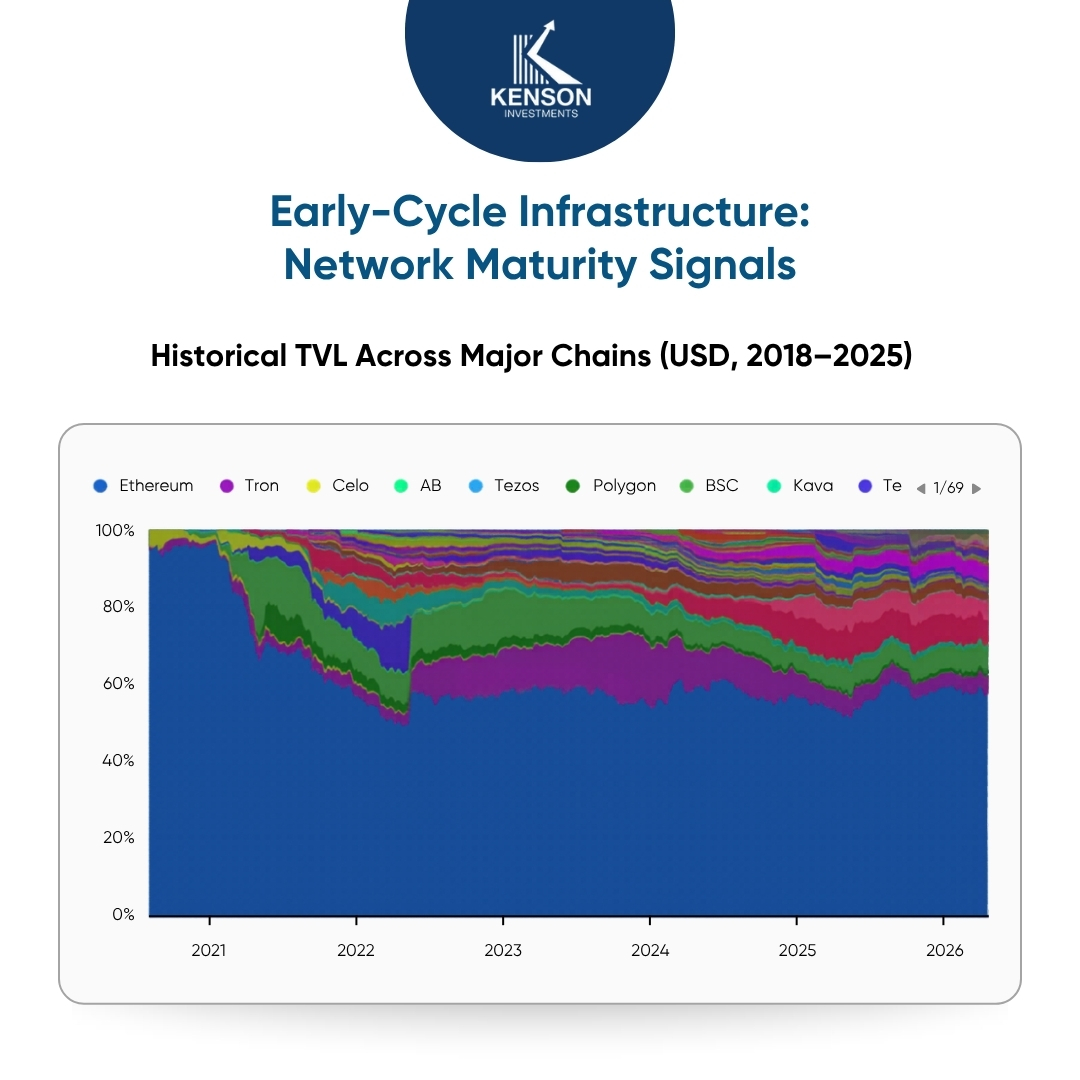
Observing the historical TVL across major chains highlights periods where infrastructure has matured enough to sustain deep capital deployment.
For example, the gradual rise in Ethereum and Layer 2 chains TVL signals operational resilience and cross-chain readiness. Institutional investors often correlate these metrics with protocol throughput, node distribution, and custody solutions to confirm that networks can handle scale and stress. This graph demonstrates that early-cycle investment decisions are informed more by structural capacity than by short-term price movements, reinforcing the focus on operational integrity as the foundation for allocation.
2. Liquidity Migration: Understanding Where Capital Flows
- Cross-Chain Flows Indicate Structural Readiness: Liquidity migration is a key signal in mid-cycle markets. Stablecoins, derivatives, and tokenized assets move toward networks with operational reliability and transparent governance. Tracking these flows allows institutions to identify corridors capable of handling substantial allocations without execution risk.
- Depth and Breadth Over Volume: High trading volume alone can be misleading. Institutions examine order book depth, spread consistency, and participant diversity to determine whether markets can accommodate significant allocations. Superficial volume with concentrated participation creates slippage risk, which can magnify losses during high-volume trades.
- Liquidity Corridors as Allocation Guides: Networks demonstrating sustained inflows and wide participation become prioritized corridors for capital deployment. Fragmented or shallow markets remain under observation, as institutional participation could be compromised by operational stress or insufficient throughput.
- Behavioral Signals Embedded in Flows: Liquidity migration also reflects confidence in network governance and operational robustness. Corridors attracting sustained inflows without sudden volatility indicate structural soundness, whereas erratic movements may signal speculative pressure. Observing these patterns informs decisions on scaling or reducing exposure.
Liquidity migration is not only about where capital is moving, but also about the quality of that movement. Institutions interpret these flows in the context of execution certainty, infrastructure health, and governance transparency. Monitoring the corridors where capital moves reliably provides a framework for disciplined allocation while minimizing exposure to fragile environments.
The analytical approach to liquidity flows integrates quantitative metrics, including token velocity, cross-chain transfer rates, and derivative positions, with qualitative assessment of network governance. By combining these perspectives, investors identify corridors capable of supporting sustained growth without structural compromise.
Stablecoin Supply as a Proxy for Liquidity Corridors
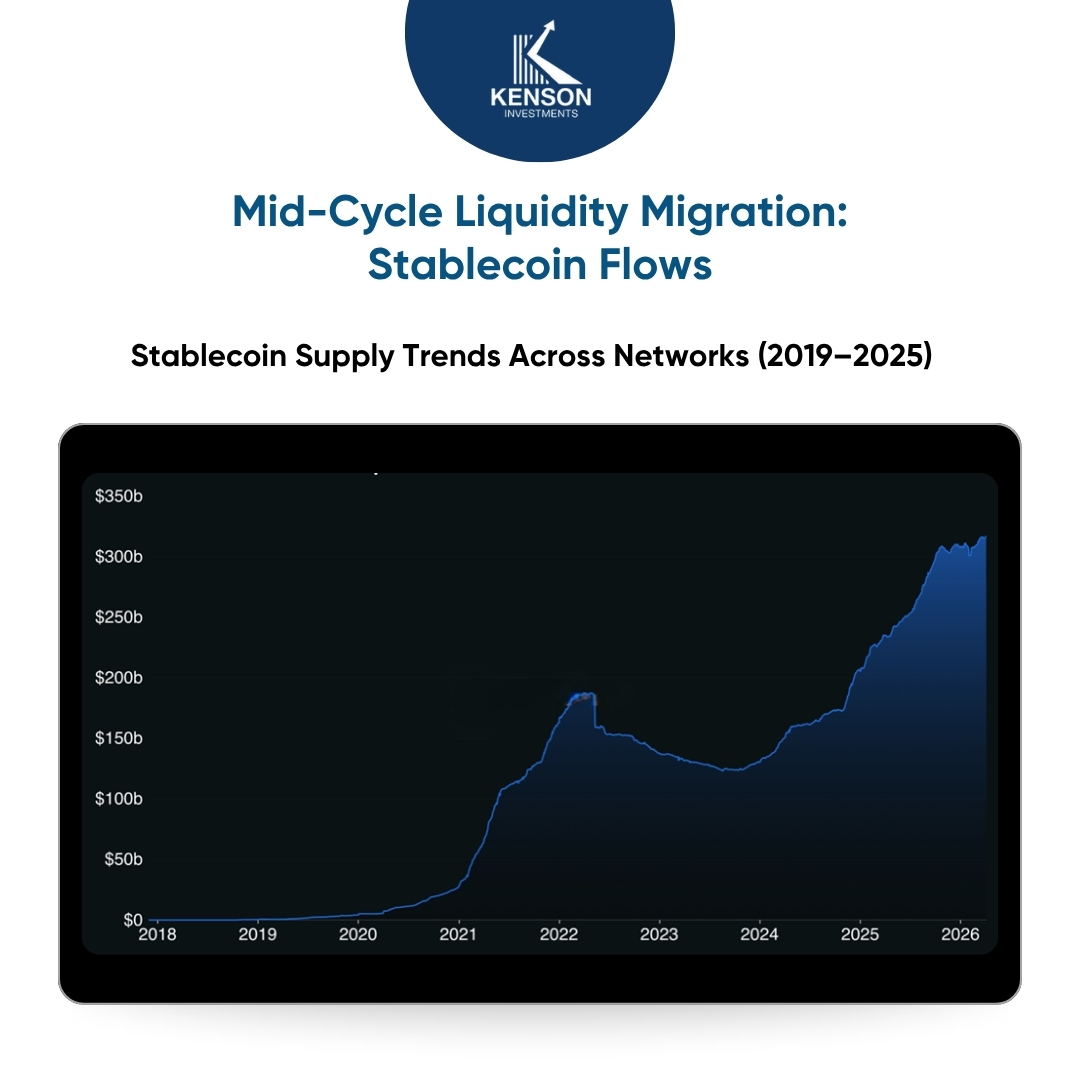
Monitoring stablecoin supply offers insight into the channels where liquidity is actively moving. As this graph illustrates, periods of increasing supply coincide with networks receiving substantial inflows, indicating operational reliability and governance confidence. Institutional participants use these signals to anticipate corridors capable of handling large allocations without execution risk.
By tracking both the magnitude and distribution of stablecoin inflows, investors can differentiate networks that are structurally robust from those driven by speculative momentum, providing a quantitative foundation for disciplined mid-cycle allocation.
3. Speculative Capital Concentration: Recognizing Structural Risks
Speculative concentration emerges as mid-cycle momentum builds. While inflows into trending assets signal adoption, they also introduce structural fragility. Institutional investors differentiate between speculative hype and corridors capable of supporting scaled allocations without operational risk.
Crowding increases correlation risk. Even well-diversified portfolios can suffer when capital accumulates in shallow or concentrated networks. Slippage, amplified volatility, and cascading execution failures may arise if allocations are too large relative to network capacity. Recognizing these concentration effects allows measured scaling while preserving optionality for other growth corridors.
Hidden interdependencies amplify risk. Staking contracts, derivatives, liquidity pools, and bridge mechanisms can transmit stress across networks. Institutions map these interconnections to understand potential exposure, allowing proactive mitigation before systemic failures propagate.
Governance evaluation is critical in speculative environments. Rapidly growing protocols may lack transparent decision-making or robust treasury management. Assessing governance ensures that allocations are deployed in networks capable of maintaining operational integrity, even under stress.
Portfolio discipline remains central. Institutions participate selectively, prioritizing corridors with proven throughput, transparent governance, and resilient liquidity. Speculative concentration acts as a structural warning, guiding allocation strategy rather than prompting reactive trading. By maintaining a rigorous, metrics-driven framework, portfolios remain insulated from mid-cycle fragility, retaining capacity to scale exposure to structurally sound corridors as they emerge.
Operational metrics, including transaction finality, settlement reliability, and node uptime, provide further insight into structural robustness. Evaluating these factors prevents overexposure to popular but operationally fragile assets, preserving capital while maintaining strategic optionality.
In essence, speculative capital concentration signals opportunity but also risk. By integrating operational and governance analysis into allocation decisions, investors maintain disciplined exposure, ensuring that participation in high-growth networks aligns with infrastructure readiness and long-term sustainability.
Perpetual Futures vs Spot Trading Volume
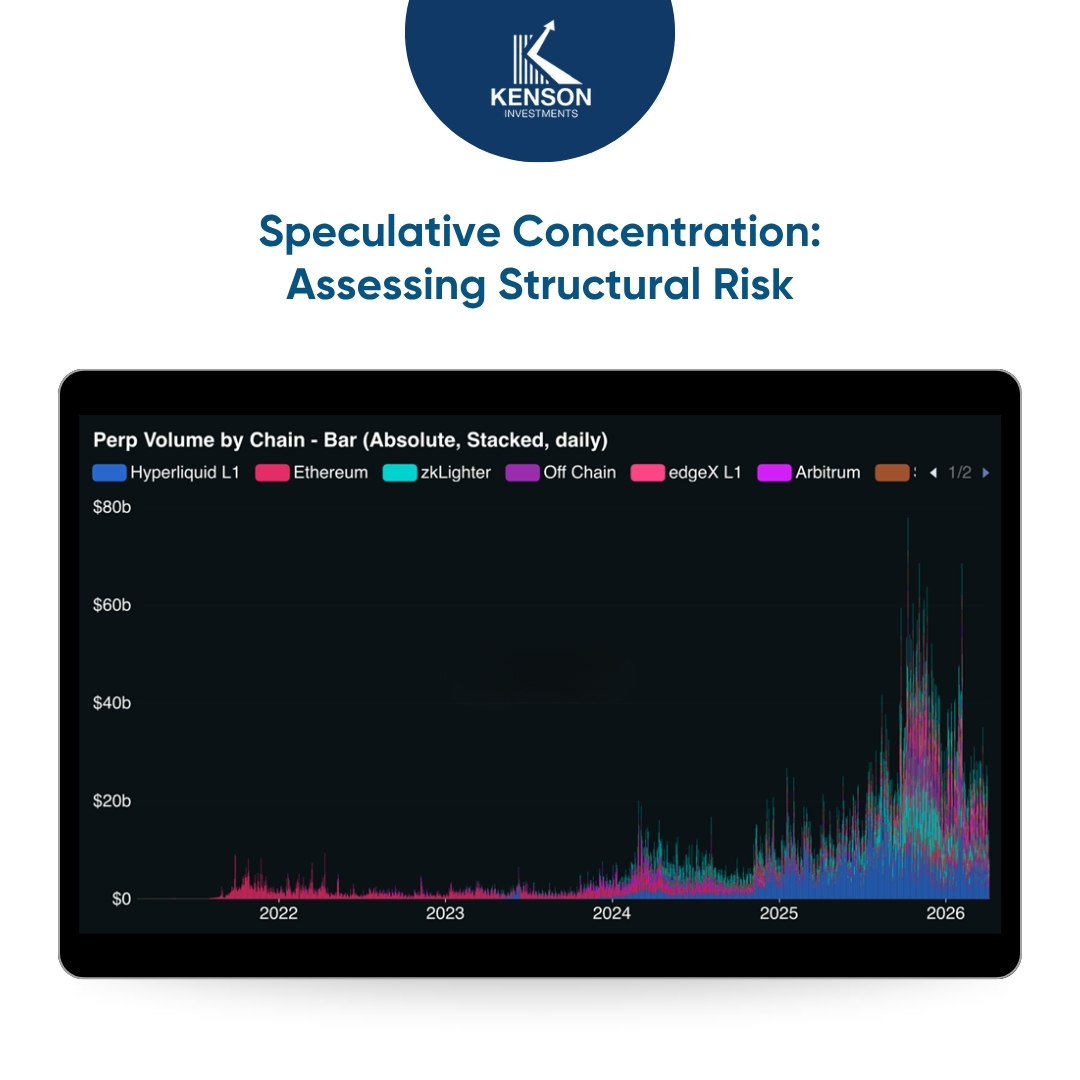
This graph shows that periods of intense perpetual trading often precede structural stress in liquidity corridors. Institutions watch these metrics closely to avoid overexposure to crowded positions, which can amplify slippage and volatility.
By analyzing the ratio of derivatives volume to spot trading, investors identify when speculative capital is disproportionately concentrated in networks that may lack the operational depth to sustain large allocations. Integrating this data into allocation strategy allows portfolios to scale selectively, mitigating risk while maintaining optionality for corridors demonstrating structural robustness.
4. Momentum vs. Fragility: Evaluating Market Strength
Price momentum in digital asset markets can be seductive, but superficial growth often masks structural fragility. Institutional investors differentiate between networks with genuine operational resilience and corridors where momentum is purely speculative. Understanding this distinction is crucial for disciplined capital deployment, portfolio preservation, and risk management.
Execution certainty is central. Networks with shallow liquidity, narrow order books, or concentrated participation are prone to slippage and amplified volatility, even when prices rise sharply. Institutions assess execution risk by evaluating throughput stability, transaction latency, and settlement finality under varied loads. This ensures allocations are feasible at scale without compromising capital integrity.
Operational robustness underpins market strength. Networks experiencing rising adoption are scrutinized for redundancy, node distribution, and load-handling capacity. Momentum without underlying operational readiness may result in network congestion, delayed settlements, or transactional failure. Early recognition of these vulnerabilities allows portfolios to be positioned selectively, favoring corridors with consistent performance.
Governance transparency acts as a structural gauge. Protocols with clear, auditable decision-making processes, accountable treasury management, and established upgrade procedures are more likely to maintain stability amid growth. In contrast, opaque governance increases the risk of unexpected disruptions, which can amplify fragility during periods of speculative enthusiasm.
Behavioral indicators also inform evaluation. Rapid influxes of capital from retail-dominated corridors, token velocity spikes, and concentrated derivative activity are warning signs that momentum may be fleeting. By correlating these signals with operational and governance metrics, institutions identify sustainable growth corridors versus those likely to experience sudden correction or stress.
This phase emphasizes a balance between opportunity and caution. Institutions deploy capital incrementally, maintaining optionality while testing execution reliability. By integrating liquidity, operational, and governance analysis, portfolios are insulated from the exaggerated risks of superficial momentum. The result is disciplined allocation that benefits from structural confidence rather than speculative hype, positioning investors to scale selectively as networks demonstrate resilience and capacity for meaningful participation.
5. Structural Weaknesses: Early Warning Indicators of Contraction
- Liquidity Stress Signals: Early contraction often begins in liquidity corridors. Narrow order books, concentrated holdings, and sudden outflows indicate stress. Observing these trends allows proactive scaling of positions or temporary withdrawal to preserve capital.
- Operational Vulnerabilities: Transaction failures, delayed finality, and reliance on single custodians or exchanges reveal systemic weaknesses. Institutions simulate high-volume transactions under stress to confirm which networks can sustain operational demands during contraction.
- Governance Opacity: Protocols lacking transparent decision-making or auditable treasury management are susceptible to abrupt stress. Monitoring governance maturity informs decisions on whether to maintain exposure or prioritize more resilient corridors.
- Interconnected Risks: Cross-chain dependencies, staking mechanisms, and derivative linkages can amplify stress across the ecosystem. Understanding these interconnections ensures that portfolios are insulated from cascading failures that may originate in structurally weak corridors.
- Behavioral Patterns: Contraction often coincides with erratic capital flows. Abrupt liquidity migrations, elevated leverage, and speculative positioning may indicate that the underlying network is not capable of sustaining high-value allocations, signaling caution for institutional participants.
Institutions integrate these indicators to identify early contraction. Rather than reacting to price alone, portfolios adjust exposure based on structural signals. This approach preserves optionality, mitigates execution risk, and maintains alignment with long-term strategic objectives.
Recognizing weakness before it impacts capital ensures disciplined management, preventing forced liquidation and protecting portfolio integrity.
6. Capital Reallocation Strategies in Mid- to Late-Cycle Markets
Strategic reallocation is the backbone of resilient portfolio management across digital asset cycles. As markets transition from mid-cycle growth to late-cycle consolidation, capital must be deployed in a way that balances opportunity capture with risk mitigation, maintaining flexibility and execution certainty.
Dynamic position adjustment is fundamental. Allocations are scaled incrementally based on structural confidence, not price momentum. Investors favor networks demonstrating consistent throughput, diversified liquidity, and operational robustness, while reducing exposure to corridors showing stress or governance opacity.
Liquidity corridors guide capital redeployment. Stable, high-volume channels with wide participation support meaningful trades without excessive slippage. Fragmented or thinly traded markets are deprioritized until operational and governance indicators demonstrate resilience. Staggered allocation across multiple corridors maintains optionality, allowing portfolios to adapt to emerging opportunities.
Operational readiness informs allocation priorities. Networks capable of scaling transaction volume reliably, with multiple redundant nodes and contingency protocols, are favored for capital deployment. Stress testing and scenario analysis confirm that these corridors can handle peak activity without compromise, ensuring execution certainty for institutional allocations.
Governance oversight also shapes reallocation. Transparent decision-making, auditable treasury operations, and established upgrade procedures reduce systemic risk. Allocating to protocols with robust governance frameworks ensures that capital is protected from unexpected disruptions during market stress.
Cross-chain diversification and hedging complement reallocation strategies. By spreading allocations across multiple protocols and leveraging derivatives selectively, institutions reduce exposure to systemic shocks while maintaining alignment with long-term portfolio objectives.
Performance monitoring drives ongoing adjustments. Key metrics (transaction throughput, liquidity depth, cross-chain flows, and governance signals) inform incremental redeployment. This disciplined approach preserves capital, captures sustainable opportunities, and avoids the pitfalls of reactive trading in volatile late-cycle environments.
7. Early-Cycle Indicators of Next Expansion
Identifying early-cycle signals is essential for strategic positioning. Institutional investors focus on structural readiness rather than short-term price movements, evaluating network adoption, protocol upgrades, and liquidity flows as predictive indicators.
Network growth metrics offer insight into potential corridors for capital deployment. Rising on-chain activity, increased transaction volume, and expanding cross-chain interoperability suggest a protocol is preparing for broader participation. These trends indicate a foundation capable of supporting larger allocations when the next cycle begins.
Liquidity availability is a key signal. Stablecoin inflows, tokenized capital migration, and emerging derivatives activity reveal which networks are acquiring depth and resilience. By tracking these patterns, investors can anticipate where capital can be deployed efficiently and with execution certainty.
Governance maturity also serves as an early warning system. Protocols demonstrating consistent, auditable decision-making, accountable treasury management, and clear upgrade procedures signal readiness for institutional-scale allocations. Conversely, opaque governance raises questions about a network’s capacity to scale without operational disruption.
Operational readiness completes the picture. Stress testing under varying load conditions confirms whether networks can handle increased transaction volume without compromising execution. Metrics such as node uptime, consensus reliability, and transaction finality inform the decision-making process.
Behavioral indicators complement structural analysis. Sustained, incremental capital inflows into networks with mature infrastructure suggest confidence, whereas sudden speculative spikes indicate potential fragility. By integrating quantitative and qualitative metrics, investors can identify networks capable of supporting long-term capital with minimal risk.
Ultimately, early-cycle indicators allow for strategic optionality. Capital can be deployed incrementally to corridors demonstrating operational, governance, and liquidity strength, while portfolios remain insulated from networks that are structurally underprepared. This proactive approach positions investors to participate in sustainable growth, aligning long-term digital asset investments with infrastructure readiness rather than market hype.
8. Risk Mitigation Across Cycles
- Liquidity Management and Depth Assessment: Institutional portfolios prioritize corridors with deep order books, diversified participants, and stable trading spreads. These metrics reduce slippage risk, ensuring that large-scale allocations can be executed reliably without distorting the market.
- Operational Diligence: Regular stress testing, network audits, and custodial oversight are integral. Protocols are evaluated for resilience under extreme conditions, including congestion, transaction delays, and multi-node failures. This proactive diligence protects portfolios from structural exposure.
- Governance Transparency: Protocols with transparent governance, auditable treasury operations, and clear upgrade paths mitigate the risk of sudden disruptions. By favoring well-governed networks, institutions reduce exposure to unforeseen operational and strategic failures.
- Dynamic Allocation and Diversification: Capital is deployed incrementally and reallocated based on real-time assessment of structural health. Cross-chain diversification and selective hedging further insulate portfolios from systemic shocks, balancing growth potential with disciplined risk management.
- Continuous Monitoring and Feedback Loops: Ongoing observation of liquidity flows, network performance, and governance decisions informs incremental adjustments, allowing portfolios to remain agile while mitigating exposure to high-risk corridors.
Risk mitigation is not reactive; it is anticipatory. By embedding execution certainty, operational reliability, and governance transparency into the decision-making process, investors maintain disciplined exposure, preserving capital while participating selectively in growth corridors. This disciplined approach ensures portfolios are insulated from fragility across cycle phases and remain positioned to capitalize on structural resilience.
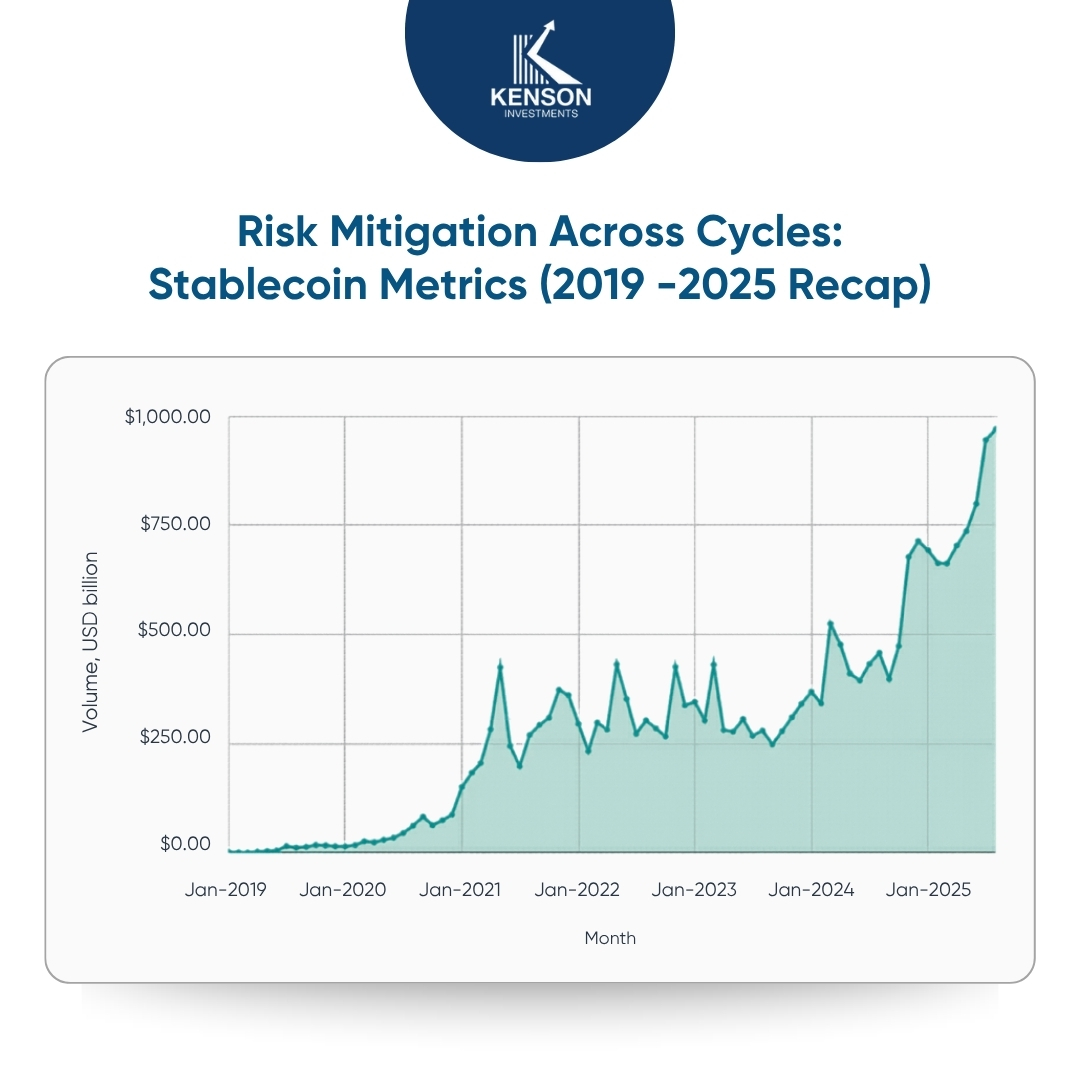
Stablecoin Activity as a Liquidity and Risk Gauge
Risk frameworks in digital asset markets increasingly incorporate stablecoin usage as both a liquidity rail and a mitigant of execution risk.
According to TRM Labs analysis, stablecoins represented approximately 30 percent of all crypto transaction volume between January and July 2025, while annual stablecoin transaction volumes reached historic highs exceeding USD 4 trillion, an 83 percent increase versus the prior year.
These figures underscore that stablecoins function not merely as trading tools but as integral liquidity infrastructure. By embedding such real usage metrics into risk assessments, institutions can distinguish between corridors with resilient liquidity and those where shallow or narrow stablecoin usage signals elevated stress vulnerability.
9. Performance Indicators for Institutional Decision-Making
Performance evaluation in digital asset markets extends beyond price. Institutional investors rely on structural and operational metrics to guide allocations and preserve execution certainty.
Throughput stability metrics reveal whether a network can reliably process high volumes of transactions. Consistent block confirmation times, minimal latency, and low settlement failure rates indicate corridors capable of supporting meaningful allocations.
Liquidity corridor analysis evaluates order book depth, participant diversity, and cross-chain flows. These indicators highlight networks where capital can be deployed without slippage or operational bottlenecks, ensuring execution precision and portfolio integrity.
Governance transparency is essential for systemic risk assessment. Protocols with documented decision-making processes, accountable treasury management, and responsive governance structures are more likely to withstand stress and support scaled allocations.
Operational redundancy complements governance evaluation. Networks with multiple validation nodes, failover mechanisms, and contingency protocols minimize the risk of operational disruption, enhancing confidence in execution.
Market health indicators, such as adoption trends, derivative participation, and token velocity, provide additional insight into structural robustness. These measures reveal which networks are developing depth, stability, and operational resilience rather than reacting to transient speculative interest.
By integrating these indicators into a comprehensive assessment framework, institutional investors can align portfolio allocations with corridors that combine growth potential, structural integrity, and execution reliability. This approach emphasizes digital asset portfolio management rooted in structural confidence rather than superficial momentum.
10. The Kenson Perspective
At Kenson, the understanding of hidden digital asset cycles is central to capital stewardship. We emphasize structural evaluation, execution certainty, and disciplined allocation as core principles guiding portfolio decisions.
Capital is deployed incrementally across corridors demonstrating operational resilience, robust liquidity, and transparent governance. Early identification of expansion opportunities is complemented by disciplined risk management during mid- and late-cycle phases, ensuring portfolios are protected from structural fragility while capturing sustainable growth.
Our approach integrates digital asset consulting into actionable frameworks. Liquidity flows, network throughput, governance signals, and operational redundancy inform strategic decisions. Allocations are adjusted based on real-time structural evaluation rather than price speculation, preserving capital and maximizing optionality.
Risk mitigation is embedded in every stage. Stress-tested networks, cross-chain diversification, and contingency protocols reduce systemic exposure, while governance transparency ensures that portfolios can scale confidently as markets evolve. Execution certainty is treated as a first-order objective, with allocations concentrated in corridors that demonstrate reliable transaction finality and operational integrity.
The Kenson framework converts complex market signals into disciplined action. Structural insight drives allocation, governance evaluation guides risk management, and operational assessment ensures execution reliability. This methodology aligns portfolios with networks capable of supporting institutional-scale capital.
By combining these elements, Kenson delivers a robust, investor-first approach that balances growth potential with disciplined risk management. Our methodology ensures portfolios remain resilient across cycles, turning structural understanding into actionable, capital-preserving decisions.
Final Thoughts
Digital asset markets are defined by hidden cycles that extend beyond superficial price trends. From early-cycle infrastructure readiness to mid-cycle liquidity migration, speculative concentration, and late-cycle contraction, structural assessment is the key to disciplined capital deployment. Price alone cannot guide institutional allocations; throughput stability, governance transparency, operational resilience, and liquidity depth are the true determinants of sustainable portfolio performance.
Investors who integrate these signals into allocation strategy preserve optionality, mitigate execution and systemic risk, and capture growth opportunities in corridors capable of handling institutional-scale capital. Incremental deployment, cross-chain diversification, and stress-tested operational frameworks ensure disciplined participation, allowing portfolios to benefit from structural confidence rather than speculative momentum.
The Kenson methodology translates these insights into actionable frameworks. By focusing on structural readiness, disciplined allocation, and risk-aware reallocation, portfolios remain positioned for sustainable growth, resilient execution, and strategic capital preservation.
Discover how Kenson’s comprehensive digital asset consulting and strategic advisory services can help align your capital with structurally sound growth corridors, ensuring execution certainty and long-term portfolio resilience. Contact our team today.