








Digital asset tax transparency is no longer only a year-end reporting issue. It is becoming a daily data discipline. As governments and tax authorities formalize reporting expectations, the operational burden is shifting toward transaction quality, wallet attribution, customer records, and consistent classification across platforms and jurisdictions.
For institutions, the challenge is not simply knowing that a transaction occurred. The harder work is proving what type of transaction it was, who controlled the wallet, which entity had reporting responsibility, what data was retained, and whether records can be reconciled across custodians, exchanges, decentralized protocols, and internal systems.
That is why the crypto asset reporting framework discussion is increasingly tied to digital asset data readiness. Reporting frameworks do not create clean data. They expose whether the data infrastructure already exists.
Reporting Rules Make Transaction Data an Operating Control
Traditional financial reporting usually relies on brokers, banks, custodians, transfer agents, and established recordkeeping systems. Digital asset activity does not always fit that structure. A single organization may use exchange accounts, institutional custodians, self-custody wallets, staking arrangements, smart contracts, stablecoin transfers, and cross-chain bridges.
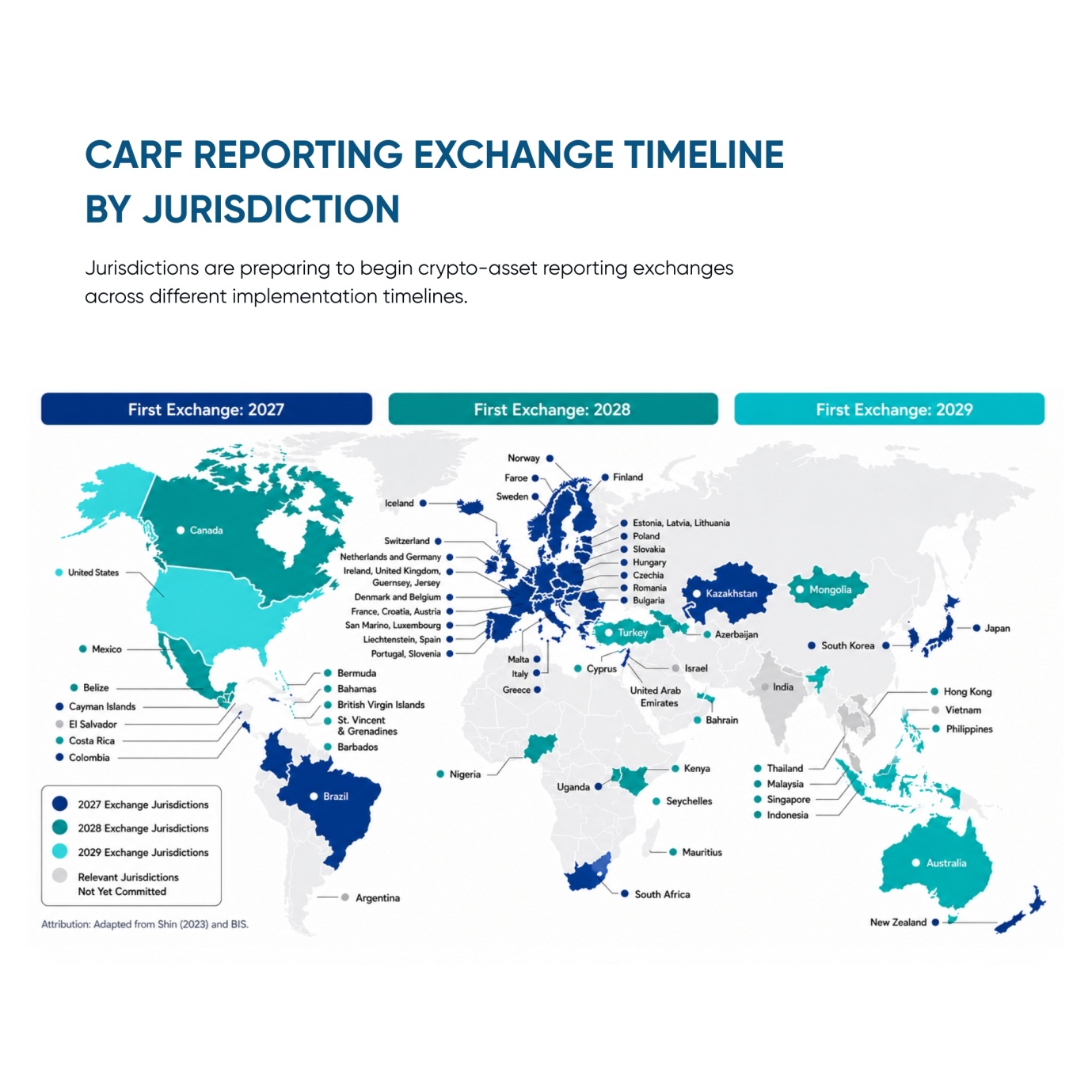
The OECD’s Crypto-Asset Reporting Framework was developed to support automatic exchange of tax-relevant information on crypto-assets and to reduce gaps caused by activity outside traditional financial reporting channels. In the United States, IRS rules require brokers to report certain digital asset sale and exchange transactions on Form 1099-DA, with reporting beginning for transactions on or after January 1, 2025. The EU’s DAC8 rules enter into force on January 1, 2026, expanding administrative cooperation and tax transparency to crypto-asset transactions.
These frameworks create a practical question for compliance and operations teams: can transaction data be converted into reportable information without manual reconstruction?
That requires more than a blockchain explorer. It requires internal rules for asset identifiers, timestamps, transaction purpose, wallet ownership, counterparty references, and cost basis support where relevant. The reporting burden starts at transaction capture, not at filing.
Wallet Attribution Becomes Central to Data Quality
Wallet attribution is one of the hardest parts of digital asset reporting because blockchain addresses do not automatically reveal legal ownership, beneficial control, or business purpose. One wallet may belong to a custodian. Another may be a treasury wallet. A third may be controlled through a multi-signature setup. Another may interact with decentralized applications without a named counterparty in the traditional sense.
For institutions, wallet records should answer several basic questions. Who controls the wallet? Which legal entity owns the activity? Which internal policy approved its use? Is it hot, cold, or operational? Does it interact with approved counterparties only? Is it used for custody, settlement, collateral, liquidity movement, or testing?
Without those answers, reporting teams may struggle to separate customer activity from proprietary activity, operating transfers from taxable events, and internal wallet movements from external dispositions. Weak attribution also creates gaps for sanctions screening, audit trails, and digital asset internal controls.
A stronger framework includes wallet inventories, approval logs, signer records, private key governance, custody architecture documentation, and transaction monitoring rules. For broader internal control context, Kenson’s digital asset risk management resources are useful for understanding how operational risk and reporting readiness intersect.
Transaction Classification Is Where Reporting Breaks Down
A digital asset ledger can show that tokens moved. It does not automatically explain why.
That distinction matters. A transfer may be a sale, exchange, custody movement, collateral posting, redemption, liquidity pool deposit, staking-related event, bridge transaction, token migration, fee payment, airdrop receipt, or smart contract interaction. Reporting frameworks increase pressure on institutions to classify these movements consistently.
Misclassification can create downstream issues. An internal wallet transfer may be mistaken for a disposal. A stablecoin redemption may be recorded without sufficient detail on proceeds and timing. A bridge transaction may be counted twice if the burn and mint events are not linked. A DeFi interaction may contain several embedded steps, including approval, deposit, swap, reward claim, and withdrawal.
This is why digital asset data readiness depends on workflow design. Institutions need naming conventions, transaction tagging, exception queues, and review processes that connect technical ledger data with accounting and reporting logic. Automation can help, but only when the classification rules are clear.
For readers studying broader blockchain and digital asset consulting, transaction classification is a useful example of why technical infrastructure and compliance workflows cannot be separated.
Record Retention Now Has to Cover On-Chain and Off-Chain Evidence
Digital asset reporting depends on a mix of on-chain and off-chain records. A wallet transaction hash may prove that an event occurred, but it may not prove customer identity, cost basis, authority to transact, business rationale, contractual terms, invoice support, or the tax reporting category.
A complete record may include exchange confirmations, custody statements, wallet approval records, private key access logs, transaction hashes, smart contract addresses, counterparty documentation, sanctions screening results, valuation sources, and internal approvals. If a transaction crosses jurisdictions, the record may also need entity mapping and reporting responsibility notes.
Retention matters because digital asset systems change. Exchanges close accounts. APIs change. blockchain analytics vendors update labels. Smart contracts are upgraded. Internal employees rotate. If the institution cannot preserve the evidence behind a transaction, later reporting review becomes harder.
Good retention practices support compliance, audit readiness, and operational continuity. They also help institutions respond when regulators, tax authorities, auditors, or internal governance teams request support for reported activity.
Cross-Border Consistency Is the Next Pressure Point
Digital assets move across borders more easily than reporting obligations do. A transaction may involve a wallet controlled in one country, a service provider based in another, a customer resident elsewhere, and a protocol deployed globally. That creates a consistency problem.
The OECD’s CARF and the EU’s DAC8 both point toward more structured cross-border reporting, but institutions still need internal policies to avoid fragmented treatment across regions. The same transaction type should not be classified differently simply because one desk uses different software or one entity stores records in a separate system.
Cross-border consistency requires a shared taxonomy. Asset types, wallet categories, transaction labels, customer identifiers, and reporting flags need common definitions. Local rules may differ, but the source data should remain coherent.
This is especially important for firms evaluating digital asset consulting for compliance or building internal readiness programs. Reporting quality depends on whether the organization can create a single reliable data view from activity that may be operationally distributed.
Data Readiness Is Now Part of Market Infrastructure
Digital asset tax transparency is often discussed as a regulatory topic, but for institutions it is also an infrastructure topic. Reporting frameworks are forcing organizations to examine how well their data systems understand wallet control, transaction purpose, asset type, jurisdictional exposure, and record retention.
The practical burden is clear: institutions need cleaner inputs before they can produce reliable outputs.
Kenson Investments tracks these developments as part of its education-first view of digital asset market structure. Readers exploring institutional blockchain infrastructure or Kenson Investments’ educational resources can use this topic as a reminder that compliance maturity is not only about policies. It is also about data architecture, operational evidence, and repeatable controls.
Build Reporting Readiness Before the Deadline Arrives
Reporting frameworks are making digital asset activity more visible to tax authorities and counterparties. The institutions best prepared for that shift will not be the ones that wait until filing season. They will be the ones that treat transaction data quality as an operating discipline now.
Kenson Investments helps informed market participants follow regulatory, infrastructure, and data-readiness developments across digital asset markets. To continue building a clearer view of tax transparency, tokenization, and compliance-aware systems, explore our digital asset market education resources.
Disclaimer: The information provided on this page is for educational and informational purposes only and should not be construed as financial advice. Crypto currency assets involve inherent risks, and past performance is not indicative of future results. Always conduct thorough research and consult with a qualified financial advisor before making investment decisions.
“The crypto currency and digital asset space is an emerging asset class that has not yet been regulated by the SEC and US Federal Government. None of the information provided by Kenson LLC should be considered as financial investment advice. Please consult your Registered Financial Advisor for guidance. Kenson LLC does not offer any products regulated by the SEC including, equities, registered securities, ETFs, stocks, bonds, or equivalents”