









Digital asset strategies often begin in controlled environments. A pilot allocation. A limited mandate. A defined execution channel. Early results may validate the thesis, technology functions as expected, and performance appears stable.
However, when strategies move from contained testing to meaningful capital deployment, the first breakdown rarely occurs in code. It happens in governance.
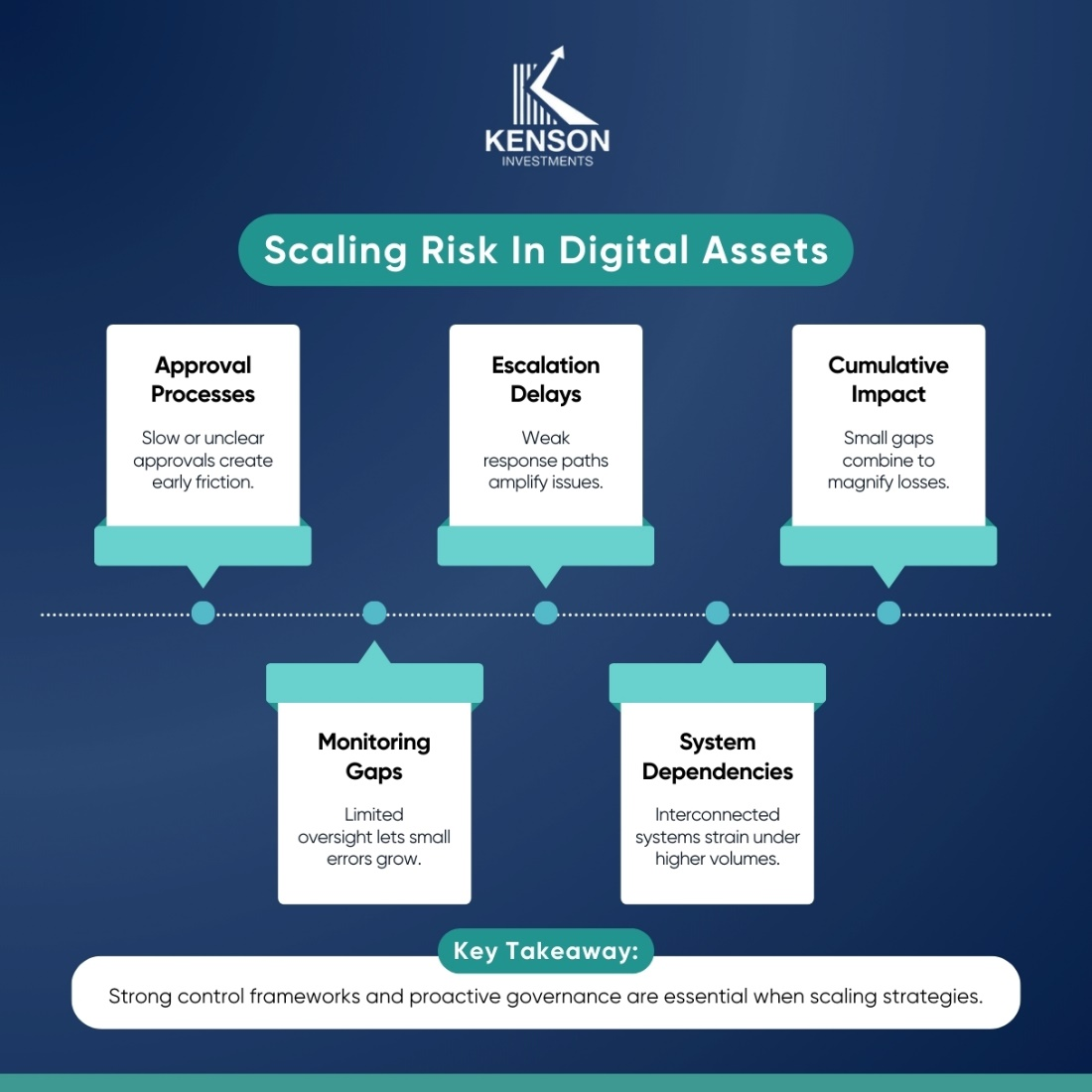
Approval processes lag. Monitoring frameworks strain. Escalation pathways blur. What initially operated efficiently under small exposure begins to show structural weaknesses under scale.
Understanding scaling risk in digital assets requires examining not just infrastructure capacity, but the strength of institutional control frameworks that support digital asset management and digital asset investment decisions.
Scaling does not simply multiply exposure. It amplifies friction, oversight gaps, and procedural assumptions that went unnoticed during early implementation.
The Illusion of Technical Readiness
When scaling discussions arise, attention often focuses on technical capacity:
- Can the infrastructure handle larger transaction volumes?
- Are custody systems robust?
- Is liquidity sufficient for larger trades?
While these questions matter, technology is frequently more elastic than governance. Cloud systems scale. Exchanges process larger orders. Protocols accommodate additional capital.
What does not scale automatically is the human process.
Control frameworks designed for limited activity can become fragile under increased complexity. Manual approvals that worked for occasional trades become bottlenecks when volume increases. Informal communication channels that once sufficed create ambiguity when teams expand.
The first failure point is rarely technological; it is procedural.
Where Scaling Risk in Digital Assets Emerges
Scaling risk in digital assets appears when systems, processes, or oversight mechanisms designed for small allocations are exposed to materially larger capital flows.
Common stress points include:
1. Approval Bottlenecks
Early-stage digital asset strategies may rely on layered approvals or centralized decision-makers. At low transaction frequency, this ensures discipline. At scale, however:
- Approval delays disrupt execution timing
- Time-sensitive opportunities are missed
- Decision-makers become overloaded
The result is either slowed execution or pressure to bypass controls, both of which introduce risk.
2. Monitoring Gaps
Monitoring frameworks that review performance weekly or monthly may suffice during pilot stages. At scale, exposure shifts more rapidly.
Risks include:
- Delayed recognitionof liquidity stress
- Slow detection of counterparty weakness
- Incomplete visibility across multiple venues
Scaling multiplies transaction frequency, and without real-time monitoring capabilities, blind spots expand proportionally.
3. Escalation Ambiguity
In small programs, escalation paths are informal and direct. As strategies scale, complexity increases:
- Multiple custodians
- Cross-venue execution
- Diverse counterparties
- Expanded operational teams
Without defined escalation hierarchies, response time during stress events deteriorates. Ambiguity becomes risk.
The Governance–Technology Imbalance
Digital asset infrastructure often evolves faster than institutional governance. Protocol upgrades, market structure shifts, and liquidity fragmentation move rapidly. Internal control frameworks adapt more slowly.
This imbalance creates tension. A strategy may technically scale to accommodate larger positions, but oversight mechanisms may not be recalibrated to match new exposure levels.
Symptoms of imbalance include:
- Risk limits not adjusted proportionally to capital growth
- Reporting structures lagging behind operational complexity
- Compliance reviews disconnected from execution mechanics
- Under-resourced oversight teams
Technology does not break first. Governance does.
Control Frameworks Under Stress
Strong control frameworks are foundational to resilient digital asset management, but frameworks that function at a small scale often assume:
- Predictable transaction volume
- Stable liquidity conditions
- Limited counterparty diversity
- Contained operational pathways
Scaling challenges each assumption.
For example:
- Larger order sizesincrease market impact risk.
- More venues introduce reconciliation complexity.
- Expanded collateral usage heightens liquidity dependency.
- Automation layers increase reliance on predefined parameters.
If control frameworks are not recalibrated before capital scales, risk compounds silently.
Human Capacity Limits
As digital asset investment programs grow, so do coordination demands. Teams that managed a small allocation may not have:
- Sufficient staffing for continuous oversight
- Specialized risk analysts for protocol-level exposure
- Defined handoffs between trading, custody, and compliance
Human bandwidth constraints often appear before technical capacity limits.
Scaling increases:
- Data volume
- Reporting frequency
- Operational coordination
- Decision complexity
Without structural reinforcement, teams experience strain. Strain leads to shortcuts. Shortcuts introduce exposure.

Monitoring Becomes Central
In pilot phases, monitoring often focuses on performance. At scale, monitoring must expand to include:
- Liquidity concentration
- Venue-specific exposure
- Counterparty health indicators
- Execution quality metrics
- Settlement timing discrepancies
Digital asset management at scale requires real-time visibility across interconnected systems.
Delayed reporting creates lag risk. Lag risk becomes capital risk.
Escalation Speed Versus Capital Exposure
When exposure increases, escalation speed must accelerate proportionally. If capital doubles but response time remains unchanged, effective risk tolerance has implicitly widened.
Scaling risk in digital assets frequently manifests during stress events:
- Sudden liquidity contraction
- Exchange outages
- Network congestion
- Margin threshold adjustments
In these moments, defined escalation protocols determine whether exposure is contained or amplified.
Questions institutions must address include:
- Who has the authority to pause execution?
- What thresholds trigger escalation automatically?
- How are cross-venue positions reconciled under stress?
Without clarity, decision paralysis emerges precisely when speed is required.
Automation Does Not Eliminate Oversight
Scaling often encourages increased automation. Automated rebalancing, algorithmic execution, and conditional triggers improve efficiency.
However, automation introduces:
- Model dependency risk
- Parameter calibration risk
- Correlated execution behavior across markets
At a small scale, automation errors may produce manageable deviations. At scale, the same errors magnify.
Control frameworks must evolve to monitor automation itself, not just the outcomes it produces.

Liquidity Concentration at Scale
Small allocations can move discreetly within market depth. Larger capital commitments influence liquidity conditions directly.
Risks include:
- Increased slippage
- Reduced exit flexibility
- Greater market signaling
- Correlated impact across related assets
Digital asset investment strategies that perform well at a small scale may encounter structural limitations when position sizes grow.
Liquidity modeling must therefore be embedded within scaling decisions, not treated as an afterthought.
The Kenson Approach to Scaling Discipline
From a Kenson Investments’ perspective, scaling is not merely an increase in allocation; it is a structural transition.
Before expanding digital asset investment exposure, governance structures must be recalibrated. Control frameworks are evaluated for proportional resilience: Do approval processes match expected volume? Does monitoring operate at sufficient frequency? Are escalation pathways formally defined and tested?
Kenson approaches scaling risk in digital assets with the view that governance must scale first. Technology, liquidity access, and execution pathways are assessed within a broader oversight framework designed to preserve capital stability.
Rather than assuming infrastructure elasticity guarantees safety, Kenson emphasizes procedural clarity, monitoring integration, and predefined escalation thresholds before exposure increases.
Scaling without governance recalibration introduces fragility. Scaling with disciplined oversight strengthens institutional resilience.
Signs That Governance Is Lagging
Institutions should assess for early indicators of scaling strain:
- Increasing reliance on informal communication
- Frequent manual overrides of established processes
- Delays in reporting under higher transaction volume
- Unclear ownership of cross-functional decisions
- Stress events expose coordination gaps
These signals often precede measurable capital loss. Identifying them early allows structural correction before exposure widens.
Building Resilient Digital Asset Management at Scale
To manage scaling risk effectively, institutions should:
1. Reassess Risk Limits
Ensure exposure thresholds align with new capital size and liquidity realities.
2. Formalize Escalation Protocols
Define authority lines and automate trigger thresholds where possible.
3. Expand Monitoring Frequency
Shift from periodic review to continuous oversight for critical risk metrics.
4. Stress-Test Control Frameworks
Simulate stress scenarios under scaled exposure conditions.
5. Align Staffing With Complexity
Operational depth must grow alongside capital commitment.
Scaling should be a deliberate, structured process, not a reaction to performance success.

Final Thoughts: Governance Scales Before Capital
Digital strategies often demonstrate early success in contained environments, but when exposure expands, the stress test shifts from technology to governance.
Approval bottlenecks, monitoring gaps, and escalation ambiguity typically break before infrastructure capacity does. Recognizing this dynamic is essential for disciplined digital asset management.
Scaling risk in digital assets is not simply about managing larger positions. It is about ensuring that control frameworks evolve proportionally with exposure.
When governance scales first, capital resilience strengthens. When it lags, fragility emerges.
Strengthening Digital Asset Strategies With Kenson Investments
Scaling digital asset investment requires more than expanding allocation. It demands structured oversight, resilient control frameworks, and disciplined execution design.
To learn more about how Kenson Investments approaches digital asset management with governance-first discipline and scalable oversight, connect with our team and explore our educational resources. As a leading digital asset strategy consulting firm, our blockchain asset consulting and blockchain and digital asset consulting services are supported by experienced blockchain asset investments consultant professionals, with specialized insight into Solana DeFi risk management to help you scale with confidence.
Disclaimer: The information provided on this page is for educational and informational purposes only and should not be construed as financial advice. Cryptocurrency assets involve inherent risks, and past performance is not indicative of future results. Always conduct thorough research and consult with a qualified financial advisor before making investment decisions.
“The cryptocurrency and digital asset space is an emerging asset class that has not yet been regulated by the SEC and the US Federal Government. None of the information provided by Kenson LLC should be considered as financial investment advice. Please consult your Registered Financial Advisor for guidance. Kenson LLC does not offer any products regulated by the SEC, including equities, registered securities, ETFs, stocks, bonds, or equivalents.”