









Automation promised speed, predictable execution, and reduced operational overhead for financial systems. In decentralized finance, automation takes a singular form: code that enforces rules without human discretion. Smart contracts and composable protocols enable programmable finance at scale, yet the same properties that deliver efficiency — determinism, speed, and composability — can also create new, amplified failure modes.
Automation at Scale: Efficiency Meets Determinism
Smart contracts are deterministic programs that execute predefined logic when triggered. This determinism is the foundation of trust in programmable systems: users can verify code and predict behavior. At scale, programmable finance can automate lending, market making, clearing, and settlement without human mediation. Execution becomes consistent, transparent, and immediate.
Deterministic execution also removes discretion. Where a human intermediary might pause, interpret intent, or apply judgment, automated systems follow code exactly. That precision reduces some classes of operational risk, but it introduces another: when assumptions embedded in code are violated, there is no human buffer to interpret or mitigate outcomes. That single-threaded precision is a root cause of smart contract automation risk.
Automation’s efficiency comes with a trade-off: predictable outcomes in normal conditions can amplify anomalies when stress occurs. Systems that execute flawlessly under expected conditions may behave unexpectedly once assumptions fail, which is the essence of programmable finance failures.
Rigid Logic and Edge Cases
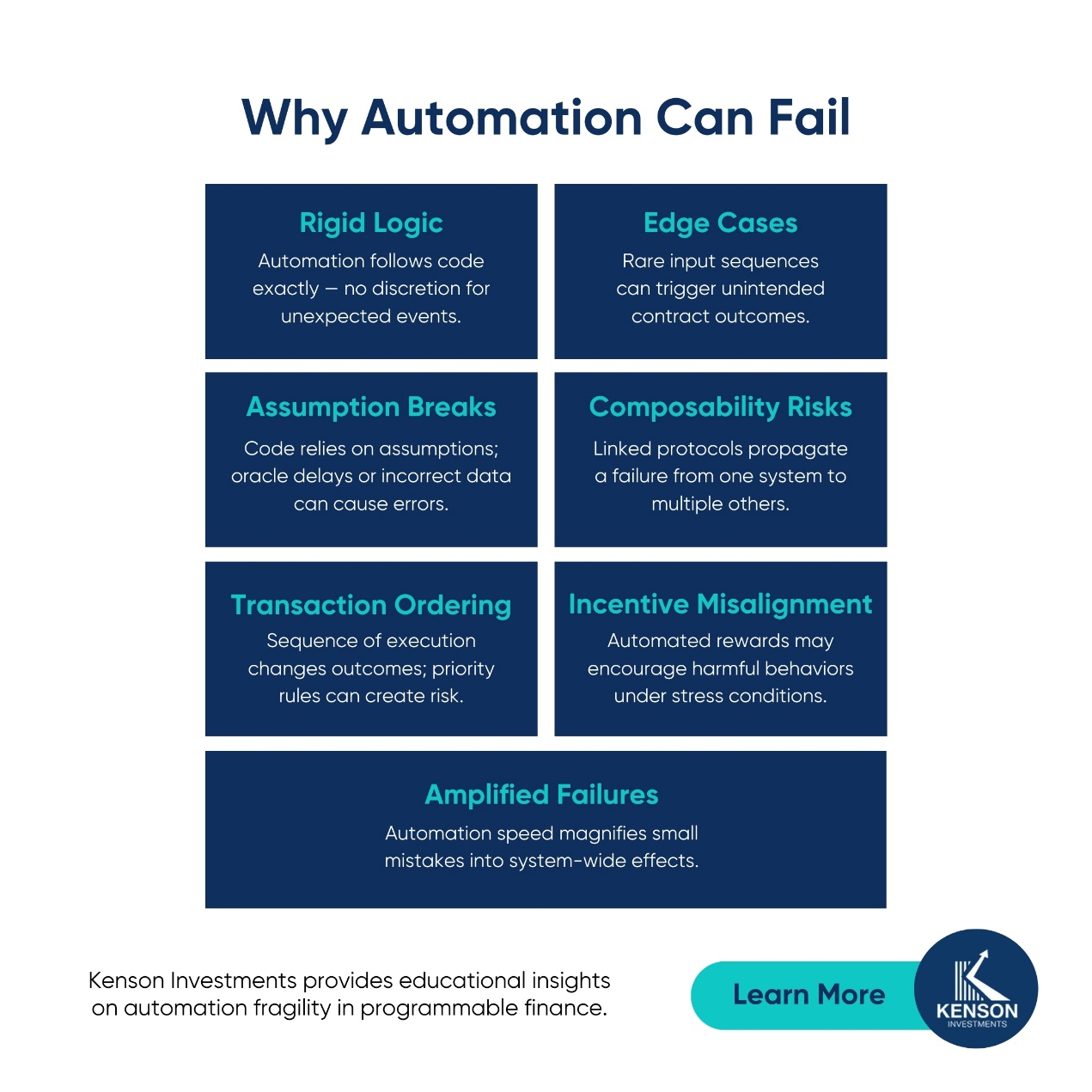
Software is only as robust as the assumptions its developers encode. Smart contracts typically formalize those assumptions in unambiguous ways. Edge cases — unusual sequences of events, atypical input values, or rare network conditions — expose how rigid logic can fail.
Edge cases can be mundane: integer overflows, unexpected token approval states, or race conditions introduced by transaction ordering. In complex, composable systems, edge cases can cascade when one contract’s outputs become another’s inputs.
Programmable finance failures often begin with an edge condition that was considered improbable during development but becomes realizable in live markets.
Even well-audited contracts cannot anticipate every potential interaction, particularly when multiple protocols interconnect. A minor misalignment in logic across systems can produce outsized effects, illustrating how fragility arises directly from the deterministic, rigid nature of automated execution.
Amplified Failure Modes
Automation amplifies failure modes in two principal ways. First, speed accelerates propagation. A malfunctioning contract can execute thousands of transactions in minutes, expanding the surface area of impact before anyone notices. Second, composability multiplies consequences: protocols linked in series can route an initial fault into multiple dependent systems.
These amplified failure modes are not hypothetical. Automated execution means that minor logical oversights can cascade into significant disruptions, because there is no manual throttle or discretionary pause to contain the event. The nature of on-chain execution — final, visible, and immediate — converts bugs into system-wide events more readily than in intermediated contexts.

Cascading Effects Across Protocols
Composability is a strength of programmable finance: building blocks can be combined to innovate rapidly. Yet composability also creates tight coupling. When one protocol experiences a malfunction or unexpected state transition, other connected contracts inherit abnormal inputs. Liquidity routing, collateral valuation, and oracle-dependent calculations can all propagate errors.
Cascading effects transform local failures into broader systemic stress. Where traditional systems often reroute or absorb shocks through intermediaries or discretionary measures, automated stacks tend to pass state along according to predefined rules, relocating risk across layers of protocol logic.
Broken Assumptions and Oracle Dependencies
Many automated contracts rely on external data feeds — oracles — for prices, rates, and off-chain events. Oracles are necessary glue between on-chain logic and real-world values, yet they also introduce points of failure. Delays, manipulation, or mismatches between an oracle’s update cadence and a contract’s expected timing can invalidate critical assumptions.
When assumptions about data timeliness or integrity break, automated policies trigger based on inaccurate inputs. The result can be mechanically correct execution that is economically or operationally harmful. This is a central vector of programmable finance failures: automation acting on flawed premises.
Transaction Ordering and Priority Risks
On-chain systems execute transactions in specific sequences that can be influenced by fee strategies, mempool dynamics, and miner or validator behavior. Transaction ordering risk — including front-running and sandwich mechanics — changes the effective semantics of an automated instruction stream.
Automation that assumes neutral ordering can behave very differently under adversarial or congested conditions. Execution priority mechanisms can advantage some actors and disadvantage others, creating operational exposures that the original contract logic did not contemplate. Understanding how sequencing affects automated outcomes is a key aspect of smart contract automation risk.
Economic Design Flaws and Incentive Misalignment
Automation encodes economic logic as well as computational steps. Rate curves, liquidation thresholds, and fee structures become rules that govern behavior. If these parameters are misaligned with real market incentives, automated mechanisms can behave in destabilizing ways under stress.
For example, incentive structures designed for normal conditions may spur harmful coordination during stress events. Automated liquidation routines, fee ramp-ups, or reward mechanisms can accelerate undesirable outcomes when market participants respond en masse to the same economic signals.
Misaligned incentives amplify programmable finance failures, demonstrating that operational fragility is not purely technical, but economic in nature.
Testing, Formal Verification, and the Limits of Assurance
Robust testing and formal verification improve confidence in code. Yet formal proofs and test suites are limited by the scope of modeled assumptions. Verification can establish correctness relative to a specification, but it cannot guarantee that the specification itself matches real-world conditions or emergent market interactions.
Furthermore, the interaction of multiple verified components does not automatically yield a verified system. Composition introduces cross-contract state transitions that may not be accounted for in isolated proofs, leaving room for unmodeled behavior and subsequent failures despite rigorous development processes.
Observability, Detection, and Human Response Time
On-chain transparency provides observability, but it does not equate to immediate mitigation. Automated failures often occur quickly, and human detection and reaction lag behind. Monitoring tools can flag anomalies, but deciding on corrective action — and coordinating protocol governance — takes time.
That temporal gap matters: when automation executes harmful transactions within minutes, a delayed human response may be insufficient to contain cascade effects. This mismatch between machine speed and human response capability is a persistent source of fragility in programmable finance.
Governance, Upgrade Paths, and Freeze Mechanisms
Protocols sometimes incorporate governance or emergency controls to address unexpected behaviors. However, the presence of governance does not eliminate risk; it redistributes decision-making pressure to a set of participants who must act under time constraints and often with imperfect information.
Emergency freezes or upgrades can mitigate ongoing failures but introduce their own trade-offs: they imply discretionary intervention, which changes trust assumptions and may create governance attack vectors. The design of upgrade mechanisms must balance the need for rapid remediation against the risks of centralization or opaque decision-making.
Composability vs. Resilience: Design Trade-Offs
Systems designed for maximum composability may prioritize modularity and reusability, but this can come at the expense of resilience. Isolation and circuit-breakers can limit propagation but reduce fluid interaction between components.
Designers face trade-offs: maximizing connectivity fosters innovation but increases the chance that local faults will propagate.
Recognizing these trade-offs is central to assessing smart contract automation risk. Resilience often requires deliberate limits on composability or explicit containment patterns that slow propagation when assumptions fail.
Behavioral and Market Responses to Automation Failures
Automated failures influence participant behavior. When a protocol behaves unexpectedly, market participants may withdraw liquidity, change execution strategies, or reroute activity — all actions that can magnify instability. Behavioral responses are both rational and reactive: participants seek to limit exposure in the face of visible uncertainty, often guided by insights from Blockchain and digital asset consulting.
These reactions feed back into the automated stack, altering the conditions that originally triggered the failure. Understanding how behavior interacts with automation is essential to anticipate the emergent properties of programmable systems, a focus area in Digital asset consulting for compliance.
Education and Awareness as Risk Mitigation
While automation introduces new fragility, knowledge and transparency reduce exposure. Educating participants about transaction sequencing, oracle dependencies, and edge-case behavior helps interpret observed conditions without misjudging risk, often supported by DeFi Finance consulting services.
Digital asset consultants at Kenson Investments offer insightful resources needed to understand smart contract automation risk and programmable finance failures, and they provide guidance on Cryptocurrency investment solutions as well as access to Security tokens investment consultants. This awareness allows operators to design systems with checkpoints, monitoring, and governance that limit cascading impacts, even without direct intervention.
Register now to understand how automation can simultaneously enhance efficiency and introduce systemic fragility in decentralized markets.
Disclaimer: The information provided on this page is for educational and informational purposes only and should not be construed as financial advice. Crypto currency assets involve inherent risks, and past performance is not indicative of future results. Always conduct thorough research and consult with a qualified financial advisor before making investment decisions.
“The crypto currency and digital asset space is an emerging asset class that has not yet been regulated by the SEC and the US Federal Government. None of the information provided by Kenson LLC should be considered as financial investment advice. Please consult your Registered Financial Advisor for guidance. Kenson LLC does not offer any products regulated by the SEC, including equities, registered securities, ETFs, stocks, bonds, or equivalents.”