








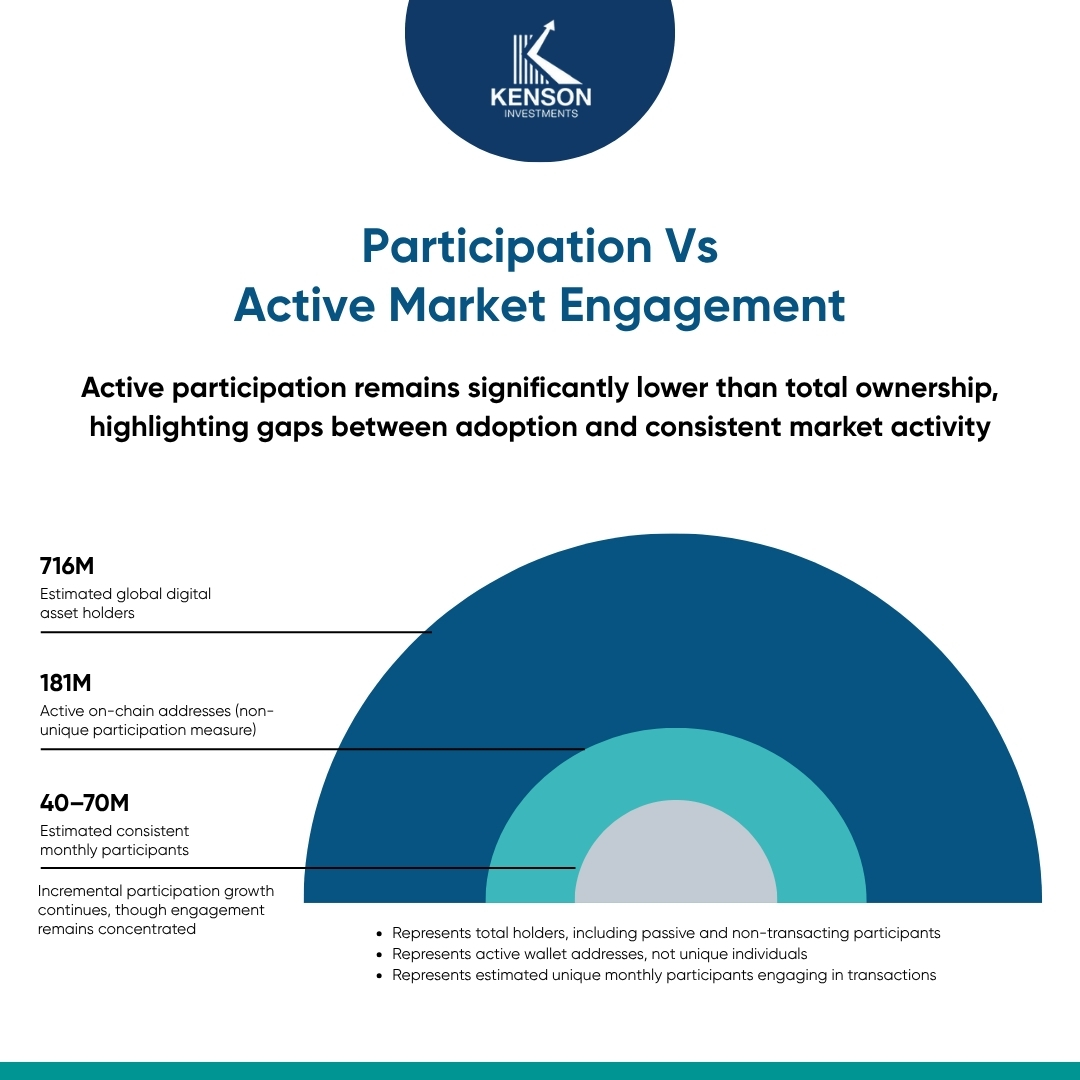
The difference between retail participation and institutional participation in digital assets is not simply access or information. It is timing. And timing, in institutional frameworks, is not reactive. It is structured, reviewed, and constrained by capital protection mandates.
For high-net-worth investors observing digital markets, this distinction matters because entry timing directly shapes exposure to structural risk. Early adopters often capture narrative-driven upside, but they also absorb infrastructure failures, liquidity distortions, and governance breakdowns. Institutional capital, by contrast, is designed to avoid these early-stage vulnerabilities.
This is the foundation of institutional digital asset adoption behavior. It is not hesitation. It is filtration.
Retail participants typically enter markets based on momentum, accessibility, or perceived opportunity. Institutional allocators, however, operate within layered approval frameworks that evaluate custody integrity, counterparty reliability, regulatory clarity, and settlement mechanics before capital is deployed. These processes extend timelines, sometimes significantly, but they are designed to reduce irreversible loss scenarios.
This divergence becomes particularly relevant in digital asset markets, where infrastructure maturity has historically lagged behind capital inflows. The result is a consistent pattern: retail capital arrives early, absorbs volatility and structural failures, and institutional capital follows once systems stabilize.
Understanding capital entry timing is not about predicting market tops or bottoms. It is about understanding when risk becomes measurable rather than speculative.
The Cost of Being Early: Infrastructure Fragility and Capital Exposure
Early-stage digital asset markets have repeatedly demonstrated that innovation often precedes stability. For investors, this creates a mismatch between opportunity and operational reliability.
Between 2020 and 2023, multiple high-profile failures highlighted this gap. Exchange collapses, custody breaches, and liquidity crises exposed how fragile early infrastructure could be under stress. These were not isolated incidents. They reflected systemic weaknesses in market structure.
Institutional capital is structured to avoid precisely these environments.
For example, before allocating to any form of digital asset investments, institutions evaluate custody providers, audit standards, and legal enforceability of asset ownership. In early market cycles, these elements were inconsistent or absent. Retail participants, by contrast, often entered through platforms without fully validated custody models.
This is why institutional capital appears “late.” In reality, it is waiting for the removal of non-compensated risk.
There is a distinction that matters here. Volatility is not the same as structural risk. Volatility can be managed. Structural failure, such as loss of custody or counterparty collapse, cannot.
From a capital preservation standpoint, waiting for improvements in security in digital asset management is not a missed opportunity. It is a prerequisite.
The maturation of custody solutions, including multi-party computation, segregated accounts, and regulated custodians, has been a critical turning point. Only after these developments did institutional flows begin to accelerate.
Counterparty Risk: From Platform Trust to Verifiable Structure
Early digital asset markets relied heavily on trust-based relationships with exchanges and intermediaries. This model proved fragile under stress.
Institutional capital does not rely on trust. It relies on verification.
Today, counterparty evaluation includes custody segregation, proof-of-reserves mechanisms, legal enforceability of claims, and operational transparency. These elements are central to security in digital asset management.
The shift from opaque platforms to verifiable structures has been a defining factor in institutional digital asset adoption behavior.
Institutions now assess not only where assets are held, but how they are held, who controls access, and what legal protections exist in the event of failure.
The rise of regulated custodians and independent crypto fund administrator frameworks reflects this transition. These structures reduce reliance on single points of failure and distribute operational risk.
Delayed entry allowed institutions to avoid exposure to earlier counterparty collapses. More importantly, it enabled them to define stricter requirements for participation.
Governance Constraints and Risk Committee Realities
Institutional capital does not move on conviction alone. It moves through governance.
Every allocation decision is subject to layered approval processes involving risk committees, compliance teams, and operational due diligence. These processes are not designed for speed. They are designed for accountability.
A typical institutional allocation to digital assets involves multiple stages:
- Internal education and research
• External validation through digital asset advisory services
• Risk modeling and scenario analysis
• Legal and compliance review
• Operational readiness assessment
• Final investment committee approval
Each of these stages introduces time. But more importantly, each stage filters risk.
This is where best practices in digital asset consulting play a role. Institutions rely on structured frameworks provided by leading digital asset consulting specialists to evaluate custody models, jurisdictional exposure, and counterparty dependencies.
For retail participants, these layers do not exist. Entry is immediate. But so is exposure.
Institutional processes also impose constraints on asset selection. The debate around altcoins vs. major cryptocurrencies is not driven by narrative appeal. It is driven by liquidity depth, market transparency, and systemic relevance.
As a result, institutional portfolios tend to concentrate on assets with established market infrastructure before expanding into broader segments.
This disciplined approach shapes not only what institutions invest in, but when they invest.
Operational Readiness as a Gatekeeper for Capital
Even when governance approval is achieved, capital does not deploy until operational systems are fully aligned.
Operational readiness includes custody integration, reporting systems, compliance workflows, and risk monitoring infrastructure. Without these elements, capital cannot be managed at scale.
This is one of the least visible but most critical drivers of delayed institutional entry.
For example, digital asset portfolio management requires systems capable of real-time valuation, audit trails, and reconciliation across fragmented blockchain networks. Traditional financial infrastructure was not built for this.
The rise of specialized digital asset management services has begun to close this gap. These services provide institutional-grade reporting, compliance tracking, and operational support that align with traditional asset management standards.
According to Kenson’s 2025 research, nearly 65 percent of financial institutions in Europe and Asia are preparing operational environments for digital asset integration within the next year, reflecting a shift from exploration to implementation readiness.
This transition is significant. It signals that institutional capital is not avoiding digital assets. It is preparing to engage under conditions that meet operational standards.
The emergence of digital asset management consulting services and finance asset management consulting frameworks has accelerated this readiness, enabling institutions to bridge the gap between traditional systems and blockchain-based infrastructure.
Time Horizon Alignment and the Illusion of “Late Entry”
Institutional capital is not measured against short-term price movements. It is measured against long-term capital preservation and consistency.
This creates a fundamental difference in how timing is perceived.
Retail participants often evaluate success based on early entry and rapid appreciation. Institutional allocators evaluate whether an allocation remains viable across multiple market cycles.
This is why long-term investment in digital assets is framed differently at the institutional level.
Entering later in a cycle, once infrastructure stabilizes and market behavior becomes more predictable, can still capture structural growth without exposure to early-stage failures.
In this context, “late” entry is often a misinterpretation. It is aligned entry.
The distinction becomes clearer when comparing speculative positioning with structured digital asset portfolio management, where allocations are integrated into broader capital strategies rather than isolated bets.
Regulatory Clarity and the Reduction of Legal Ambiguity
Regulatory uncertainty has been one of the primary reasons institutional capital has delayed entry into digital asset markets.
Unlike retail participants, institutions cannot operate in environments where legal classification, compliance obligations, and reporting requirements are unclear. The risk is not just financial. It is reputational and regulatory.
Recent developments have begun to shift this landscape. Frameworks such as Europe’s MiCA regulation and ongoing legislative efforts in the United States are providing clearer guidelines for asset classification, custody, and market conduct.
This clarity reduces what can be described as compliance spillover risk. Without clear rules, institutions face the possibility that exposure in one jurisdiction could trigger regulatory consequences in another.
The rise of digital asset consulting for compliance reflects the demand for structured guidance in navigating these complexities.
Institutional allocators are increasingly working with global digital asset consulting firm networks to ensure alignment across jurisdictions. This is particularly relevant as digital assets operate across borders by design.
The introduction of Central Bank Digital Currency pilots further reinforces this trend. With over 135 countries exploring CBDCs, representing the majority of global GDP, institutional frameworks are being developed with compliance and interoperability at their core.
As regulatory clarity improves, the barrier to entry for institutional capital decreases. But the delay in entry has already served its purpose. It has allowed institutions to avoid periods of legal ambiguity that could have introduced uncontrollable risk.
Market Structure Stabilization and Liquidity Evolution
Another critical factor in institutional timing is the stabilization of market structure.
Early digital asset markets were characterized by fragmented liquidity, inconsistent pricing, and limited transparency. These conditions create inefficiencies that can be exploited by sophisticated participants but pose significant risks for large-scale capital deployment.
Institutional capital requires depth, consistency, and reliability in market infrastructure.
Recent data points illustrate how the market is evolving. Tokenized government debt has surpassed $1.5 billion in circulation, while real-world asset protocols now account for more than $8 billion in locked value.
These developments are not just indicators of growth. They reflect structural maturation.
The expansion of tokenized assets, improved settlement mechanisms, and the rise of interoperability frameworks are creating environments where blockchain-based investment opportunities can be evaluated with greater confidence.
Liquidity has also improved, with institutional trading venues, derivatives markets, and structured products providing more robust price discovery.
This evolution supports long-term investment in digital assets, as capital can now enter and exit positions with greater predictability.
For institutions, this is a prerequisite. Without reliable liquidity, capital deployment becomes constrained and risk exposure increases.
Liquidity Constraints: Why Size Changes Everything
Retail capital can enter and exit positions with minimal market impact. Institutional capital cannot. The size of allocation introduces a different layer of timing discipline.
For large allocators, entering a position is not a single transaction. It is a process that must consider market depth, slippage, and exit pathways under stress conditions. Even in 2026, many digital asset markets do not offer sufficient liquidity to absorb large allocations without price distortion.
This is where capital entry timing becomes structurally linked to market maturity.
Institutions assess whether a position can be built and unwound without materially impacting price. If liquidity is fragmented or dependent on a small number of venues, the risk is not just volatility, it is illiquidity during adverse conditions.
The expansion of institutional trading venues, derivatives markets, and tokenized asset platforms has improved this dynamic. However, allocation size still dictates pacing.
This is one reason why institutional participation often appears gradual rather than decisive. Capital is deployed in tranches, aligned with liquidity conditions and execution quality.
From a capital protection standpoint, the ability to exit matters as much as the ability to enter. Timing decisions reflect both.
The Role of Consulting Frameworks in Institutional Entry
Institutional participation in digital assets is rarely self-directed. It is supported by structured advisory ecosystems.
The growth of blockchain and digital asset consulting reflects the complexity of the space. Institutions require specialized knowledge across custody, compliance, and market structure.
These services are not about identifying opportunities. They are about reducing uncertainty.
For example, consulting on digital asset management involves evaluating custody providers, assessing operational workflows, and ensuring alignment with internal risk frameworks.
Similarly, digital asset strategy consulting firm engagements focus on integrating digital assets into broader portfolio structures without disrupting existing allocation models.
The rise of strategic digital asset consulting partners has been particularly important for institutions entering the market for the first time. These partnerships provide continuity, ensuring that decisions are not based on isolated insights but on structured analysis. The role of consulting is not to accelerate entry. It is to ensure that when entry occurs, it is aligned with institutional standards.
DeFi Transition: From Experimental Yield to Structured Access
Decentralized finance was initially driven by retail participation and experimental capital. Institutional engagement remained limited due to smart contract risk, governance uncertainty, and lack of compliance frameworks.
That dynamic is changing.
The emergence of permissioned DeFi environments, governance-controlled protocols, and compliance-aware infrastructure is creating new pathways for institutional participation.
This has led to increased demand for navigating DeFi finance assets with consultants.
Institutions are not approaching DeFi as a yield-driven opportunity. They are evaluating it as a programmable financial layer with potential applications in settlement, collateral management, and liquidity optimization.
The timing of institutional entry into DeFi will likely mirror broader digital asset adoption patterns. Early volatility and experimentation will give way to structured participation once risk becomes quantifiable.
The Kenson Perspective
Institutional timing in digital asset markets is often misunderstood as hesitation or missed opportunity. From a capital protection standpoint, it is neither.
Delayed entry reflects a deliberate effort to align market participation with governance, operational readiness, and structural reliability. It is a recognition that early-stage markets often carry risks that are not priced into returns.
From our perspective, the evolution of digital asset markets is now reaching a stage where these risks are becoming more measurable.
The expansion of tokenized assets, the integration of compliance frameworks, and the development of institutional-grade infrastructure are reshaping how capital interacts with the market. The release of structured resources such as Kenson’s 2025 Market Map reflects this transition toward clarity and organization in a previously fragmented ecosystem.
At the same time, institutional interest is being reinforced by developments such as CBDC pilots, interoperability standards, and the growth of regulated custody solutions.
The implication for investors is not that early participation is inherently flawed. It is that timing must be aligned with risk tolerance and operational capability.
Understanding navigating the digital asset market requires recognizing where infrastructure has matured and where it remains experimental.
In this context, institutional behavior provides a useful framework. It highlights the importance of patience, due diligence, and structural awareness in capital allocation decisions.
Retail Momentum vs Institutional Discipline
Retail participation often drives early market narratives. It is more agile, less constrained, and more responsive to emerging trends.
This agility can create significant short-term opportunities. It can also amplify volatility and mispricing.
Institutional capital, by contrast, is designed to operate within constraints that prioritize consistency over speed.
This distinction becomes particularly evident when comparing approaches to investing in cryptocurrencies.
Retail investors may pursue high-growth segments, including altcoin investment options, based on momentum or community adoption. Institutional allocators focus on assets with established liquidity, regulatory clarity, and operational infrastructure.
This does not mean institutions avoid innovation. It means they engage with it differently.
The emergence of cryptocurrency growth fund management structures reflects this approach. These vehicles provide diversified exposure while maintaining risk controls aligned with institutional mandates.
Similarly, the use of stablecoins for investment has evolved as a tool for liquidity management rather than speculative positioning.
This disciplined approach reduces exposure to extreme volatility and structural failures, even if it limits participation in early-stage upside.
What Delayed Entry Reveals About Market Maturity
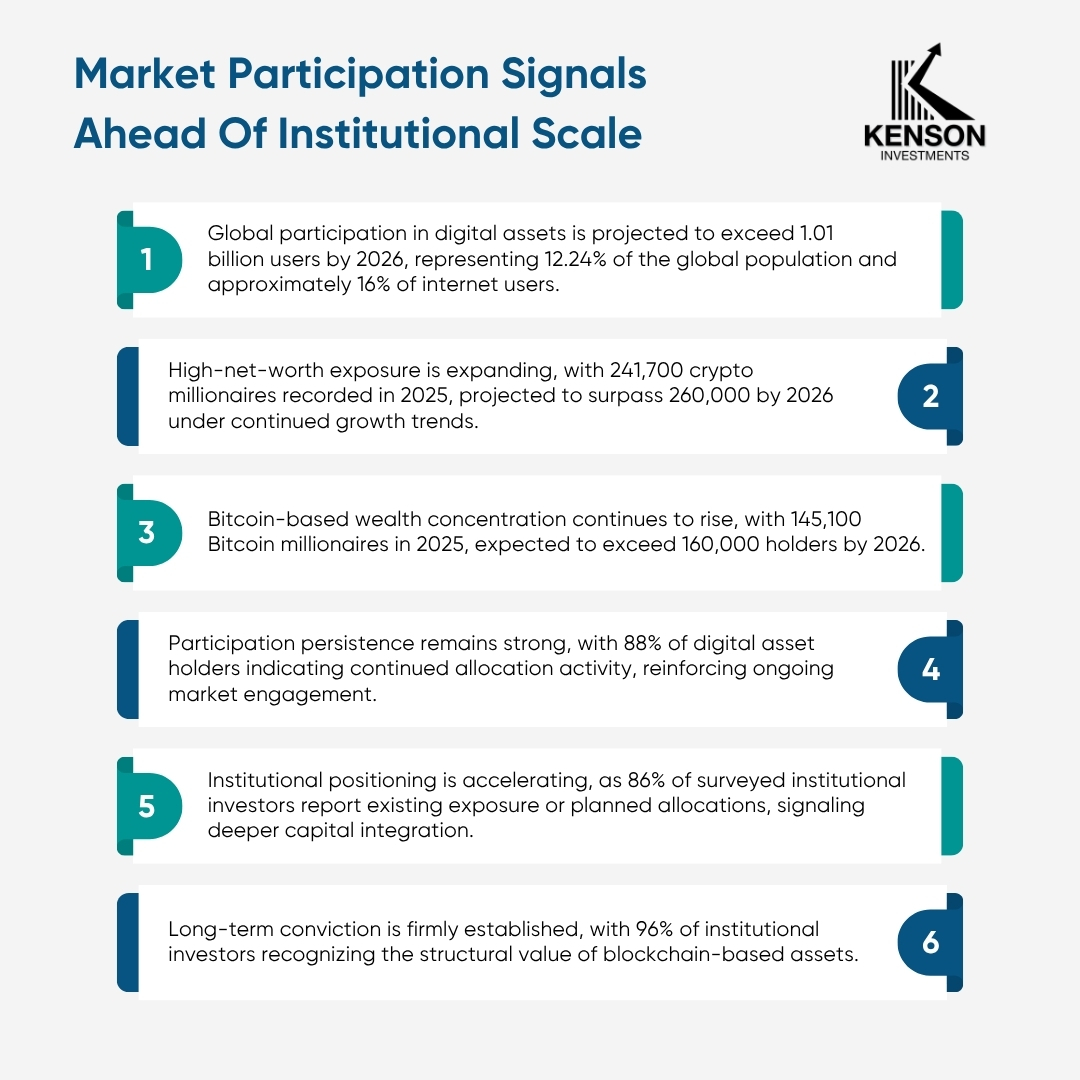
The timing of institutional capital is often a leading indicator of market maturity.
When institutions begin allocating at scale, it signals that key thresholds have been met:
- Custody solutions are reliable
• Regulatory frameworks are clearer
• Market liquidity is sufficient
• Operational systems are functional
These conditions do not eliminate risk. They transform it from unknown to measurable.
This shift is critical for risk management in crypto investments. It allows capital to be allocated within defined parameters rather than speculative assumptions.
The growth of crypto asset management platforms and fund management services tailored to digital assets further reinforces this transition.
Institutional participation also influences market behavior. It introduces longer time horizons, reduces speculative volatility, and supports the development of more stable liquidity structures.
This creates a feedback loop where increased institutional participation contributes to further market stabilization.
The Direction of Institutional Capital in 2026 and Beyond
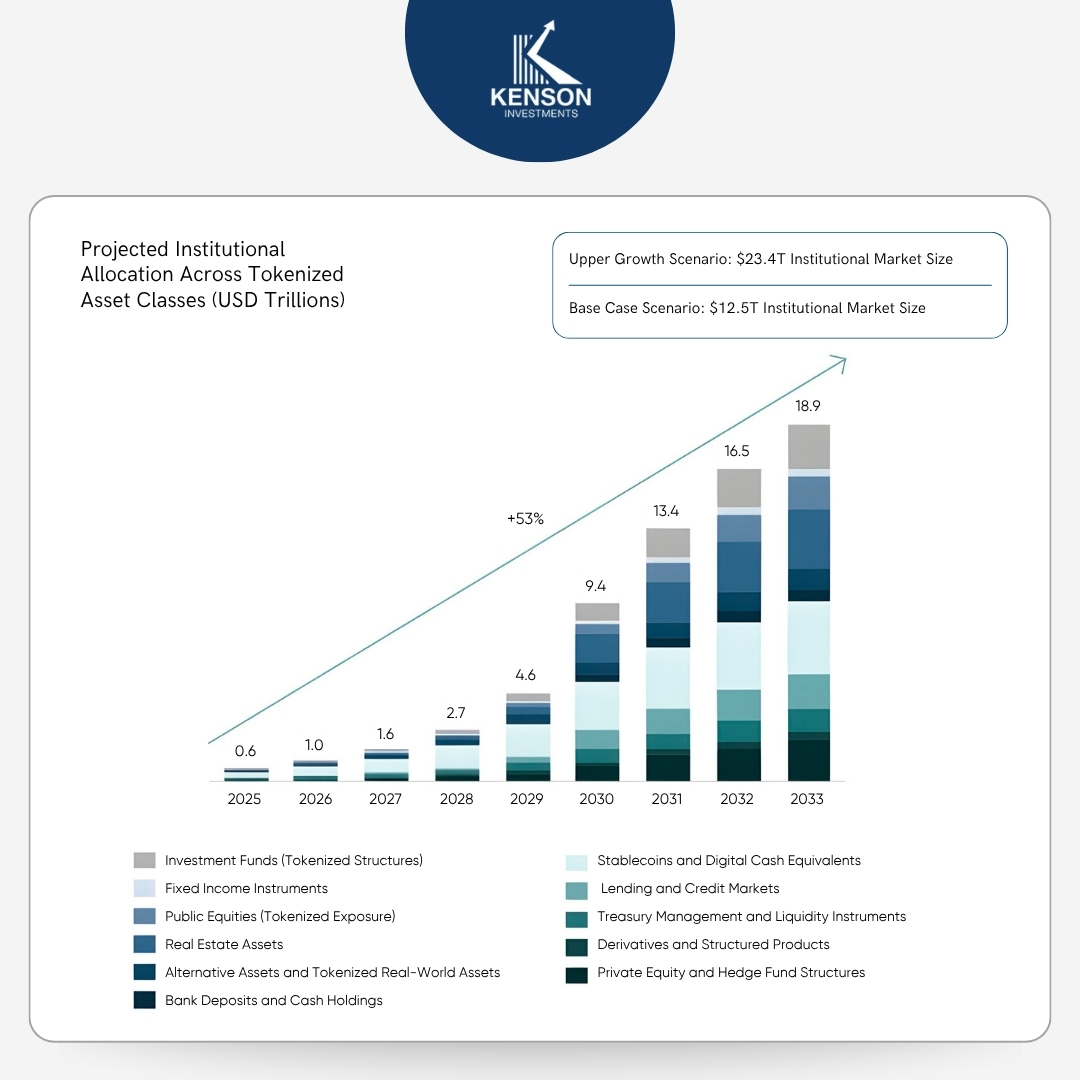
Looking ahead, institutional participation in digital assets is expected to expand, but not uniformly.
Certain segments are likely to attract capital earlier:
- Tokenized real-world assets
• Regulated custody and settlement infrastructure
• Interoperability solutions
• Compliance-enabled DeFi platforms
These areas align with institutional priorities around transparency, scalability, and risk control.
The growth of decentralized finance advisory reflects a shift toward structured engagement with previously experimental segments.
At the same time, institutions are increasingly focused on integrating digital assets into broader portfolio frameworks rather than treating them as isolated allocations.
This is where digital asset portfolio management intersects with traditional investment analysis and portfolio management practices.
The result is a more integrated approach to investing in the digital age, where digital assets are evaluated alongside traditional asset classes based on risk, liquidity, and long-term value.

Closing Insight: Timing Is a Risk Management Tool
The perception that institutional capital “arrives late” overlooks the role of timing as a risk management mechanism.
Delayed entry is not about avoiding opportunity. It is about ensuring that opportunity is aligned with structural reliability.
For high-net-worth investors, this perspective offers a different lens on market participation. It suggests that understanding when to enter is as important as understanding what to invest in.
The evolution of digital asset markets continues to create new opportunities. But those opportunities are not static. They are shaped by infrastructure, regulation, and market behavior.
Institutional capital provides a framework for navigating this complexity with discipline.
Clarity Before Capital Allocation
Kenson Investments focuses on helping investors understand how market structure, governance, and operational readiness influence digital asset participation. Our approach centers on education, transparency, and informed decision-making across evolving market conditions.
Explore how structured insights can support better awareness of digital asset markets by connecting with our team. Reach out to us.