









Crypto markets are often described as trustless systems, built to remove discretion and minimize reliance on intermediaries. Smart contracts execute automatically, blockchains publish transactions publicly, and decentralized protocols replace traditional gatekeepers.
Yet when yield enters the discussion, trust quietly reappears. Yield does not exist in isolation; it reflects assumptions about behavior, structure, and risk that participants accept when capital is deployed on-chain.
On-chain yield mechanisms promise returns through lending, staking, liquidity provision, or incentive programs. Each mechanism depends on something working as expected: code must perform correctly, incentives must align participant behavior, governance decisions must preserve economic balance, and counterparties must remain solvent. These dependencies form the foundation of digital asset yield risk, even in systems designed to reduce human judgment.
The misconception is not that crypto eliminates trust, but that trust has been transformed. Instead of relying on institutions, participants rely on software logic, economic incentives, and collective coordination. Understanding trust assumptions in crypto is essential for interpreting yield claims responsibly.
Without examining where trust exists and how it can fail, yield becomes a headline number divorced from the risks supporting it. This framing sets the context for evaluating yield as structured risk rather than passive income assumptions embedded.
Yield Always Comes From Somewhere
Yield in digital asset markets is often presented as a native feature of decentralized systems, but every yield stream originates from an identifiable source of risk. Returns are generated because someone else is paying, borrowing, trading, or absorbing volatility. When that relationship breaks down, yield disappears.
Lending protocols generate yield by compensating lenders for borrower default risk and liquidation uncertainty. Liquidity providers earn fees because they accept price divergence and inventory imbalance. Stakers receive rewards because they commit capital to network security and operational assumptions. Incentive programs distribute tokens to attract participation, transferring dilution risk to holders.
These mechanisms mirror traditional finance more than many participants acknowledge. The difference lies in how risk is packaged. On-chain yield compresses multiple risks into a single percentage figure, obscuring the underlying dependencies. Digital asset yield risk emerges when participants focus on returns without examining what must remain true for those returns to persist.
Yield should therefore be interpreted as a signal of stress distribution. High yield often indicates heightened uncertainty, fragile liquidity, or aggressive incentive structures. Low yield reflects reduced compensation for risk, not necessarily safety. Understanding where yield originates clarifies which assumptions are being priced and which are ignored by participants broadly.
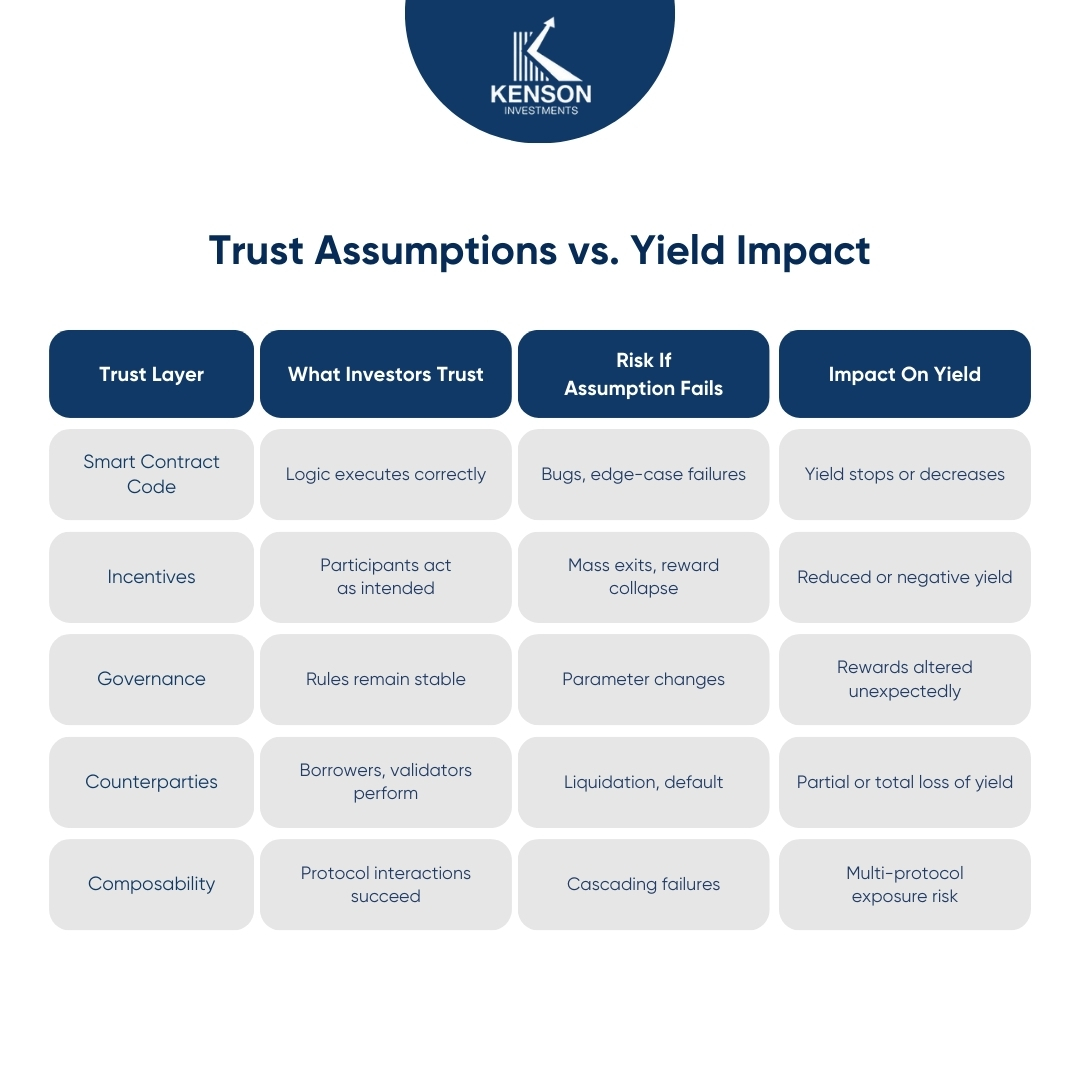
Trust Embedded in Code and Smart Contracts
Smart contracts are often described as eliminating trust by replacing discretion with automation. In practice, they relocate trust into technical and economic assumptions that participants must accept when pursuing yield.
Trust in Code Correctness
Participants implicitly trust that:
- The smart contract logic matches its stated purpose
- The code executes without critical bugs or edge-case failures
- Interactions with external contracts behave as expected
Even formally verified or audited contracts remain dependent on human-defined specifications. Audits reduce uncertainty but do not eliminate it. Yield strategies relying on complex code paths introduce latent risk that may only surface during extreme market conditions.
Trust in Economic Design
Beyond technical execution, smart contracts encode economic rules. Yield mechanisms assume that:
- Incentives motivate rational behavior
- Penalties discourage abuse
- Parameters remain effective across market regimes
If economic assumptions fail, the contract can function “correctly” while still producing harmful outcomes. This distinction is critical: code can operate as written while value is lost.
Composable Risk Amplification
Yield strategies often rely on multiple smart contracts interacting simultaneously. Each integration adds a dependency:
- External price feeds
- Collateral contracts
- Liquidity pools
- Governance modules
Trust assumptions compound as systems stack together. A failure or exploit in one component can propagate across the entire structure, increasing digital asset yield risk without any single contract malfunctioning in isolation.
Trust in code, therefore, is not the absence of trust—it is confidence in layered technical and economic assumptions holding under stress.
Incentives, Emissions, and Behavioral Trust
On-chain yield frequently relies on incentives rather than organic economic activity. Token emissions, reward multipliers, and liquidity mining programs are used to attract capital quickly. While effective in the short term, these mechanisms embed behavioral trust assumptions that materially affect yield stability.
Yield Built on Incentives
Incentive-driven yield assumes that:
- Participants remain engaged beyond initial rewards
- Emissions do not overwhelm natural demand
- Capital providers behave as long-term stakeholders
In reality, incentives often attract highly mobile capital. Participants enter when rewards are high and exit when returns compress. Yield exists, but only while incentives outweigh perceived risk. Once incentives decline, liquidity can evaporate rapidly.
Reflexivity and Yield Compression
Incentives can create reflexive loops:
- High yield attracts capital
- Increased participation dilutes rewards
- Yield compresses
- Capital exits
This dynamic transforms yield into a temporary behavioral phenomenon, not a durable return stream. Trust is placed not in code, but in participant behavior remaining stable under changing conditions.
Mispricing Risk Through Headline Yields
Headline yields can obscure underlying fragility. When returns are driven by emissions rather than cash flow, participants trust that token value will hold as supply increases. This assumption frequently breaks during market stress, revealing dilution risk embedded within yield strategies.
Incentive-based yield depends on collective behavior aligning with protocol design. When behavior diverges, yield collapses without any technical failure. This reinforces why trust assumptions crypto participants make about incentives are central to evaluating digital asset yield risk responsibly.

Governance as a Hidden Trust Layer
Decentralized governance is often presented as a solution to centralization, offering participants control over protocol decisions. However, governance introduces a subtle layer of trust that directly influences yield outcomes.
Token-Based Voting Assumptions
Yield strategies frequently rely on governance to adjust:
- Fee structures
- Reward distribution
- Risk parameters
- Protocol upgrades
Participants trust that proposals will be evaluated fairly, voted on actively, and implemented as intended. In reality, governance often suffers from:
- Low voter participation, leaving decisions to a small subset
- Token concentration, which can centralize influence
- Rushed proposals, which may overlook edge cases or systemic impact
These dynamics create a form of political risk on-chain, even without human discretion in execution. Yield that depends on governance assumes these risks remain manageable.
Economic Alignment Through Governance
Governance decisions aim to maintain economic balance and sustainability. When governance functions as intended, it reinforces yield reliability by aligning incentives with protocol health.
However, misaligned governance—such as voting by parties with short-term interests—can alter the risk-reward profile abruptly. Participants implicitly trust that the governance system preserves expected returns over time.
Hidden Dependencies
Even protocols labeled as “fully decentralized” require participants to interpret proposals, vote responsibly, and anticipate the impact of governance changes.
Yield reflects confidence in these processes. Where governance is weak, poorly distributed, or captured, digital asset yield risk increases despite technical code functioning perfectly.
Recognizing governance as a trust layer helps investors differentiate between yield derived from robust design versus yield contingent on fragile political coordination.
Counterparty, Liquidity, and Composability Risk
Even in decentralized systems, yield depends on participants, platforms, and interactions—a reality often overlooked in discussions of trustless finance. Counterparty risk, liquidity limitations, and composability all shape digital asset yield risk in meaningful ways.
Counterparty Risk on-Chain
On-chain yield often abstracts human counterparts, but dependencies remain. Lenders trust borrowers’ solvency; liquidity providers trust traders to behave rationally; stakers trust validators to operate honestly.
Even automated systems rely on participants acting according to economic assumptions. When counterparties fail—through insolvency, misbehavior, or systemic stress—yield can disappear instantly, demonstrating that trust is never fully eliminated, only redistributed.
Liquidity as a Yield Constraint
Liquidity underpins the ability to enter or exit positions efficiently. Yield strategies assume:
- Adequate market depth
- Orderly liquidations during volatility
- Minimal slippage for rebalancing
When liquidity evaporates, even technically functioning protocols cannot deliver expected returns. Yield becomes illusory if investors cannot realize gains or adjust exposure promptly.
Composability: Compounding Dependencies
Composability—the ability for protocols to interact seamlessly—amplifies yield potential but introduces layered risk. For example:
- Collateral from one protocol may be deposited in another
- LP tokens can be leveraged in derivative platforms
- Rewards can cascade across multiple layers
Each additional integration adds a new dependency. Failure in a single layer can propagate throughout the stack, magnifying losses even when all contracts perform as coded.
Understanding counterparty, liquidity, and composability risks shifts focus from simple return metrics to trust assumptions embedded in multi-layered systems, emphasizing that yield is inseparable from structural and behavioral dependencies.
Informed Yield Analysis for Risk-Aware Crypto Participants
At Kenson Investments, we approach on-chain yield through a risk-first lens. Yield is never evaluated in isolation. We analyze the trust assumptions embedded in code, incentives, governance, and counterparties to help investors understand where risk truly resides, often drawing on cryptocurrency investment solutions.
Our digital asset consultants break down yield mechanisms beyond surface returns, identify implicit trust dependencies in on-chain systems, evaluate incentive sustainability and governance exposure, and help investors interpret yield as a market signal, not a promise. This includes guidance in altcoin investment options and digital asset portfolio management.
Our approach emphasizes clarity, discipline, and informed decision-making in digital asset markets where trust has not disappeared—it has simply changed form, leveraging insights from digital asset consulting for compliance and consultancy for DeFi finance investments.
Register now to explore our research, educational insights, and structured perspectives on digital asset yield risk and trust assumptions in crypto systems.
Disclaimer: The information provided on this page is for educational and informational purposes only and should not be construed as financial advice. Crypto currency assets involve inherent risks, and past performance is not indicative of future results. Always conduct thorough research and consult with a qualified financial advisor before making investment decisions.
“The crypto currency and digital asset space is an emerging asset class that has not yet been regulated by the SEC and the US Federal Government. None of the information provided by Kenson LLC should be considered as financial investment advice. Please consult your Registered Financial Advisor for guidance. Kenson LLC does not offer any products regulated by the SEC, including equities, registered securities, ETFs, stocks, bonds, or equivalents.”