









Liquidity is fragmented across Ethereum, Solana, Avalanche, and dozens of emerging networks. As a result, building and managing a treasury is no longer about allocating capital within a chain—it’s about managing capital across chains.
This shift is driving demand for infrastructure that can move assets, execute smart contracts, and enforce governance across ecosystems. Bridges like LayerZero, Axelar, and Wormhole are answering that demand.
Far beyond token bridges, they provide messaging layers and execution frameworks that allow institutions to construct interoperable portfolios, transfer real-world assets cross-chain, and tap into decentralised liquidity in real time.
The Challenge: Treasury Management in a Fragmented Ecosystem
Institutions managing digital assets face a complexity problem. Assets live across different Layer 1s (Ethereum, Avalanche, Solana), Layer 2s (Arbitrum, Optimism), and application-specific chains. Each network has its own execution layer, consensus protocol, and liquidity silos.
This fragmentation poses challenges:
- Inefficient Capital Deployment: Liquidity cannot flow natively across chains.
- Operational Risk: Treasury teams must manage multiple wallets, UIs, and custody setups.
- Limited Portfolio Flexibility: Portfolio rebalancing and asset diversification are slowed by interoperability constraints.
To address this, institutions are turning to cross-chain infrastructure protocols that allow for secure, real-time communication and asset movement between chains — without sacrificing decentralisation.
The Infrastructure Stack: Bridges Driving Treasury Transformation
LayerZero: Messaging-First, Chain-Agnostic Coordination
LayerZero allows smart contracts to send messages across blockchains without requiring wrapped assets. For institutional treasuries, this unlocks:
- Automated rebalancingof assets across chains via message-triggered logic
- Delegated execution—where treasury policy is encoded in one contract but executed across many
- Omnichain vault constructionwith dynamic exposure to assets on multiple chains
This is particularly valuable for funds managing diversified on-chain strategies like staked assets, delta-neutral LPs, or synthetic instruments.
What a Cross-Chain Institutional Treasury Looks Like in Practice
Let’s break down how institutional treasuries are actually deploying this infrastructure:
✅ Unified Multi-Chain Vaults
- Hold USDC on Ethereum
- Stake SOL on Solana
- LP AVAX on Avalanche
- All managed by a central policy contract, using LayerZero for execution commands
✅ Cross-Chain Tokenised Funds
A tokenized equity index fund minted on Polygon can be distributed across Optimism, Base, and Sui for greater reach—each chain hosting its own liquidity pools and investor channels.
✅ RWA-Based Yield Distribution
Stable yield from tokenised real-world assets (bonds, credit products) on Ethereum can be paid out to stakers on Cosmos or Arbitrum using Axelar’s GMP or Wormhole’s cross-chain payout module.
✅ DAO Treasury Synchronisation
Protocol revenues earned across chains can be automatically routed to a unified treasury, converted to governance tokens, and redeployed using a single dashboard.
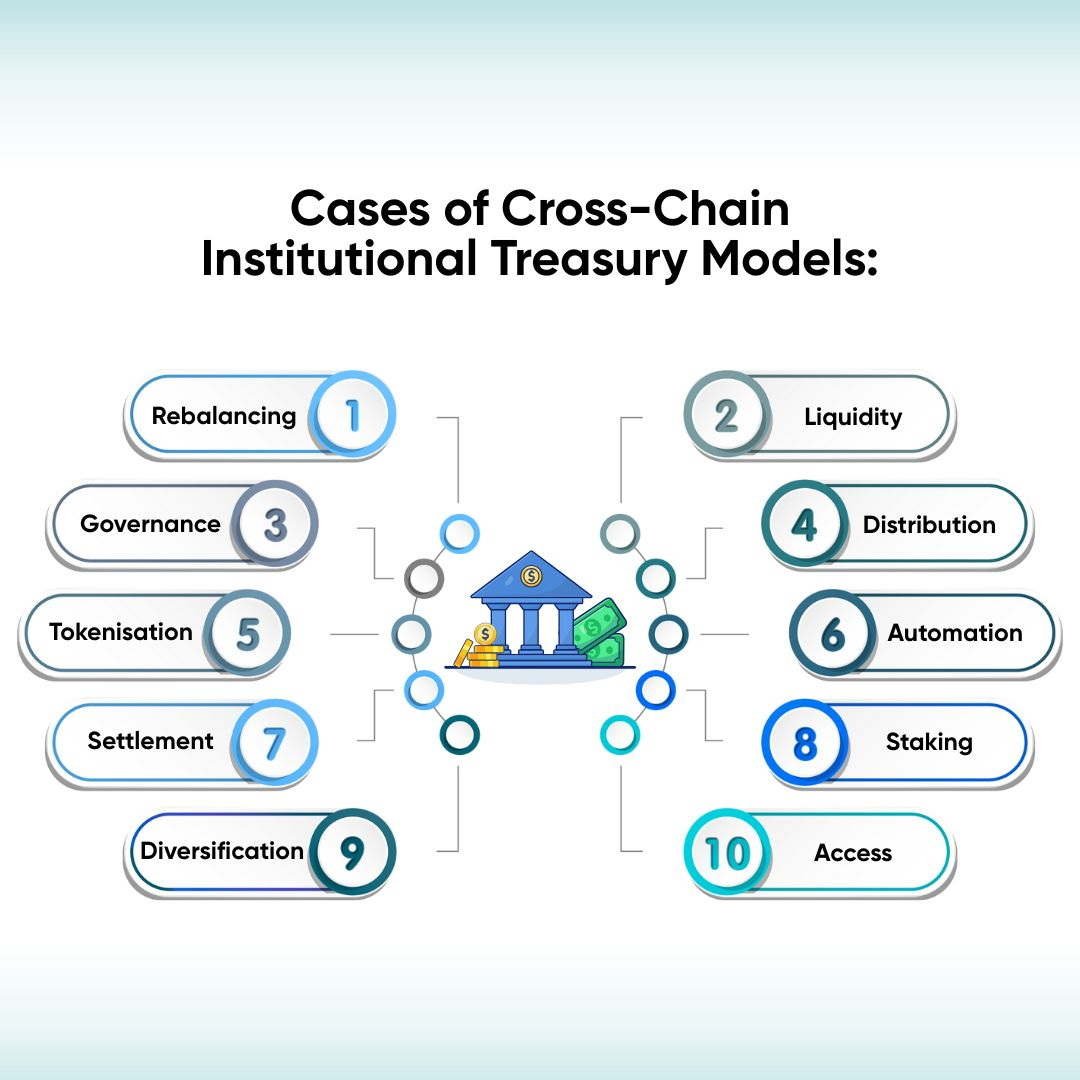
Real-World Use Cases of Cross-Chain Institutional Treasury Models
1. Diversified On-Chain Treasuries
By using Axelar’s GMP or LayerZero’s omnichain messaging, institutional treasuries can hold USDC on Ethereum, staked SOL on Solana, and BTC bridged to Avalanche — all managed via unified dashboards or smart contract controllers. This enhances risk management and FX exposure without relying on centralised exchanges.
2. RWA Transfers Across Chains
Tokenised assets like Treasury Bills, carbon credits, and real estate are increasingly being minted on-chain. With bridge infrastructure, these RWAs can now be moved across chains to tap into DeFi liquidity or settle obligations in the most cost-effective network.
For instance, a tokenised T-bill minted on Ethereum could be bridged via Axelar to Osmosis for yield aggregation, then returned to Ethereum for redemption.
3. DAO Treasury Management
DAOs like Aave, Uniswap, and Lido are adopting multi-chain treasury strategies. Wormhole enables DAO multisigs to execute cross-chain governance decisions, distribute funds, and rebalance protocol revenue. This avoids the inefficiencies of chain-specific DAO tooling and enhances capital efficiency.
4. Cross-Chain Liquidity Staking and Yield Strategies
Using LayerZero, institutions can build custom vaults that stake ETH on Ethereum, delegate ATOM on Cosmos, and LP USDC on Arbitrum — with rebalance logic running from a central controller. This unlocks higher APYs while preserving governance control and security guarantees.
Risks and Requirements for Institutions
As promising as these models are, institutions must approach them with rigour.
- Security First: Not all bridges are equal. Institutional-grade solutions should have slashing mechanisms, insurance, and multi-audit transparency.
- Custodial Control: Cross-chain movement should integrate with the institution’s custody stack (cold storage, MPC, or smart contract-based multisigs).
- Regulatory Readiness: Bridges must support compliance features like transaction history, whitelisting, and transaction origin tagging.
Institutions also need contingency policies for paused bridges, failed messages, or validator downtime—no small consideration when managing eight-figure treasuries.

Why It Matters: The Competitive Edge in Treasury Strategy
In a world of real-time DeFi markets, global asset tokenisation, and AI-driven execution, institutional capital must be equally agile. Cross-chain treasury models don’t just offer diversification—they enable:
- Faster reaction to market volatility
- Broader exposure to on-chain yield
- Programmable control over portfolio allocation
Institutions that fail to build this infrastructure may find themselves outpaced by more flexible, blockchain-native competitors.
Take the Next Step with Kenson Investments
At Kenson Investments, we provide educational resources and insights for organisations exploring blockchain-based capital strategies. Our digital asset management consultant works with you to understand how emerging bridge infrastructure—such as LayerZero, Axelar, and Wormhole—can support more interoperable and responsive treasury models across blockchain networks.
Get in touch with Kenson Investments to learn how cross-chain technologies are shaping the next chapter of institutional blockchain strategy.
Disclaimer: The information provided on this page is for educational and informational purposes only and should not be construed as financial advice. Crypto currency assets involve inherent risks, and past performance is not indicative of future results. Always conduct thorough research and consult with a qualified financial advisor before making investment decisions.
“The crypto currency and digital asset space is an emerging asset class that has not yet been regulated by the SEC and the US Federal Government. None of the information provided by Kenson LLC should be considered as financial investment advice. Please consult your Registered Financial Advisor for guidance. Kenson LLC does not offer any products regulated by the SEC, including equities, registered securities, ETFs, stocks, bonds, or equivalents.”