








For much of financial history, execution quality has been measured by price. Did the order beat the benchmark? Was slippage minimized? Were fees competitive? In tokenized markets, that definition is no longer sufficient. Institutions are discovering that the true cost of execution includes what happens before, during, and after the trade.

As on-chain markets mature, execution quality in digital assets increasingly reflects a bundle of outcomes: fill certainty, settlement assurance, collateral impact, and operational reliability. For institutional trade execution, headline pricing is only one variable in a far more complex equation.
Price Is Visible, Execution Risk Is Not
Digital markets are transparent by design. Quotes are visible, order books are public, and transaction fees are explicit. What is less visible are the risks surrounding execution.
A trade priced favorably can still fail, partially fill, or settle under adverse conditions. In 2024, several large institutional desks reported that trades executed at expected prices but incurred losses due to delayed settlement, failed collateral movements, or post-trade operational breaks.
This has shifted attention toward execution resilience rather than execution optics. Institutions engaging blockchain and digital asset consulting increasingly assess venues based on reliability metrics, not just price competitiveness.
Fill Certainty Matters at Scale
Retail participants can tolerate partial fills and retries. Institutions cannot.
Large orders require predictable completion. In tokenized markets, liquidity can appear deep until stress arrives. Automated market makers reprice instantly, and order book liquidity can vanish between block inclusion and confirmation.
Fill certainty now ranks alongside price in execution evaluation. Institutions are measuring how often trades complete as intended, within acceptable time windows, and without cascading retries. This focus has driven demand for digital asset advisory services that analyze execution pathways, venue behavior, and liquidity fragmentation.
Settlement Assurance Changes the Cost of a Trade
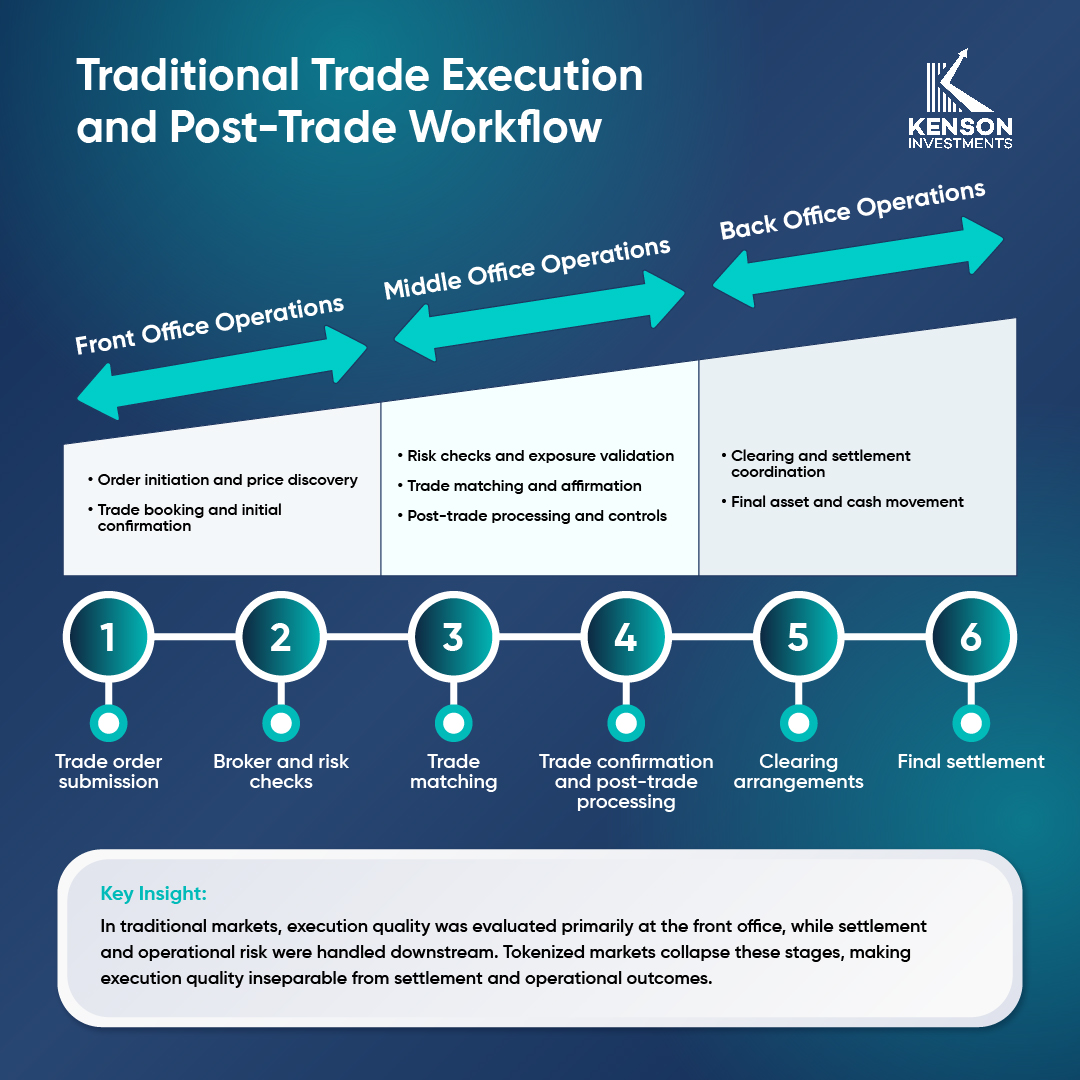
Settlement is no longer a back-office afterthought. In on-chain environments, settlement is part of execution.
Atomic settlement reduces counterparty risk but introduces binary outcomes. Either settlement occurs, or it does not. When settlement fails, capital can be locked, margin can be breached, and downstream obligations can be affected.
Institutions managing digital asset portfolio management strategies increasingly price settlement reliability into execution decisions. A slightly worse price with high settlement assurance can outperform a marginally better price with execution risk.
This perspective has influenced how firms evaluate digital asset consulting firms, prioritizing those that understand settlement mechanics, not just trading interfaces.
Collateral Impact Is Part of Execution Quality
Execution quality also affects balance sheets.
Trades consume collateral, trigger margin requirements, and alter liquidity buffers. In tokenized markets, collateral movement is immediate and visible. A trade that executes cleanly but drains liquidity at the wrong moment can force deleveraging elsewhere.
Institutions engaged in risk management in crypto investments now model collateral impact as part of execution analysis. This includes how trades affect borrowing capacity, liquidation thresholds, and cross-margin positions.
As a result, digital asset management consulting services increasingly integrate execution planning with collateral optimization.
Operational Reliability Separates Venues
Operational reliability is not glamorous, but it determines outcomes.
Network congestion, validator outages, RPC failures, and wallet permission errors can all degrade execution quality. These issues rarely appear in price charts, yet they drive real costs.
In 2025, several institutional surveys found that operational disruptions accounted for more execution-related losses than price slippage during volatile periods. This has reinforced the importance of security in digital asset management and infrastructure resilience.
Firms seeking secure digital asset consulting solutions now assess execution venues through operational stress testing, not just historical pricing data.
Execution in DeFi Adds Another Layer
Decentralized finance introduces additional execution variables.
Smart contract logic, oracle timing, and transaction ordering all influence outcomes. A trade may execute at an expected price but trigger unintended liquidations or unfavorable routing.
Institutions navigating DeFi finance assets with consultants pay close attention to execution pathways. Which pools are used. How price impact propagates. Whether fallback mechanisms exist when conditions change mid-execution.
This has elevated DeFi finance consulting services that focus on execution analysis rather than yield projections.
Execution Quality Is Contextual, Not Absolute
There is no universally best execution venue. Quality depends on context.
During calm markets, price may dominate. During stress, fill certainty and settlement assurance matter more. For large allocations, collateral impact may outweigh marginal price improvements.
Institutions pursuing long-term investment in digital assets increasingly tailor execution strategies to market conditions rather than applying static rules. This approach reflects a maturation of digital markets toward institutional norms.
Why Benchmarking Needs to Evolve
Traditional benchmarks focus on price-based metrics. In tokenized markets, these benchmarks miss critical dimensions.
Execution quality now includes failure rates, settlement delays, collateral efficiency, and operational stability. Institutions are developing multi-dimensional scorecards that reflect these realities.
This evolution has created demand for customized digital asset consulting solutions that help firms design execution benchmarks aligned with their risk appetite and operational constraints.
Implications for Asset Managers and Funds
For asset managers, execution quality directly affects performance attribution.
A strategy that appears profitable on paper may underperform once execution costs are fully accounted for. Funds involved in cryptocurrency fund administration are increasingly transparent about execution methodologies and constraints.
Investors are asking not just what was traded, but how reliably it was executed. This scrutiny favors managers with disciplined execution frameworks and robust controls.
The Strategic Role of Execution Infrastructure
Execution quality is shaped by infrastructure decisions.
Data feeds, access controls, transaction routing, and monitoring all influence outcomes. These elements rarely feature in marketing materials, yet they define execution success.
Institutions working with a global digital asset consulting firm often focus first on execution infrastructure, then on strategy. Without reliable execution, strategy becomes theoretical.
This mindset aligns with best practices in digital asset consulting, where operational foundations precede tactical decisions.
Execution Quality Signals Market Maturity
As markets mature, participants care less about headline features and more about dependable outcomes.
Execution quality becomes a signal of institutional readiness. Venues that deliver consistent fills, reliable settlement, and predictable collateral behavior attract long-term capital, a trend closely examined in Blockchain and digital asset consulting.
This dynamic supports transparent investment solutions and strengthens trust across the ecosystem, often guided by Digital asset consulting for compliance.
Execution Quality Is a System, Not a Statistic
In tokenized markets, execution quality is not defined by price alone. It emerges from the interaction of liquidity, settlement, collateral, and operations. Institutions that recognize this complexity are better positioned to navigate volatility, protect capital, and scale participation, frequently working with DeFi Finance consulting services and Security tokens investment consultants to evaluate market structure and risk.
Kenson Investments works with institutions analyzing execution quality across digital markets, focusing on reliability, resilience, and operational alignment. Explore how disciplined execution frameworks support informed participation in evolving tokenized markets and structured Cryptocurrency investment solutions. Reach out to us.
Disclaimer: The information provided on this page is for educational and informational purposes only and should not be construed as financial advice. Crypto currency assets involve inherent risks, and past performance is not indicative of future results. Always conduct thorough research and consult with a qualified financial advisor before making investment decisions.
“The crypto currency and digital asset space is an emerging asset class that has not yet been regulated by the SEC and the US Federal Government. None of the information provided by Kenson LLC should be considered as financial investment advice. Please consult your Registered Financial Advisor for guidance. Kenson LLC does not offer any products regulated by the SEC, including equities, registered securities, ETFs, stocks, bonds, or equivalents.”