








When blockchain networks and decentralized protocols promise to remove middlemen from financial activity, one common interpretation is that risk simply vanishes. That is not the case.
What changes is not the presence of risk but its address — from banks, clearinghouses, and regulated custodians to protocol code, governance rules, network design, and user operations. This relocation matters because it changes how losses happen, who bears the fallout, and how systemic pressures build across ecosystems.
Keep reading as our digital asset management consultants highlight how digital asset risk transfer works in practice, why crypto systemic risk looks different from traditional systemic risk, and how protocol design, user behavior, and operational execution become the primary arenas where failures propagate — areas frequently analyzed by Consultancy for DeFi Finance investments professionals.
How Risk Shifts in Blockchain Systems
Traditional finance relies heavily on intermediaries to manage and mitigate risk. Banks, custodians, clearinghouses, and trading platforms absorb operational errors, correct mistakes, and provide procedural oversight.
Delayed settlement windows and human intervention allow for partial remediation of mistakes, giving participants an implicit buffer against some financial and operational risks.
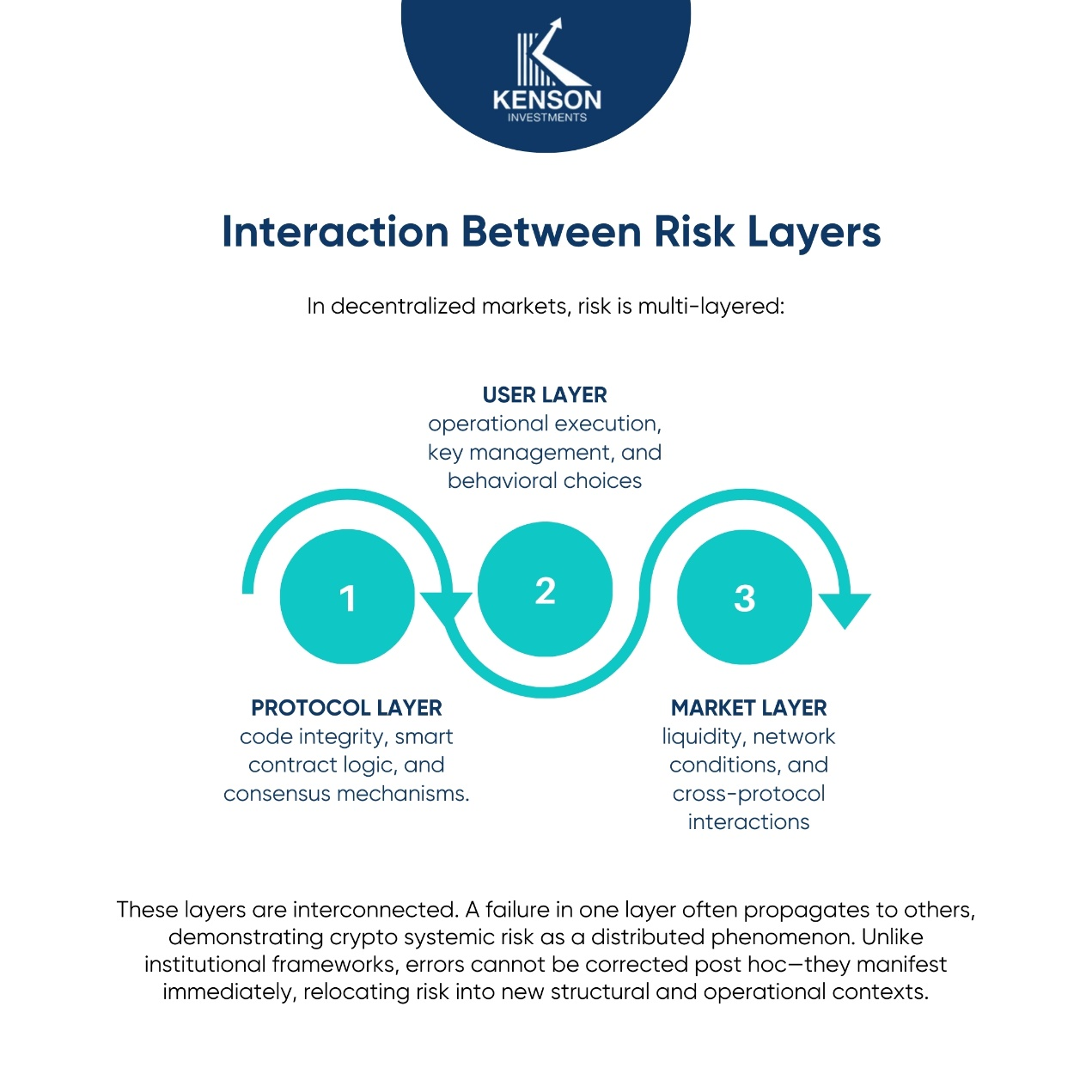
In contrast, blockchain systems relocate these risk buffers. Transactions are confirmed and recorded immutably, and network consensus protocols enforce rules automatically. While this reduces dependence on centralized institutions, it transfers responsibility to:
- Protocol design:The rules, algorithms, and code governing the blockchain define how transactions are processed, how consensus is reached, and what failure scenarios exist. Bugs or unintended interactions can propagate without centralized intervention.
- User behavior:Participants’ operational accuracy, security hygiene, and decision-making directly impact outcomes. Lost keys, incorrect network selection, or misconfigured smart contracts can result in irreversible consequences.
- Operational execution:Every step, from wallet management to transaction monitoring, now carries inherent risk. On-chain systems demand precise execution because errors cannot be reversed by an intermediary.
This relocation does not eliminate risk; it redistributes it across participants, systems, and processes, often making it more visible and immediate.
Digital Asset Risk Transfer in Action
When using decentralized finance (DeFi) platforms, stablecoins, or tokenized assets, the risk transfer is apparent in multiple ways— particularly in structures evaluated by real world asset consultants assessing on-chain exposure. For example:
- Protocol bugs:Smart contracts automate complex financial logic. If a coding error exists, the network executes it automatically, with consequences unfolding at protocol speed.
- Key management errors:Participants control access via private keys. Losing a key or entering a wrong address results in permanent asset loss.
- Network congestion:During periods of high activity, transaction timing and fees become critical, and delayed confirmations can lead to unintended exposure or lost opportunities.
While traditional systems might absorb similar errors via customer support or regulatory remediation, on-chain systems shift these responsibilities entirely to the participant and the protocol.
Systemic Risk in Crypto Networks
Crypto systemic risk arises when vulnerabilities or failures in one part of the network can propagate and affect other areas, a structural concern often examined by rwa tokenization investment consultants when evaluating interconnected asset layers. Examples include:
- Interconnected smart contracts that rely on the same price oracles
- Cross-chain bridges that expose liquidity pools to attack
- Network consensus mechanisms vulnerable to manipulation
These are not hypothetical risks; they are structural consequences of decentralized systems. By removing intermediaries, risk is no longer absorbed silently by institutions—it becomes explicit and measurable in the protocol itself.
Unlike regulated financial systems, there is no central counterparty guaranteeing correction. Operational errors, software vulnerabilities, or external attacks can ripple through the ecosystem without mitigation, highlighting the relocation of risk rather than its elimination.
Behavioral Risk in Decentralized Systems
Behavioral factors are critical in understanding relocated risk. Participants must make decisions in an environment where:
- Every transaction is permanent
- Feedback is immediate
- Price discovery occurs 24/7 across global markets
The permanence of actions intensifies cognitive and operational pressure. Participants may misjudge timing, underestimate network activity, or fail to verify details accurately. While traditional systems offer review periods and human oversight, decentralized environments amplify the consequences of behavioral errors.
Behavioral finance research shows that immediacy of feedback can increase stress, accelerate decision cycles, and magnify the impact of minor mistakes. In blockchain systems, these factors contribute directly to digital asset risk transfer, as human error becomes an explicit component of systemic vulnerability.

Operational Complexity and Risk Relocation
Blockchain systems introduce operational complexity that does not exist in traditional finance. Users must navigate:
- Wallet creation and backup procedures
- Network selection and fee management
- Smart contract interactions and multi-step transactions
- Monitoring protocol updates and governance proposals
Each operational step introduces a potential failure point. Mismanagement in any of these areas can result in permanent consequences, illustrating that risk has shifted from institutional intermediaries to protocol execution and user responsibility.
Operational errors compound quickly in decentralized systems. Unlike intermediated systems, there are no safety nets. Each misstep reinforces the importance of precise execution, proactive preparation, and an understanding of system mechanics.
Protocol Design as Risk Carrier
Protocols themselves carry embedded risk. Software is written by humans, and even rigorous audits cannot guarantee the absence of vulnerabilities. Protocol-level decisions—such as transaction prioritization, gas fee structures, or consensus rules—define how risk manifests in real-time.
- A poorly designed fee mechanism can delay transactions, creating exposure to volatility.
- Oracles that provide price data introduce systemic dependencies; errors propagate across connected smart contracts.
- Consensus protocols determine the speed and security of transaction finality, influencing operational outcomes.
By decentralizing control, risk becomes more distributed and visible, rather than hidden behind institutional processes. This is a key illustration of digital asset risk transfer, where structural elements of the system carry measurable consequences.
Liquidity and Market Risk
Liquidity in on-chain markets is determined by protocol rules, staking, and active participants rather than regulated intermediaries, a dynamic closely monitored by hedge fund investment consultation specialists assessing decentralized liquidity structures. While efficient in principle, this introduces systemic exposure:
- Sudden withdrawals or liquidity shifts can affect multiple smart contracts simultaneously
- Cross-protocol dependencies may transmit shocks across markets
- Continuous settlement amplifies the immediacy of consequences, leaving no time for traditional correction
Operational errors, network delays, or misjudged trades interact with liquidity conditions, reinforcing that risk is inherent, mobile, and redistributed rather than eliminated.
Cybersecurity and Relocated Risk
Security in blockchain systems is also a relocated responsibility, particularly for participants engaging with digital currencies through bitcoin investment consultants who evaluate custody and execution risks. Centralized institutions traditionally provide protection against theft, fraud, and unauthorized transactions. On-chain, participants must secure their own private keys, manage hardware wallets, and ensure safe interaction with smart contracts.
Cyber risks become user-centric:
- Phishing attacks, malware, and compromised software directly impact individuals
- Smart contract exploits can drain funds without recourse
- Cross-chain interactions expose participants to vulnerabilities that intermediaries would normally manage
By decentralizing control, security risk shifts from the institution to protocol design and operational execution, highlighting how risk persists even when intermediaries are removed.
Observability and Transparency
One advantage of relocated risk is visibility. Blockchain systems make risk explicit:
- Every transaction is recorded and verifiable
- Dependencies between protocols are observable
- Errors and exploits are public, providing measurable feedback
Transparency allows participants to understand crypto systemic risk, but it also requires that they actively manage their own exposure. The network enforces consequences automatically; there is no delayed or silent absorption of mistakes.
This structural transparency reinforces the principle that risk has not disappeared—it has simply moved into the hands of protocol architecture and user operations.
The Role of Protocol Governance
Governance mechanisms in decentralized systems also serve as risk relocation pathways, influencing tokenized ecosystems reviewed by Security tokens investment consultants analyzing compliance-aware protocol structures. Token holders, voting processes, and decentralized autonomous organizations (DAOs) influence protocol evolution and decision-making.
While governance cannot remove risk from the system, it redistributes it to participants who are actively engaged in maintaining, upgrading, or modifying protocol rules.
Misaligned incentives or incomplete understanding among participants can create additional exposure. Risk is shifted from central authorities to the distributed network of stakeholders.
Technology Dependency as a Risk Factor
Decentralized systems depend on technology, from network nodes to cryptographic algorithms. Failures in software, hardware, or network connectivity can directly impact outcomes.
Traditional financial systems mitigate such risks with redundancy, disaster recovery, and human oversight. In blockchain ecosystems, these safeguards are distributed across nodes and participants. Risk relocation is evident: technical reliability and operational execution are now primary determinants of exposure.
This dependency illustrates how digital asset risk transfer occurs at a structural level. Institutions are no longer the first line of defense—participants and protocols collectively absorb the consequences.
Learn More About Digital Assets With Kenson Investments
Risk in digital asset ecosystems is not eliminated—it relocates. In decentralized systems, exposure moves from traditional institutions to protocol design, operational execution, and user behavior, making understanding these dynamics essential for anyone engaging with blockchain networks.
As a reputable digital asset management consultancy, Kenson Investments provides educational resources and general market insights to help you explore how these structural shifts affect digital asset risk transfer and contribute to crypto systemic risk.
Our digital asset management consultants focus on breaking down complex on-chain processes, transaction mechanics, and operational responsibilities into clear, actionable knowledge.
Register now for resources to gain deeper insight into digital asset risk transfer and enhance your understanding of decentralized systems.
Disclaimer: The information provided on this page is for educational and informational purposes only and should not be construed as financial advice. Crypto currency assets involve inherent risks, and past performance is not indicative of future results. Always conduct thorough research and consult with a qualified financial advisor before making investment decisions.
“The crypto currency and digital asset space is an emerging asset class that has not yet been regulated by the SEC and the US Federal Government. None of the information provided by Kenson LLC should be considered as financial investment advice. Please consult your Registered Financial Advisor for guidance. Kenson LLC does not offer any products regulated by the SEC, including equities, registered securities, ETFs, stocks, bonds, or equivalents.”