









In the modern digital asset landscape, the speed and ease of moving capital across chains, wallets, and protocols create new opportunities and new risks. While traditional financial assets often require intermediaries, settlement windows, or regulatory approvals, digital assets can be transferred almost instantaneously across borders. This frictionless mobility introduces both flexibility and fragility, forcing portfolio managers, investors, and institutions to rethink how stability is achieved and maintained over time.
Digital asset mobility risk is increasingly recognized as a defining factor in portfolio construction. Unlike conventional markets, where liquidity constraints, transfer costs, and operational frictions provide implicit buffers, digital assets operate in an environment where execution is near-immediate and largely irreversible. While this speed allows participants to respond quickly to opportunities, it also exposes them to amplified consequences when controls, monitoring, or contextual awareness are insufficient.
Understanding Asset Mobility in Digital Markets
At its core, asset mobility refers to the ability to move holdings across networks, wallets, and protocols with minimal delay or friction. It is enabled by blockchain technology, decentralized finance (DeFi) infrastructure, and interoperability tools that remove traditional gatekeepers. For digital asset investment, mobility translates into several characteristics:
- Instantaneous transfers:Assets can be moved in seconds, enabling near real-time portfolio adjustments.
- Borderless execution:Geographical limitations and cross-border banking delays are no longer obstacles.
- Programmable routing:Smart contracts and automated protocols can facilitate pre-set transfers, collateralization, or leverage strategies.
- Reduced settlement risk:The traditional risk of delayed or failed settlement is minimized, but operational and sequencing risks increase.
While these traits enhance flexibility, they also reduce the inherent “frictional damping” that historically slowed the propagation of errors, misjudgments, or volatility. In other words, speed amplifies both positive and negative outcomes.
How Mobility Affects Portfolio Stability
Digital asset mobility affects portfolios in subtle yet meaningful ways:
1. Amplified Correlation Effects
Rapid transfers can exacerbate correlations across assets. When market conditions shift, positions that were previously isolated may suddenly move together, increasing systemic exposure.
2. Compounded Operational Risk
Immediate execution leaves little room for manual intervention. Misrouted transactions, erroneous transfers, or unintended protocol interactions can cascade quickly, impacting multiple positions.
3. Liquidity Shock Propagation
The ability to move assets instantaneously can create liquidity “whiplash.” For instance, a large withdrawal from one protocol or exchange can affect pricing, slippage, and funding costs elsewhere.
4. Short-Term Volatility vs Long-Term Allocation
Asset mobility encourages reactive behavior. While investors can capitalize on transient opportunities, frequent adjustments may erode long-term allocation objectives and risk management discipline.
5. Invisible Dependencies
Interconnected protocols, wrapped tokens, and cross-chain bridges create hidden dependencies. Mobility increases the likelihood that a stress event in one area ripples through a portfolio unexpectedly.
These dynamics illustrate that portfolio stability is no longer determined solely by diversification, allocation percentages, or market direction. Instead, execution speed, operational discipline, and structural resilience become central factors in risk management.
Behavioral Dimensions of Mobility Risk
Behavioral patterns are magnified in environments with high mobility:
- Overconfidence in Execution:Investors may assume that the technology guarantees flawless execution, leading to larger or more complex positions than risk appetite warrants.
- Reactionary Rebalancing:Quick access encourages knee-jerk adjustments based on short-term price movements, rather than strategic objectives.
- Neglect of Frictional Safeguards:Traditional checks, such as manual reconciliation, time delays, or multi-layer approvals, can be bypassed, creating vulnerability.
Recognizing these behavioral risks is critical. Digital asset mobility is not inherently dangerous, but without structured oversight, human decision-making interacts with frictionless systems to magnify exposure.
Kenson Perspective: Building Resilience Around Mobility
At Kenson Investments, we view digital asset mobility risk not as a challenge to be eliminated, but as a structural feature to be managed. Our approach focuses on embedding resilience and context into every aspect of digital asset management:
- Strategic Friction:We intentionally introduce checkpoints, approvals, and monitoring mechanisms that slow critical movements just enough to detect misalignments without compromising agility.
- Contextual Oversight:Every asset movement is evaluated not only on the immediate execution but on its potential impact across the portfolio and connected networks.
- Scenario Planning:Stress-testing mobile portfolios under extreme but plausible scenarios allows us to understand ripple effects, liquidity bottlenecks, and hidden dependencies.
- Education & Risk Awareness:Investors and digital asset teams are trained to interpret the implications of mobility, reducing overconfidence and reactionary behaviors.
By integrating these principles, we aim to preserve the benefits of speed while limiting the fragility that high mobility introduces.
Operational Controls for Mobile Portfolios
Practitioners can implement several operational measures to mitigate mobility-related risk:
- Layered Approvals and Limits:High-value transfers or cross-protocol movements should trigger multi-step approval processes or automated limits.
- Real-Time Monitoring:Track position movements, chain activity, and protocol health continuously. Automated alerts can flag unusual patterns before they escalate.
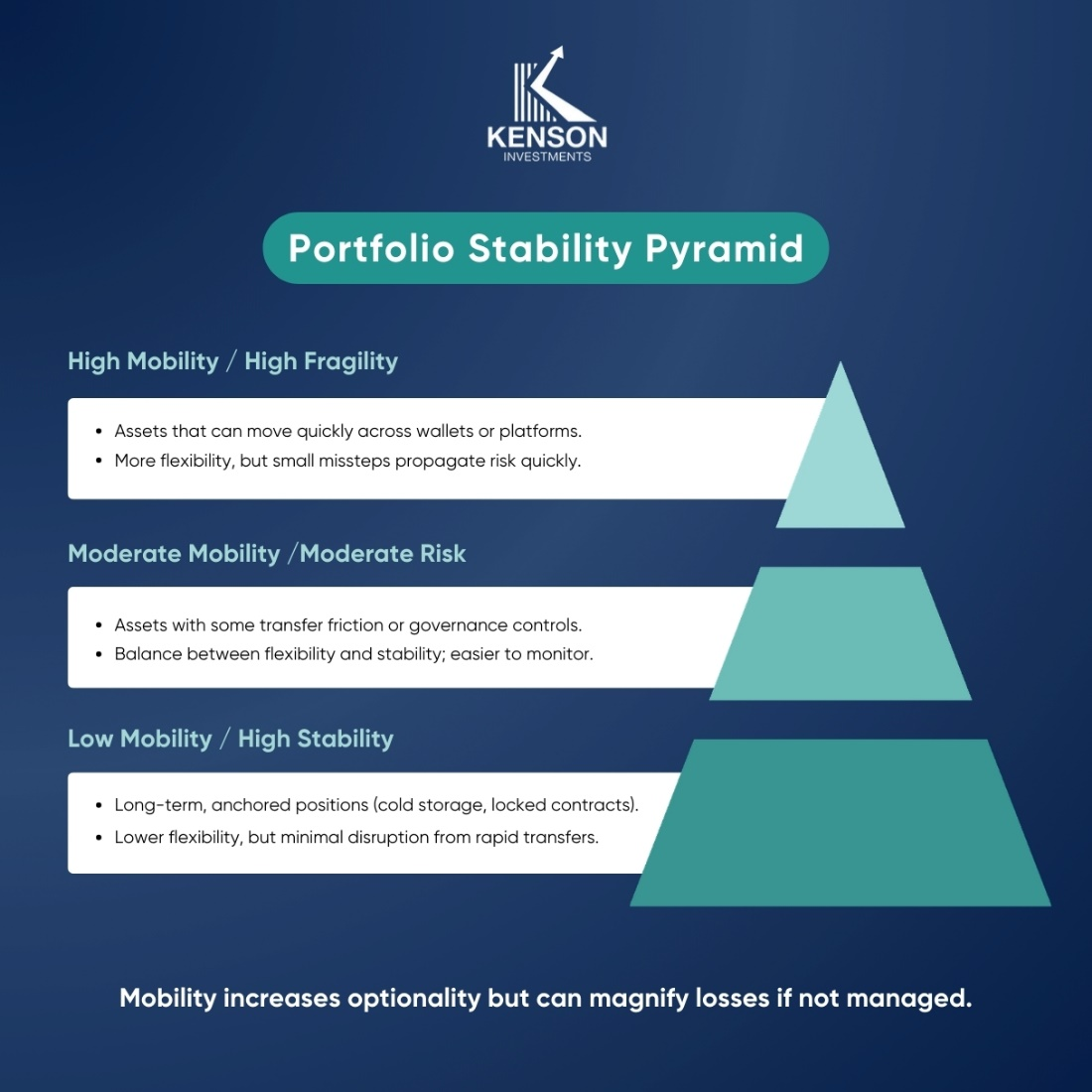
- Segmentation of Assets:Maintain a balance between immediately mobile funds and reserve pools. This ensures liquidity is available without compromising capital protection.
- Interconnected Risk Mapping:Document relationships between assets, protocols, and wallets. Understand which positions could influence others in volatile conditions.
- Versioned Smart Contract Reviews:Automated protocols facilitating mobility must be reviewed and tested under stress scenarios. Code errors or vulnerabilities can propagate instantly.
While these controls do not slow execution excessively, they introduce strategic friction that aligns high-speed execution with long-term stability goals.

The Role of Technology and Governance
Mobility introduces a convergence of technology and governance considerations:
- Code as a Control Mechanism: Smart contracts can enforce rules around transfers, allocations, and collateralization, reducing reliance on human discretion.
- Decentralized Oversight:Multi-signature arrangements, DAO-based approvals, and other governance models provide checks across autonomous networks.
- Auditability:On-chain tracking enables transparent movement of funds, but interpretation requires expertise. Raw visibility alone is insufficient without contextual understanding.
The interplay between technical infrastructure and governance policies defines the ultimate resilience of mobile portfolios.
Strategic Implications for Digital Asset Investment
Investors and institutions must recognize that portfolio stability is not guaranteed by technology alone. Digital asset mobility risk requires:
- Thoughtful allocation decisions that account for cross-protocol dependencies.
- Governance structures capable of enforcing discipline at high speeds.
- Behavioral discipline to avoid overreacting to short-term signals.
- Continuous learning and adaptation as systems evolve.
Ignoring mobility dynamics can create a false sense of security. Even well-diversified portfolios may experience outsized losses if speed and interconnectedness are not managed effectively.

Kenson Approach: Operationalizing Stability in Mobile Markets
Kenson Investments emphasizes proactive risk alignment in environments with high asset mobility:
- Portfolio Mobility Mapping:Identify which assets are most mobile, the paths they can traverse, and how movements affect correlated positions.
- Scenario Simulations:Test extreme but plausible mobility-driven events to refine response protocols.
- Integrated Oversight:Combine human and automated monitoring to balance agility with control.
- Investor Education:Clients are trained to understand not just the mechanics of asset transfer, but the strategic implications for portfolio risk.
This framework allows participants to capitalize on digital asset flexibility without sacrificing structural stability. By approaching mobility as a managed feature rather than an uncontrollable variable, portfolios become both adaptable and resilient.
Final Thoughts: Balancing Flexibility with Fragility
Digital asset mobility is a defining characteristic of modern financial ecosystems. Its speed and frictionless nature provide unprecedented opportunities for portfolio optimization, diversification, and real-time management. Yet without attention to operational discipline, governance, and behavioral dynamics, mobility introduces fragility that can magnify losses, amplify correlations, and create hidden exposures.
Effective digital asset management requires embracing mobility while embedding strategic friction, contextual oversight, and scenario-based planning. Long-term stability in this environment depends not on slowing execution, but on ensuring that every movement is purposeful, monitored, and aligned with overall portfolio objectives.

Kenson Investments: Education and Oversight for Mobile Portfolios
Kenson Investments provides resources, frameworks, and advisory insights to help investors understand the implications of digital asset mobility. By combining educational programs, operational protocols, and risk-focused portfolio analysis, Kenson helps participants navigate frictionless markets without compromising long-term capital preservation. Our cryptocurrency investment consultant team delivers blockchain and digital asset consulting alongside comprehensive digital asset investment solutions, including guidance on stablecoins for investment to support balanced, resilient portfolio construction.
Explore how Kenson Investments integrates risk-aware digital asset strategies and structured oversight into mobile portfolios. Learn more about our approach to resilient, long-term digital asset investment.
Disclaimer: The information provided on this page is for educational and informational purposes only and should not be construed as financial advice. Cryptocurrency assets involve inherent risks, and past performance is not indicative of future results. Always conduct thorough research and consult with a qualified financial advisor before making investment decisions.
“The cryptocurrency and digital asset space is an emerging asset class that has not yet been regulated by the SEC and the US Federal Government. None of the information provided by Kenson LLC should be considered as financial investment advice. Please consult your Registered Financial Advisor for guidance. Kenson LLC does not offer any products regulated by the SEC, including equities, registered securities, ETFs, stocks, bonds, or equivalents.”