










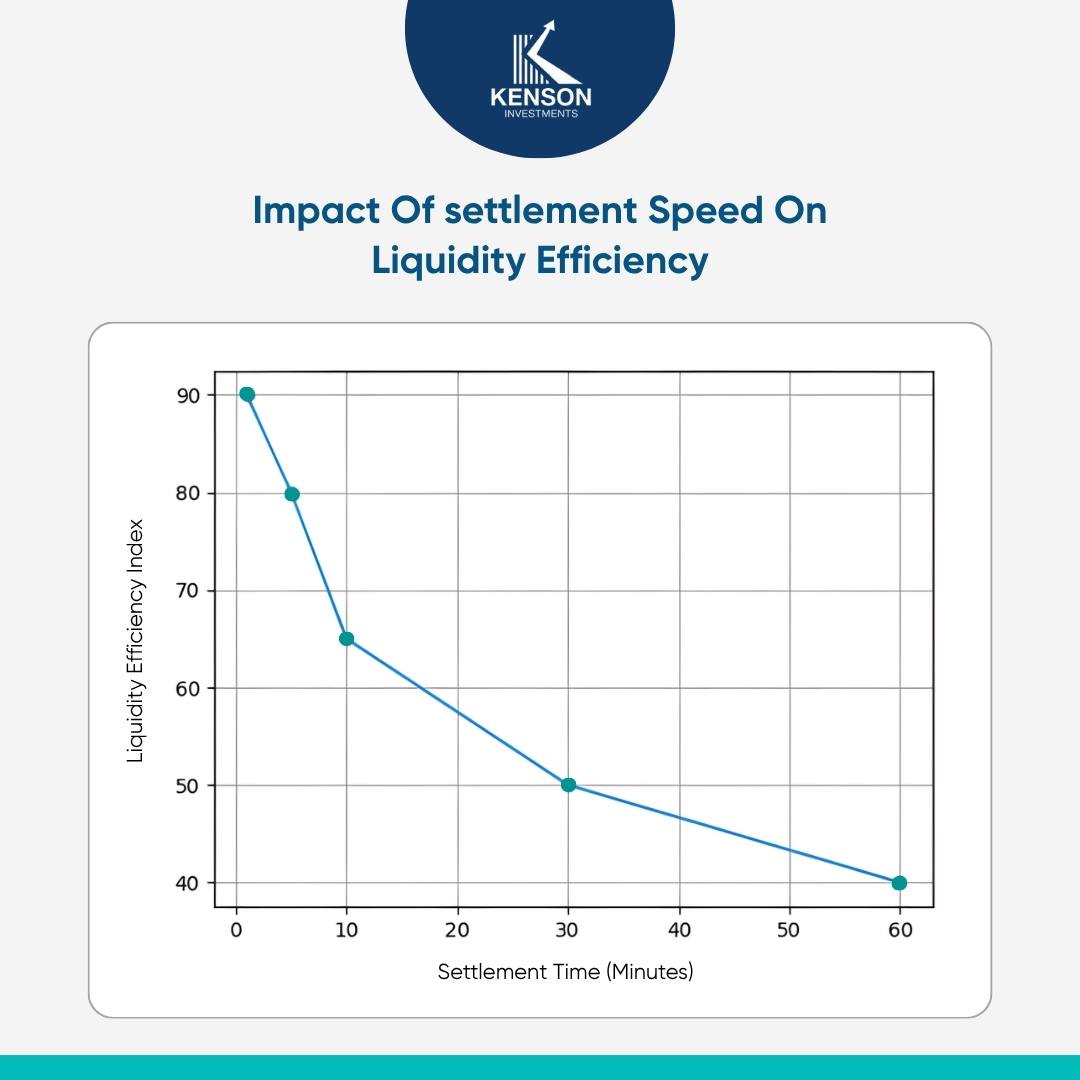
Liquidity has never been static, but in digital asset markets it is no longer even cyclical in the traditional sense. It is continuous, reactive, and increasingly compressed. As settlement cycles move from T+2 and T+1 toward near-instant execution, the assumptions that once governed capital availability begin to break down.
For high-net-worth investors and allocators, this is not a technical footnote. It is a structural shift that directly affects how capital is deployed, how risk is measured, and how consistency is preserved over time. Faster settlement changes how liquidity behaves at every layer, from order books to collateral flows.

A disciplined approach to digital asset investments now requires understanding not just where liquidity exists, but how quickly it moves, disappears, and reappears under stress.
Settlement Compression and the Velocity of Capital
Traditional markets allowed for temporal buffers. Settlement delays created windows for reconciliation, margin adjustment, and error correction. In contrast, digital asset infrastructure has removed much of that latency.
Bitcoin and Ethereum settle transactions within minutes, while certain layer-2 networks and alternative systems reduce that timeframe to seconds. Stablecoin settlement across networks often occurs in near real time, with billions of dollars moving daily without intermediary clearinghouses.
In 2025 alone, stablecoin transaction volumes exceeded $10 trillion annually, with a significant portion settling within minutes. This level of velocity alters the fundamental equation of liquidity provisioning.
Capital is no longer “parked” in the same way. It is continuously recycled.
For institutions engaged in crypto asset management, this creates both opportunity and exposure. Faster turnover can enhance capital efficiency, but it also increases the frequency of decision points. Every redeployment becomes a potential risk event.
This is where investment analysis and portfolio management shifts from periodic review to continuous evaluation.
Liquidity Is No Longer Passive
In slower systems, liquidity providers could afford to be passive. Market makers operated within defined spreads, adjusting positions at predictable intervals.
Near-instant settlement changes this dynamic. Liquidity must now be actively managed at all times.
Consider derivatives markets, where liquidation cascades can unfold within minutes. In March 2024, a single volatility event triggered over $1 billion in liquidations within hours. By 2025, similar events have occurred in even shorter windows, often amplified by automated systems reacting simultaneously.
This is where risk management in crypto investments becomes inseparable from liquidity strategy.
Institutions must now monitor:
- Real-time collateral positions
- Cross-exchange liquidity fragmentation
- Automated liquidation thresholds
- Stablecoin redemption flows
The result is a shift toward secure digital asset consulting solutions that prioritize operational awareness rather than static allocation models.
Liquidity is no longer something you access. It is something you actively maintain.
Capital Turnover and the Illusion of Efficiency
At first glance, faster settlement appears to improve efficiency. Capital cycles more quickly, idle balances shrink, and opportunities can be captured faster.
But this efficiency can be misleading.
Higher turnover increases exposure to execution risk, slippage, and market microstructure volatility. It also compresses the time available to respond to adverse conditions.
In traditional finance, capital turnover was constrained by settlement delays. In digital markets, it is constrained by discipline.
This distinction matters.
Without structured processes, rapid turnover can degrade performance rather than enhance it. Institutions engaging in digital asset portfolio management must now define:
- Maximum turnover thresholds
- Execution pacing strategies
- Liquidity concentration limits
This is where best practices in digital asset consulting become critical. Speed without structure introduces fragility.
The Impact on Liquidity Provisioning Models
Market makers and liquidity providers are adapting quickly. Traditional inventory-based models are being replaced with dynamic, algorithm-driven systems.
These systems continuously rebalance exposure across venues, adjusting to real-time conditions.
However, this introduces new dependencies:
- Reliance on data latency and accuracy
- Sensitivity to exchange outages
- Exposure to cross-platform arbitrage gaps
In fragmented markets, liquidity can appear deep but disappear instantly.
This is particularly relevant for allocators navigating the digital asset market. Depth on a single exchange does not guarantee executable liquidity across the broader ecosystem.
As a result, institutions increasingly rely on blockchain and digital asset consulting frameworks to assess true liquidity conditions rather than surface-level metrics.
Risk Monitoring in a Continuous Environment
Faster settlement compresses not just execution timelines, but also risk detection windows.
In traditional systems, risk could be evaluated at discrete intervals. In digital asset markets, risk evolves continuously.
This requires a shift toward:
- Real-time monitoring systems
- Automated alert frameworks
- Integrated risk dashboards
For firms offering digital asset advisory services, the focus is no longer on periodic reporting. It is on continuous oversight.
The difference is operational, not conceptual.
A position that appears stable at one moment can become vulnerable minutes later due to shifts in collateral value, liquidity depth, or counterparty exposure.
This is particularly relevant in DeFi environments, where smart contract interactions and collateralized lending amplify sensitivity to market movements. Institutions navigating DeFi finance assets with consultants must account for these dynamics at a structural level.
Stablecoins and Instant Settlement Risk
Stablecoins play a central role in accelerating settlement cycles. They provide the bridge between traditional capital and blockchain-native liquidity.
However, their speed introduces unique risks.
Large-scale redemptions can occur instantly, draining liquidity from specific pools or exchanges. In periods of stress, this can create localized dislocations that propagate quickly across markets.
For example, during recent volatility events, stablecoin outflows exceeding hundreds of millions of dollars have occurred within hours, impacting liquidity availability across multiple venues.
Institutions exploring stablecoins for investment must therefore consider not just yield opportunities, but redemption dynamics and counterparty exposure.
This is where digital asset consulting for compliance and operational risk frameworks intersect. Speed amplifies the consequences of structural weaknesses.
Operational Discipline as a Competitive Advantage
As settlement accelerates, operational discipline becomes the defining factor in long-term performance.
Technology alone is not sufficient. Systems must be supported by processes that enforce consistency under pressure.
This includes:
- Defined escalation protocols
- Pre-set risk thresholds
- Continuous liquidity mapping
- Scenario-based stress testing
Firms positioned as a global digital asset consulting firm increasingly differentiate themselves not through access to opportunities, but through their ability to manage risk in compressed timeframes.
For allocators, evaluating digital asset consulting firms now requires assessing operational infrastructure, not just market insight.
How Kenson Approaches This
At Kenson Investments, settlement speed is not treated as a benefit or a risk in isolation. It is understood as a structural condition that reshapes how capital behaves.
Our framework is built around maintaining control in environments where time is compressed.
We focus on:
- Limiting unnecessary capital turnover to reduce exposure to execution volatility
- Maintaining diversified liquidity access across venues to mitigate fragmentation risk
- Implementing real-time monitoring systems that prioritize signal over noise
- Structuring allocations to withstand rapid liquidity contractions
Rather than chasing velocity, the objective is to preserve consistency.
This approach aligns with a broader philosophy of long-term investment in digital assets, where capital protection takes precedence over short-term optimization.
As part of our comprehensive digital asset consulting services, we emphasize clarity, discipline, and transparency in every layer of the investment process.
Industry Direction: Toward Instant Settlement Infrastructure
The trend toward faster settlement is not slowing down. If anything, it is accelerating.
Tokenized securities, real-world asset platforms, and institutional DeFi protocols are all moving toward near-instant settlement models.
Major financial institutions are actively exploring blockchain-based settlement systems that eliminate clearinghouse delays. Pilot programs in 2025 and 2026 indicate settlement times measured in seconds rather than days.
This evolution will further compress liquidity cycles.
For investors, this reinforces the importance of working with strategic digital asset consulting partners who understand not just the technology, but the behavioral implications of these changes.
The conversation is shifting from access to infrastructure toward control within infrastructure.
Liquidity Behavior in a Compressed Future
Looking ahead, liquidity will continue to become more dynamic, more fragmented, and more sensitive to real-time conditions.
Key trends include:
- Increased reliance on algorithmic liquidity provisioning
- Greater integration of cross-chain liquidity pools
- Higher sensitivity to macro and micro market signals
- Reduced tolerance for operational inefficiencies
Institutions engaging in digital asset management consulting must adapt to this environment by prioritizing resilience over speed.
This is particularly relevant when comparing altcoins vs. major cryptocurrencies, where liquidity profiles differ significantly under stress conditions.
Not all assets behave equally in compressed markets.
Speed Changes Behavior, Discipline Preserves Capital
Settlement speed does more than accelerate transactions. It changes how liquidity behaves, how risk manifests, and how capital must be managed.
For investors investing in the digital age, the challenge is not simply keeping up with faster markets. It is maintaining control within them.
This requires:
- Continuous monitoring
- Structured execution
- Clear risk frameworks
- Long-term discipline
Firms that treat speed as a structural constraint rather than an advantage are better positioned to navigate volatility without compromising capital.
Build Consistency in Faster Markets
Understanding settlement speed is one step. Structuring around it is where outcomes are determined.
Kenson Investments provides secure digital asset consulting solutions designed for investors seeking clarity in complex, fast-moving environments. Through disciplined digital asset management services, we focus on preserving capital while navigating evolving market structures.
Connect with Kenson Investments to explore how a structured, risk-aware approach can support long-term consistency in increasingly compressed digital asset markets.
Disclaimer: The information provided on this page is for educational and informational purposes only and should not be construed as financial advice. Crypto currency assets involve inherent risks, and past performance is not indicative of future results. Always conduct thorough research and consult with a qualified financial advisor before making investment decisions.
“The crypto currency and digital asset space is an emerging asset class that has not yet been regulated by the SEC and US Federal Government. None of the information provided by Kenson LLC should be considered as financial investment advice. Please consult your Registered Financial Advisor for guidance. Kenson LLC does not offer any products regulated by the SEC including, equities, registered securities, ETFs, stocks, bonds, or equivalents”



