








Collateral management is built around timing. A margin call arrives, eligible assets are identified, valuations are confirmed, instructions are sent, custodians move assets, and counterparties reconcile what has changed. In stressed markets, delays can create liquidity strain, operational pressure, and avoidable disputes.
Tokenization may improve parts of that workflow. Tokenized collateral can represent traditional assets on programmable rails, making movement, status tracking, and settlement logic easier to coordinate. But faster movement does not automatically create safer collateral management. It can also compress decision windows and expose weak controls more quickly.
For institutions, tokenized collateral margin is not only a technology topic. It is a control framework topic involving valuation, custody status, transfer permissions, collateral eligibility, governance, and exception handling.
Why Margin Workflows Are Hard to Modernize
Margin operations depend on agreement terms, asset eligibility schedules, haircut rules, valuation sources, settlement cutoffs, custody arrangements, and legal enforceability. The process is often split across trading systems, collateral platforms, custodians, settlement venues, and internal risk teams.
That fragmentation creates manual work. It also makes it harder to know, at a precise moment, whether collateral is available, eligible, valued correctly, and transferable. Tokenization can help by creating a shared representation of collateral ownership or control, but it does not remove the need for legal and operational clarity.
ISDA’s Tokenized Collateral Model Provisions for VM CSA show how documentation may need to change when tokenized collateral is used in variation margin arrangements. ISDA also notes that firms need regulatory certainty that tokenized assets will be permitted as collateral under margin rules for non-cleared derivatives.
That is the first lesson: tokenized collateral must fit the agreement, not just the ledger.
Valuation Controls Cannot Be an Afterthought
A token can move quickly, but its value still needs to be calculated, validated, and disputed when necessary. Margin workflows depend on valuation confidence. If a tokenized treasury fund, money market instrument, bond, or other eligible asset is used as collateral, the institution needs to know which price source controls, when the value updates, how haircuts apply, and what happens if pricing data becomes stale.
This creates new dependencies around oracles, fund administrators, pricing vendors, custodians, and ledger data. A smart contract may enforce a collateral transfer rule, but it should not blindly accept an outdated value. The risk is especially relevant when collateral is tokenized from traditionally off-chain assets, where market prices, fund NAVs, or custody confirmations may not update continuously.
BIS has framed tokenization as a way to combine assets, money, and information on programmable infrastructure, but the same work also makes clear that legal, operational, and risk arrangements remain central to tokenized systems.
For digital asset risk controls, valuation governance should define accepted pricing sources, update frequency, fallback logic, dispute windows, and exception escalation. Faster margin movement only helps if valuation quality keeps pace.
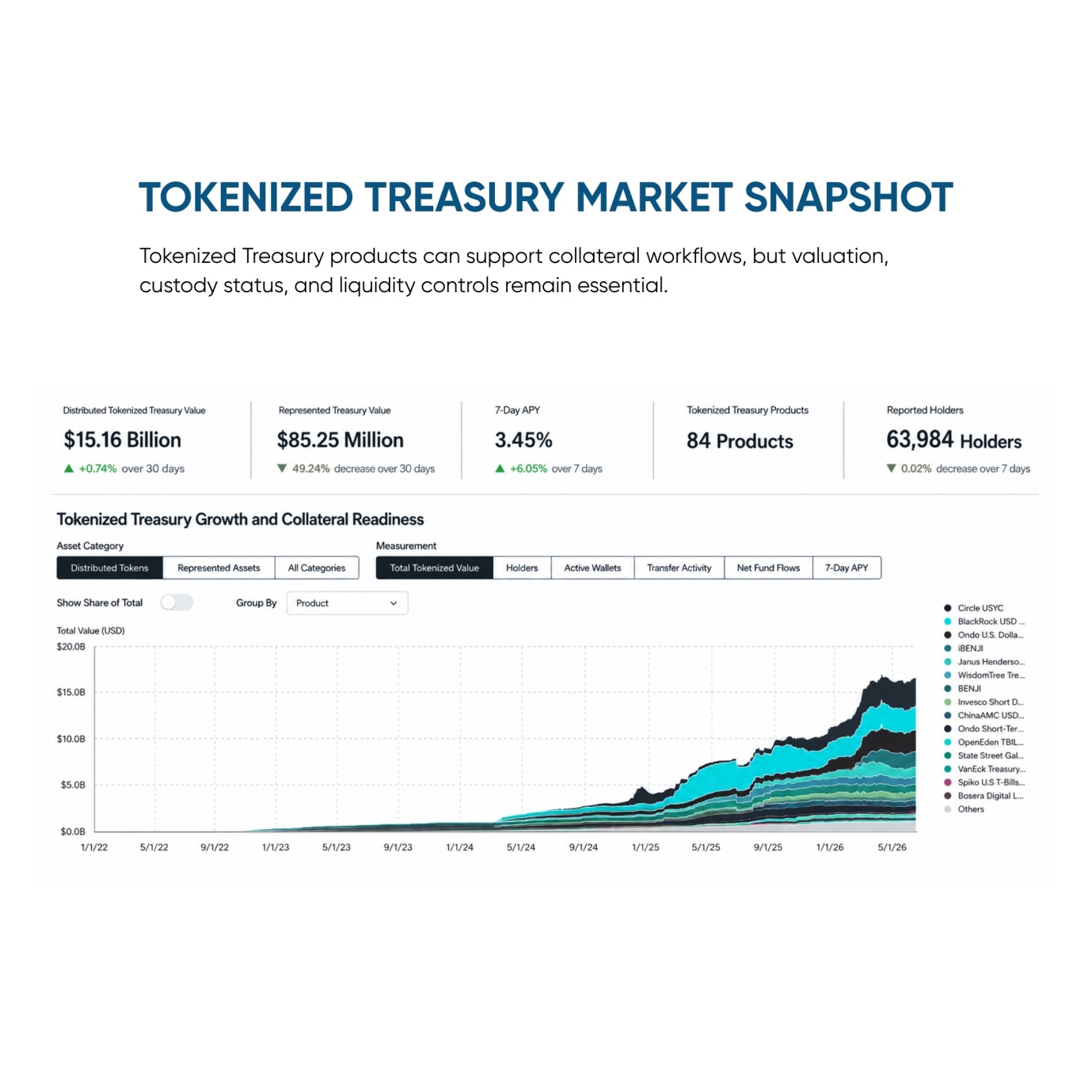
Custody Status Must Be Visible Before Transfer
Collateral is not useful if its custody status is unclear. A tokenized representation may show that an asset exists, but margin teams still need to know whether it is pledged, encumbered, restricted, locked, pending settlement, or available for transfer.
This is where custody architecture becomes critical. Tokenized collateral systems should be able to distinguish between assets held for safekeeping, assets posted as collateral, assets pending transfer, and assets subject to rehypothecation limits. The control environment should also show who can initiate movement, who must approve it, and whether the receiving party has accepted the collateral under the governing agreement.
DTCC’s collateral appchain work describes how digital assets, blockchain, and tokenization can support more scalable collateral market infrastructure. Its 2026 research also argues that tokenized representations of traditional assets and near real time collateral mobility could help institutions manage liquidity buffers and market stress more effectively.
That potential depends on custody visibility. If collateral can move quickly but custody records lag behind, the institution may create a reconciliation problem rather than solve one.
Transfer Limits Protect the Workflow
Tokenized collateral systems need transfer controls because not every technically possible transfer should be allowed. Margin workflows are governed by counterparty agreements, eligibility schedules, regulatory rules, sanctions controls, and internal policies.
A stronger design may include allowlisted counterparties, asset-level eligibility rules, maximum transfer sizes, jurisdictional restrictions, dual approval thresholds, settlement window controls, and automated checks against outstanding obligations. These controls help prevent tokenized collateral from moving outside approved workflows.
This is especially important for digital asset operational risk. A wrong wallet address, excessive token approval, invalid collateral type, or unauthorized transfer could create immediate exposure. In legacy workflows, manual friction sometimes slows errors. In tokenized workflows, weak permissions can allow errors to settle faster.
Transfer rules should be explicit. Which wallets are approved? Which assets are eligible? Which contracts can receive collateral? Which transfers require human approval? Which conditions trigger a hold?
Operational Readiness Matters More Than Speed
Institutions often discuss tokenization in terms of faster settlement and collateral mobility. Those are real design goals, but readiness is wider than speed.
Operational readiness means teams can monitor collateral status, reconcile records, manage exceptions, revoke permissions, test smart contract logic, respond to failed transfers, and preserve audit evidence. It also means legal, treasury, risk, operations, compliance, and technology teams understand the same workflow.
MAS Project Guardian has explored asset tokenization with policymakers and financial institutions, including work across tokenized funds, bonds, foreign exchange, and related market infrastructure. That type of institutional collaboration matters because tokenized collateral workflows cannot be built in isolation. They need standards around settlement assets, custody, permissions, and interoperability.
For readers studying real-world asset tokenization or broader institutional blockchain infrastructure, tokenized collateral is a useful example of how market structure and operational controls must develop together.
What Better Controls Should Include
A practical control framework for tokenized collateral should begin before assets are posted. Institutions need documented eligibility rules, valuation methodology, approved custodians, wallet permission maps, smart contract review, and transfer approval thresholds.
During the workflow, systems should check collateral availability, current valuation, custody status, counterparty eligibility, transfer limits, and settlement confirmation. After execution, records should support reconciliation, audit review, dispute management, and reporting.
This is where institutional digital asset readiness becomes concrete. Tokenized collateral should not depend on one dashboard or one smart contract event. It should connect ledger activity to legal records, custody statements, valuation files, and operational approvals.
Kenson’s digital asset risk management resources help frame why controls around speed, permissions, and evidence are central to market education. For organizations exploring blockchain and digital asset consulting, collateral workflows show why technical design must be matched with governance discipline.
Build Collateral Mobility on Control Discipline
Tokenized collateral may improve margin workflows by making assets easier to identify, move, and reconcile. But mobility without strong controls can create new forms of operational pressure.
The institutions best positioned to understand this shift will focus on valuation quality, custody visibility, transfer limits, permissioning, documentation, and exception handling before scaling activity. The goal is not simply faster movement. The goal is controlled movement.
Kenson Investments helps informed market participants follow tokenization, collateral, and risk infrastructure through an education-first lens. To continue building a clearer view of digital asset market structure and operational readiness, explore our digital asset market education resources.
Disclaimer: The information provided on this page is for educational and informational purposes only and should not be construed as financial advice. Crypto currency assets involve inherent risks, and past performance is not indicative of future results. Always conduct thorough research and consult with a qualified financial advisor before making investment decisions.
“The crypto currency and digital asset space is an emerging asset class that has not yet been regulated by the SEC and US Federal Government. None of the information provided by Kenson LLC should be considered as financial investment advice. Please consult your Registered Financial Advisor for guidance. Kenson LLC does not offer any products regulated by the SEC including, equities, registered securities, ETFs, stocks, bonds, or equivalents”