









Smart contracts let trades settle atomically, meaning both sides transfer at once or not at all. They also automate order logic, collateral management and liquidations, and make trading rules publicly verifiable. These capabilities reduce settlement and counterparty risk, but introduce code, oracle and network risks.
Key takeaways
The biggest capability is atomic settlement: delivery and payment happen in one transaction, removing settlement risk between counterparties.
Programmable orders, automated collateral and composability enable strategies that are impractical off-chain.
The trade-off is new risk: code exploits, oracle manipulation, MEV and network congestion.
More than $3.4 billion was stolen in crypto in 2025, a reminder that smart contract risk is a cost of these features.
Traditional trades involve a chain of intermediaries: brokers, clearing houses and custodians, with settlement often a day or more after execution. Smart contracts collapse much of that chain into code. For investors, that can mean faster, more transparent settlement, but also a different set of risks to understand. This guide focuses on concrete trading capabilities; for funding and escrow uses, see conditional capital release.
Capability 1: Atomic Settlement (Delivery Versus Payment)
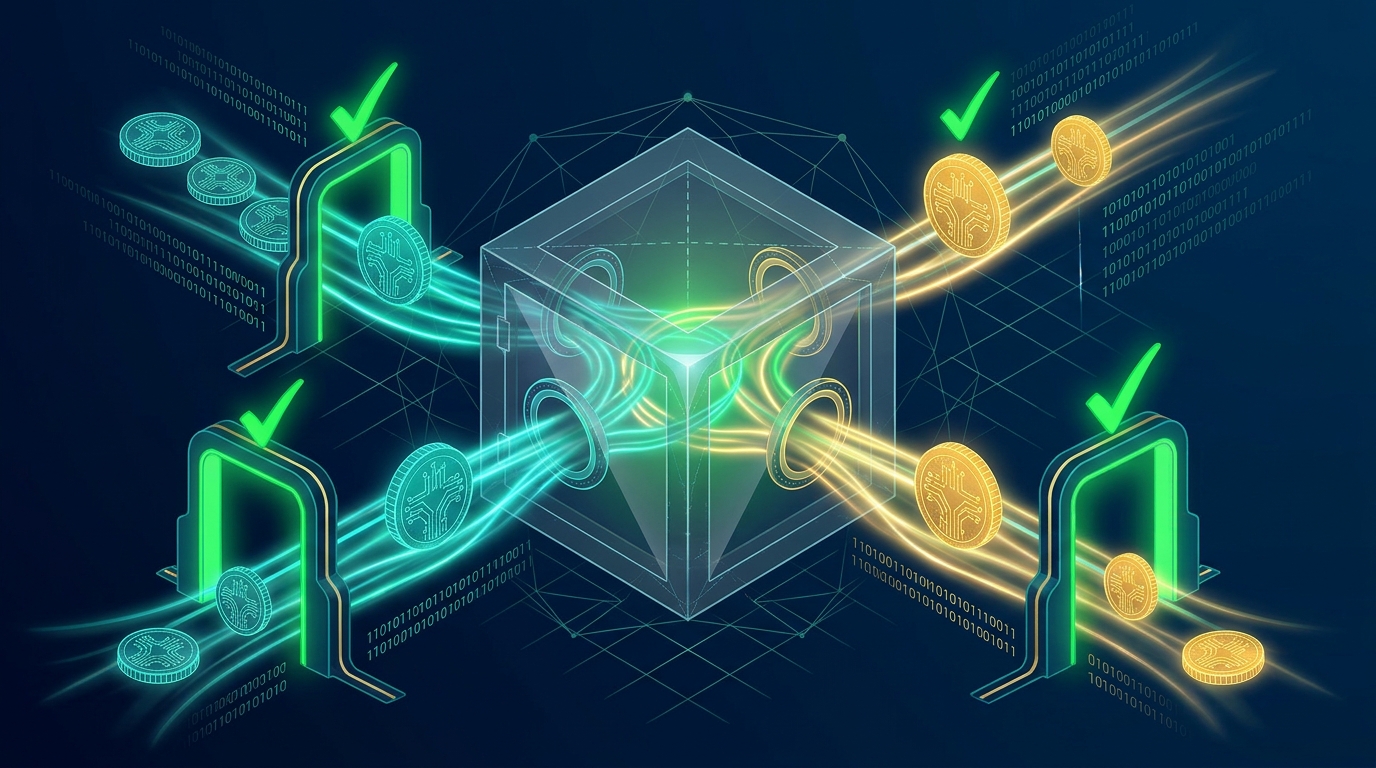
In an atomic swap, the transfer of the asset and the payment are bundled into one transaction. If either leg fails, the whole transaction reverts. This eliminates the risk that one party delivers and the other does not, which traditional markets manage through clearing houses.
Example: a fund buys $1 million of a tokenized Treasury fund with a stablecoin. A smart contract checks both balances and transfers both assets in the same block. There is no window in which the fund has paid but not received. Tokenized Treasury products reached about $15.7 billion by September 2026 per rwa.xyz data, much of it settled this way (Eco).
Capability 2: Programmable Order Logic
Limit and stop logic on-chain: orders execute only when price conditions are met, without a broker holding funds.
Time-based execution: contracts can split orders over time, similar to TWAP algorithms.
Intent-based trading: a trader signs a desired outcome and competing solvers find the best route.
Conditional and multi-step trades: e.g. swap, deposit as collateral and borrow in one transaction. Our guide to algorithmic execution covers off-chain equivalents.
Capability 3: Automated Collateral and Liquidation
Lending and derivatives protocols use smart contracts to track collateral values continuously and liquidate positions automatically when they fall below thresholds. This removes discretionary margin calls but makes outcomes depend entirely on the accuracy of price data and the code’s rules.
Automation cuts both ways. During the October 2025 sell-off, automated liquidation engines across centralized and decentralized venues fed a record $19 billion+ deleveraging (FTI Consulting).
Capability 4: Composability and Transparency
Composability: protocols can call each other, so a trade can route through several liquidity sources in one transaction.
Flash loans: borrowing and repaying within one transaction enables arbitrage and refinancing, and has also been used in many exploits.
Public verifiability: rules, reserves and trades are visible on-chain, enabling independent monitoring.
24/7 operation: no market hours or settlement cut-offs.
Costs and Where Smart Contract Trading Fails
| Risk or cost | How it arises | Typical mitigation |
| Code exploits | Bugs or logic flaws let attackers drain funds | Audits, battle-tested protocols, exposure limits, bug bounties |
| Oracle manipulation | Price feeds are distorted, triggering wrong liquidations or trades | Robust oracles with multiple sources and time-weighting |
| MEV / front-running | Pending transactions are reordered by bots | Tight slippage, private transaction routing |
| Network congestion | Fees spike and transactions stall when demand surges | Layer-2 networks, gas limits, timing |
| Upgrade and admin keys | Developers can change contract logic | Timelocks, multisig governance, immutable contracts |
| Irreversibility | Errors cannot be undone | Simulation before signing, small test transactions |
Scale of the problem: Chainalysis estimated more than $3.4 billion was stolen across crypto in 2025 (Fortune). Failed and partial on-chain executions carry their own costs; see managing failed and partial executions.
Decision Criteria: When Smart Contract Execution Adds Value
Smart contract execution adds most value when settlement risk is high, when assets are already on-chain, when transparency matters, or when strategies require composability. It adds least when off-chain venues offer deeper liquidity and the investor cannot manage code and key risks.
| Situation | Smart contract execution | Off-chain execution |
| Swapping two on-chain assets with settlement risk | Strong fit (atomic) | Requires trusting an intermediary |
| Large trade in a liquid major asset | May face price impact | Often cheaper |
| Collateralized borrowing against tokens | Automated, transparent | Discretionary, opaque terms |
| Investor without self-custody experience | High user-error risk | Simpler |
Pre-Trade and Post-Trade Controls
Before
Confirm the protocol’s audits, age, total value secured and incident history.
Check whether contracts are upgradeable and who controls upgrades.
Simulate the transaction and review exactly what will be approved.
Set slippage tolerance and use limited token approvals.
Cap exposure to any single protocol.
After
Verify final balances on a block explorer.
Revoke approvals no longer needed.
Track positions that depend on oracles or liquidation thresholds.
Free educational tool
How much technical risk are you comfortable with?
The Crypto Risk Profile Quiz helps you think through your tolerance for volatility, technology risk and loss before using on-chain trading tools.
Take the Crypto Risk Profile Quiz →
Educational tool. Results are not investment advice.
Indicators to Monitor
Effective cost including network fees and slippage.
Collateral health factor or margin ratio on lending and derivatives positions.
Protocol risk signals: governance proposals, admin-key changes, audit updates, unusual outflows.
Oracle deviation between on-chain feeds and market prices.
Frequently Asked Questions
Are smart contracts legally binding?
They execute automatically, but legal enforceability depends on jurisdiction and whether a separate agreement exists.
Can a smart contract trade be reversed?
Generally no. Once confirmed, transactions are final unless the contract includes specific recovery functions.
Do audits make a protocol safe?
Audits reduce risk but do not eliminate it; audited protocols have still been exploited.
Work With Kenson Investments
Kenson Investments’ digital asset specialists focus on education around on-chain markets and their risks. Explore our DeFi consultation services or contact the team to learn more.
Disclaimer: The information provided on this page is for educational and informational purposes only and should not be construed as financial advice. Digital assets involve significant risk, including the possible loss of principal, and past performance is not indicative of future results. Always conduct thorough research and consult a qualified financial advisor before making investment decisions.
Digital asset regulation in the United States is still developing. Some areas, such as payment stablecoins, now have a federal framework, but comprehensive market-structure legislation has not yet been enacted. None of the information provided by Kenson LLC should be considered financial investment advice. Please consult your Registered Financial Advisor for guidance. Kenson LLC does not offer any products regulated by the SEC, including equities, registered securities, ETFs, stocks, bonds, or equivalents.



