








A digital signature proves that a message was signed using a particular cryptographic key, but it does not automatically restrict where that signature can be used.
If two blockchain networks accept the same signed transaction or message, an action intended for one network could potentially be repeated on another. Blockchain chain ID replay protection helps limit this risk by binding signed transactions to a specific network or cryptographic domain.
However, replay protection has a defined scope. It can help prevent a signature from being reused in an unintended domain, but it does not prove that the recipient is correct, that the signer understood the transaction, or that the transaction is safe.
How Chain IDs Help Prevent Transaction Replay
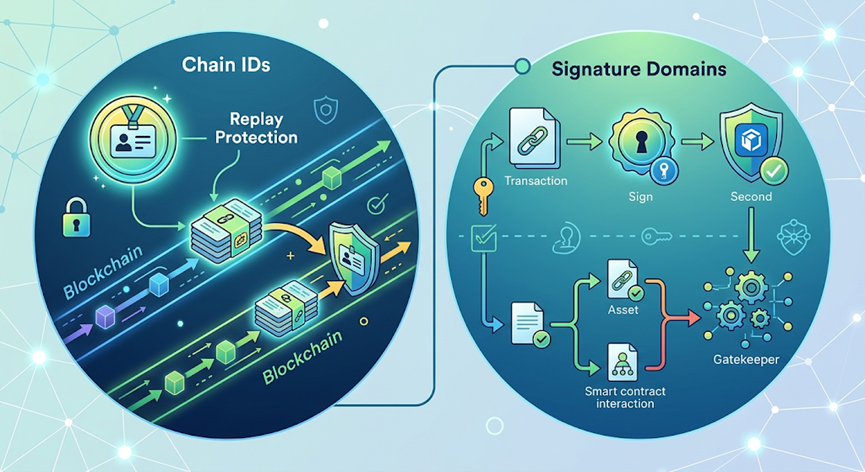
A chain ID is an identifier used by blockchain networks to distinguish their transaction-signing domains. On Ethereum-compatible networks, chain IDs are incorporated into transaction signing under the replay-protection scheme introduced by EIP-155.
When a wallet signs a transaction using this scheme, the chain ID is included in the data used to produce the signature. A network expecting a different chain ID will generally reject that signed transaction because its signature does not validate under the expected transaction format and signing rules.
For example, a user may sign a transaction to transfer assets on one EVM-compatible network. If another network uses a different chain ID and applies the corresponding replay-protection rules, the original signed transaction should not be valid there as the same transaction.
This protection depends on the networks correctly implementing and enforcing the relevant rules. A chain ID is not, by itself, a universal guarantee that every transaction or signed message is protected against replay.
Signature-Domain Separation Adds Context
Chain IDs are one form of domain separation. Other signing systems include additional information in the data being signed to specify the context in which a signature should be accepted.
Ethereum’s EIP-712 defines typed structured-data signing with a domain separator. Depending on the implementation, the domain can include fields such as the chain ID and verifying contract address. These fields help distinguish messages intended for different networks or applications.
For instance, a structured message signed for one contract can be tied to that contract’s address and chain context. A verifier checking the signature against a different domain should reject it if the relevant domain fields differ and are correctly enforced.
Yet protection depends on how the application constructs, signs and verifies the message. If important context is omitted, or a system accepts signatures across domains without appropriate checks, replay risks may remain.
What Replay Protection Does Not Prove
Replay protection addresses whether a signed transaction or message can be reused in another context. It does not establish that the original action was legitimate or safe.
A correctly domain-bound signature may still authorize a transfer to an unintended address, approve excessive token allowances, or interact with a malicious smart contract. It cannot confirm that the signer understood the transaction details or intended the consequences. Nor does it prevent every form of replay within the same domain, where application-specific nonces, deadlines or execution rules may be needed.
Chain IDs also do not independently prove that a network is trustworthy. Two networks may share an identifier, and a chain split can create circumstances in which transactions remain valid on both branches unless additional protections apply.
Why the Distinction Matters
Evaluating blockchain chain ID replay protection requires examining what is actually signed, which domain fields are included, and how the receiving network or contract validates them. A signature can be cryptographically valid while still authorizing an action the signer did not intend.
Kenson Investments examines blockchain mechanisms and digital asset operational risks to help readers understand how protocol-level protections work—and where their limits remain.
Register now for more digital asset research for further analysis of transaction security, network design and market infrastructure.
Disclaimer: The information provided on this page is for educational and informational purposes only and should not be construed as financial advice. Crypto currency assets involve inherent risks, and past performance is not indicative of future results. Always conduct thorough research and consult with a qualified financial advisor before making investment decisions.
“The cryptocurrency and digital asset space is an emerging asset class that has not yet been regulated by the SEC and the US Federal Government. None of the information provided by Kenson LLC should be considered as financial investment advice. Please consult your Registered Financial Advisor for guidance. Kenson LLC does not offer any products regulated by the SEC, including equities, registered securities, ETFs, stocks, bonds, or equivalents.”



