









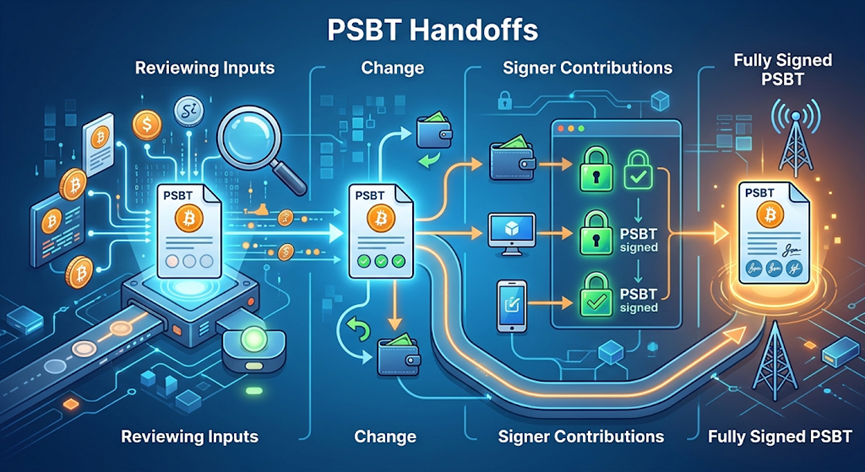
A Partially Signed Bitcoin Transaction (PSBT) allows participants to exchange transaction data before all required signatures have been added. It supports collaborative transaction preparation by carrying an unsigned transaction alongside information needed for signing and finalization. However, receiving a PSBT does not automatically make its contents trustworthy.
A careful PSBT review checks which inputs are being spent, where the outputs are going, how much value is changing hands, and what previous signers have contributed.
The objective is to understand the transaction each signature will authorize, rather than merely confirm that the file can be processed.
Reviewing Inputs Before Signing
A PSBT identifies the transaction inputs, which reference existing unspent transaction outputs (UTXOs). Each input identifies a previous transaction and the specific output being spent. The PSBT may also include the previous output’s amount and locking script, information that helps a signer evaluate the transaction.
The reviewer should verify that the inputs correspond to the intended UTXOs and that the supplied amounts and scripts are consistent with the relevant transaction data. These details matter because input values contribute to the fee calculation, while locking scripts determine the conditions governing how the funds can be spent.
A PSBT may contain incomplete information. For example, an input might lack metadata required by a particular signing process. Missing information should be resolved before signing, rather than treated as proof that the input is safe or correct.
The PSBT format is defined by Bitcoin Improvement Proposal 174 (BIP 174), which specifies how transaction data and signing information are carried between participants.
Checking Outputs, Recipients and Change
Outputs determine how the transaction distributes value. Each output specifies a Bitcoin amount and a destination script. Reviewers should compare the intended recipient and amount against the actual outputs in the transaction.
Change deserves separate attention. When a transaction spends UTXOs whose combined value exceeds the payment and fee, the remaining value may return to an address controlled by the sender. That output is change, but it is still an output that must be verified.
A change address should be identified using trusted wallet information, such as known address derivation data or a verified record of the wallet’s own addresses. An unfamiliar output should not be assumed to be change simply because its amount looks plausible.
The reviewer should also calculate the transaction fee by subtracting the total output value from the total input value. This calculation depends on accurate input amounts. An incorrect amount or misidentified change output can make the transaction appear different from what the participants intended.

Understanding Existing Signer Contributions
A PSBT can carry partial signatures and related metadata from earlier participants. During a handoff, the next signer should understand which inputs have already been signed, which remain unsigned, and whether the existing contributions match the intended transaction.
A partial signature is not a general approval of the entire PSBT file. Its scope depends on the signature hash type and the transaction data committed to by the signature. Under common signing modes, changes to committed inputs or outputs invalidate the signature. Certain sighash modes deliberately permit some transaction elements to remain outside that commitment.
Reviewing signer contributions therefore means checking both signature validity and what each signature actually covers. A valid partial signature does not, by itself, establish that every other input, output or transaction detail is correct.
What a Complete PSBT Review Establishes
Before adding a signature, each participant should be able to establish that the transaction spends the intended inputs, directs funds to the expected recipients, returns change appropriately, and calculates fees from reliable values. Existing signatures should also be evaluated within their actual scope.
Even then, review is not a guarantee of overall safety. It cannot independently establish that the recipient is trustworthy or that the transaction reflects the intentions of every participant unless those details are verified against trusted information.
Kenson Investments examines Bitcoin transaction mechanics and digital asset operational risks, including the controls that support reliable transaction review. Join the Kenson academy for further analysis of Bitcoin infrastructure, transaction integrity and market operations
Disclaimer: The information provided on this page is for educational and informational purposes only and should not be construed as financial advice. Crypto currency assets involve inherent risks, and past performance is not indicative of future results. Always conduct thorough research and consult with a qualified financial advisor before making investment decisions.
“The cryptocurrency and digital asset space is an emerging asset class that has not yet been regulated by the SEC and the US Federal Government. None of the information provided by Kenson LLC should be considered as financial investment advice. Please consult your Registered Financial Advisor for guidance. Kenson LLC does not offer any products regulated by the SEC, including equities, registered securities, ETFs, stocks, bonds, or equivalents.”



